
医美行业规范发展

Search documents
普丽妍“拉黑”新氧 新氧反告“造谣”:谁在破坏医美规则?
2 1 Shi Ji Jing Ji Bao Dao· 2025-11-28 06:22
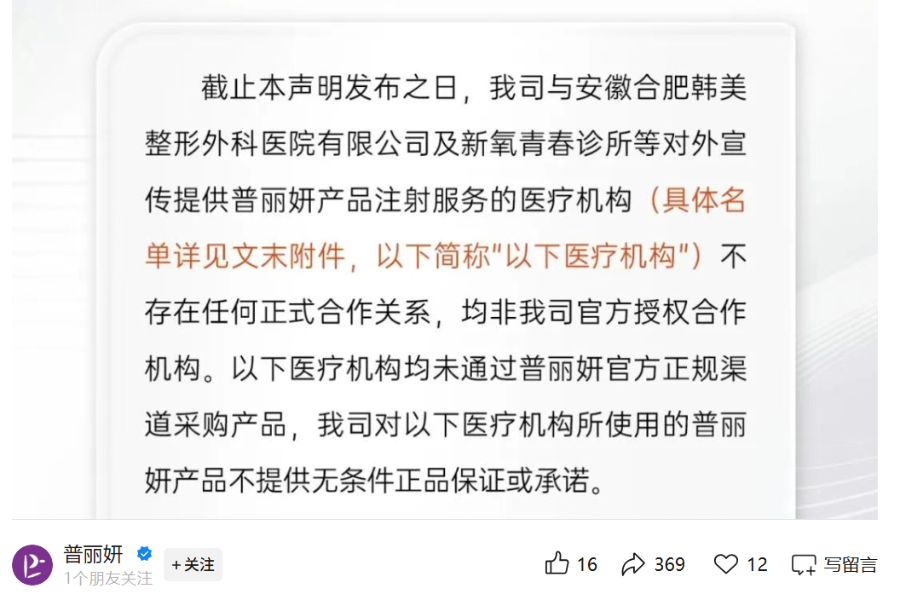
Core Viewpoint - The medical beauty industry is experiencing a tug-of-war between upstream manufacturers and terminal institutions regarding product authorization and pricing, highlighting the need for regulatory compliance and market order [1][2]. Group 1: Industry Dynamics - The conflict centers around product authorization and compliance channels, reflecting a struggle for pricing power between upstream manufacturers and terminal medical beauty institutions [2]. - The medical beauty market in China is expanding, with unauthorized sales of related products becoming increasingly common, indicating a shift from "wild growth" to "regulated development" in the industry [2]. Group 2: Pricing Strategies - The market for "童颜针" (youthful beauty injections) has seen rapid growth, with its market size exceeding 30 billion yuan last year and projected to reach 100 billion yuan in five years [4]. - New Oxygen's introduction of low-priced "童颜针" projects has disrupted the pricing structure of upstream manufacturers, with prices significantly lower than official guidance [5]. - New Oxygen's pricing strategy aims to make medical beauty services more affordable, addressing the issue of consumers turning to unregulated "black medical beauty" services due to high prices [6]. Group 3: Compliance and Regulation - Concerns have been raised regarding New Oxygen's compliance, as it has been accused of using products without proper authorization, which could jeopardize consumer safety [7][8]. - Legal experts emphasize that medical institutions must procure medical devices from authorized sources to ensure traceability and compliance with regulations [8]. - The ongoing issues of counterfeit products and unauthorized sales highlight the urgent need for effective governance in the medical beauty industry [10][11]. Group 4: Consumer Protection - Consumers are advised to verify product authenticity through official channels and request proper documentation from medical institutions to safeguard their rights [12]. - The responsibility for ensuring compliance should not solely rest on consumers; a collaborative effort among manufacturers, institutions, and regulatory bodies is essential for sustainable development in the medical beauty sector [13].


万元童颜针价格被打至4999元,医美巨头遭上游厂商拉黑
21世纪经济报道· 2025-11-28 06:18
Core Viewpoint - The ongoing conflict between upstream manufacturers and downstream medical beauty institutions highlights the challenges in product authorization and market pricing within the medical aesthetics industry, indicating a shift from "wild growth" to "regulated development" in China’s medical beauty market [4][5]. Group 1: Industry Dynamics - The medical beauty industry is experiencing a tug-of-war over product pricing and authorization, with companies like Purity and New Oxygen at the forefront of this conflict [4][5]. - New Oxygen's low pricing strategies for products like "Miracle Youth 3.0" have disrupted traditional pricing structures, leading to tensions with upstream manufacturers [8][9]. - The market for youth-enhancing products, such as the "童颜针" (youth needle), has seen rapid growth, with estimates suggesting it will reach a scale of 100 billion in five years, up from over 30 billion last year [7]. Group 2: Compliance and Regulation - There are significant compliance concerns regarding the sourcing of medical products, with allegations that New Oxygen has used products without proper authorization, raising questions about product safety and traceability [11][12]. - Legal experts emphasize the importance of purchasing medical devices from authorized sources to ensure compliance with regulations, highlighting the potential penalties for non-compliance [12]. - The medical beauty industry faces challenges with counterfeit products and unauthorized sales, necessitating stronger regulatory measures and consumer awareness [15][16]. Group 3: Consumer Safety and Market Integrity - The prevalence of unauthorized medical beauty institutions and counterfeit products poses a significant risk to consumer safety, with only 35% of products in circulation being genuine [9][15]. - Industry leaders argue that lowering prices for legitimate medical beauty services is essential to combat the prevalence of "black medical beauty" practices, which thrive on high prices in the legitimate market [9][10]. - There is a call for a collaborative approach among manufacturers, medical institutions, and regulatory bodies to ensure consumer rights and product quality are prioritized in the evolving medical beauty landscape [17].

重拳出击 广东多部门持续合力整治医美乱象
2 1 Shi Ji Jing Ji Bao Dao· 2025-08-11 15:34
Core Viewpoint - The medical beauty industry is experiencing a transition from chaotic growth to regulated development, with increasing scrutiny on issues such as false advertising, illegal operations, and unlicensed medical practices [1] Group 1: Industry Challenges - The medical beauty sector is facing rampant issues including misleading promotions and illegal injections, which have been highlighted in various media reports [1] - Recent investigations revealed that some legitimate medical beauty institutions are involved in deceptive practices, including unauthorized injections and the use of smuggled products [1] Group 2: Regulatory Measures - Guangdong province is implementing a multi-faceted approach to address these issues, involving collaboration among health, drug supervision, police, and market regulation departments [2] - New regulations have been introduced, such as the prohibition of non-medically necessary cosmetic procedures for minors and the requirement for public institutions to sell medical supplies at zero markup [2][3] - A comprehensive regulatory network has been established, with a focus on dynamic policy improvements based on emerging issues [3] Group 3: Enforcement Actions - In 2022, a special campaign led to the closure of 217 illegal medical beauty establishments and fines totaling 38.6 million yuan [3] - Ongoing joint enforcement actions are transforming regulatory measures from theoretical frameworks into practical applications, ensuring compliance and safety [5][6] - The introduction of a "double review system" for injectable medical devices aims to close loopholes in online sales [3] Group 4: Future Outlook - The ongoing transformation in the medical beauty industry in Guangdong is expected to lead to a more regulated and orderly market, enhancing public safety and trust [6] - The collaborative efforts among various regulatory bodies are designed to create a robust framework for the sustainable development of the medical beauty sector [6]