
卫星互联网商业化

Search documents
未知机构:中金军工商业航天信科移动更新点评市场部分投资者传言1-20260203
未知机构· 2026-02-03 02:20
Summary of Conference Call Notes Company and Industry Involved - The focus is on **信科移动 (Xinke Mobile)** and the **satellite internet industry** in China, particularly in relation to competitors like **华为 (Huawei)** and **中兴 (ZTE)** Core Points and Arguments 1. **Market Concerns**: There are rumors among investors that: - Chinese satellite internet may not achieve commercialization - Xinke Mobile's second-generation satellite payload is inferior to those of Huawei and ZTE - As a result, Xinke Mobile's stock dropped by 8.4% in early trading [1] 2. **Starlink's Validation**: - Starlink has demonstrated the commercial and strategic value of global communication infrastructure - Xinke Mobile, leveraging China's manufacturing advantages, is expected to be economically competitive with Starlink once satellite and rocket capabilities are established [1][2] 3. **User Preferences**: - Overseas users are seeking alternatives to US-based services for reasons of economic viability and information security [1] 4. **Competitive Landscape**: - Xinke Mobile's main competitor in the domestic satellite internet and 6G industrialization process is Huawei - Xinke Mobile is a key player in developing communication protocols for the satellite network, holding a significant position in the global 5G NTN standards [1] 5. **Progress and Partnerships**: - Xinke Mobile has completed payload in-orbit verification, leading ahead of competitors like Huawei and ZTE [2] - The second-generation system involves numerous suppliers, with the final market share dependent on technology, cost, and efficiency [2] 6. **Feasibility and Future Plans**: - The second-generation system has completed feasibility studies, with Xinke Group planning approximately 30,000 satellite launches [2] - The system will adopt a 5G NTN framework, which is expected to unify standards for 6G and global satellite internet [2] Other Important but Overlooked Content - There is a concern among end-users and some satellite manufacturers regarding the collaborative culture of certain companies, which may affect partnerships and market dynamics [2]

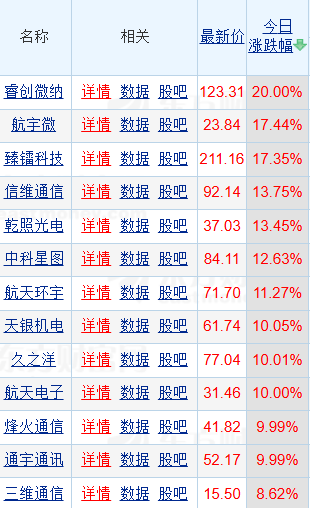
卫星互联网商业化提速!睿创微纳20%涨停,著名演员黄景瑜官宣将上太空,SpaceX2027年推第二代星链系统
Jin Rong Jie· 2026-01-23 03:15
Market Performance - The satellite internet sector experienced a significant increase, with the sector rising by 4.72% as of the report's publication [1] - Leading stocks included Ruichuang Micro-Nano, which surged by 20.00%, and several others such as Tongyu Communication and Aerospace Electronics, which hit the daily limit [1][2] Industry Trends - The core market speculation is driven by the accelerated commercialization of satellite internet, with expectations for new developments from overseas giants and steady progress in domestic low-orbit satellite networks [2] - The third Beijing Commercial Space Industry High-Quality Development Promotion Conference and the 2026 Beijing International Commercial Space Exhibition will take place from January 23 to 25, featuring over 300 global companies [3] Technological Developments - SpaceX plans to launch its second-generation Starlink system in 2027, with the approval to deploy 7,500 new satellites capable of achieving internet speeds of up to 1 Gbps [4] - Blue Origin announced its TeraWave satellite communication network, consisting of 5,408 satellites, set to launch in Q4 2027, offering symmetrical data transmission speeds of up to 6 Tbps [4] Related Industries - The demand for low-orbit satellite networks is increasing, with domestic satellite production capabilities improving, leading to a potential expansion of the industry scale [6] - There is a pressing need for high-performance RF chips for satellite communication, particularly those supporting direct satellite connections for mobile devices, benefiting from technological advancements [6] - Ground terminal equipment is essential for the commercialization of satellite internet, with companies capable of developing and manufacturing these devices expected to see growth opportunities [6] - The satellite internet sector can address communication gaps in remote areas, with increasing demand for high-bandwidth services from enterprises and government users, indicating a broad long-term growth potential for companies in this space [6]


马斯克“收购”瑞安航空:一场星链之争引爆的欧洲廉航资本大戏
Xin Lang Cai Jing· 2026-01-21 12:42
Core Insights - The incident began with a disagreement over the installation of Starlink in Ryanair's aircraft, escalating into a public feud between Elon Musk and Ryanair's CEO Michael O'Leary, highlighting the clash between low-cost airline operations and satellite internet commercialization [2][9] Group 1: Trigger of the Conflict - Ryanair's CEO Michael O'Leary rejected the installation of SpaceX's Starlink service, citing that the top-mounted antenna would increase weight and drag, thereby raising fuel costs, which contradicts Ryanair's low-cost business model [3][10] - Musk countered that O'Leary was misinformed, arguing that the lightweight antenna's fuel consumption impact is negligible and that onboard Wi-Fi could generate new revenue [3][10] Group 2: Musk's Acquisition Proposal - On January 20, Musk made headlines by asking on social media how much it would cost to buy Ryanair and suggested firing O'Leary, even conducting a public poll on whether he should acquire the airline [4][11] Group 3: Business Logic - Ryanair, as Europe's largest low-cost airline with over 500 aircraft, is a key target for Starlink's entry into the aviation market, and Musk's acquisition proposal aims to pressure Ryanair into collaboration, opening a significant market for Starlink [5][12] Group 4: Regulatory Barriers - Despite Musk's substantial wealth exceeding $200 billion, acquiring Ryanair faces strict EU regulations that require airlines to be controlled by EU entities, limiting non-EU ownership to 49%, making actual control difficult for Musk [6][13] Group 5: Clash of Business Models - Ryanair's competitive edge lies in extreme cost control, with minimal onboard services, while Musk aims to enhance the airline experience through Starlink, proposing a "free plus premium charge" model, representing a fundamental clash between traditional low-cost and tech-enabled service models [6][14] Group 6: Market Reaction and Implications - Following the incident, over 10 million participated in the poll on social media, with Ryanair's stock experiencing brief volatility before stabilizing, as the market largely viewed the acquisition as a publicity stunt [6][15] - O'Leary announced a press conference and launched a promotional campaign to counter the situation, while Musk continued to advocate for Starlink's potential in aviation, setting the stage for future collaborations [6][15] Group 7: Broader Industry Implications - Musk's acquisition proposal signals a strong intent for tech giants to penetrate the airline industry, as advancements in technologies like Starlink and AI are poised to reshape service models and profit structures in aviation [7][16]


中国星网换帅增资 冲刺星座部署关键期
经济观察报· 2026-01-20 14:01
Core Viewpoint - The market's expectations for China Star Network have shifted from technological breakthroughs to commercial implementation, with a focus on the upcoming three years for increased satellite launches [1][3]. Management Changes - China Star Network has undergone significant management changes, with new appointments including Gou Ping as chairman and Liang Baojun as general manager, signaling a strengthened focus on satellite technology development and integration with traditional telecom operators [2][5]. Satellite Deployment Timeline - The urgency of deploying the planned 13,000 low-orbit satellites is driven by international regulations requiring the first satellite to be launched within seven years and 10% of the planned satellites deployed within nine years, making 2029 a critical deadline [2][6]. Capital Investment - China Star Network's subsidiary, Star Network Digital Technology, has increased its registered capital from 120 million to 700 million RMB, a 483% increase, to support ground-based infrastructure and application ecosystems for satellite internet [3][9]. Ground Infrastructure Development - The company plans to build a large-scale ground station network in Xiong'an, which is essential for connecting satellite signals to ground networks, thereby enhancing service capabilities [10][11]. Commercialization Challenges - The satellite internet industry faces dual challenges: competition for frequency resources with international rivals and uncertainties in market acceptance and technology stability [13][14]. Policy Environment - While satellite internet has been included in the "new infrastructure" category, uncertainties remain regarding policy implementation and regulatory frameworks, which could impact project timelines and operational costs [14]. Strategic Collaborations - China Star Network is exploring partnerships, such as its joint venture with China Mobile to establish a satellite-ground integrated network, which may serve as a breakthrough for commercialization [14]. Technological Advancements - Recent technological milestones include the successful trial of a satellite broadband video call based on 5G NTN standards, laying the groundwork for consumer applications in satellite internet [14]. Industry Outlook - With technological breakthroughs, policy support, and increasing market demand, the satellite industry is rapidly evolving, and the management changes and capital investments at China Star Network are pivotal in this competitive landscape [15].
万和财富早班车-20250911
Vanho Securities· 2025-09-11 02:23
Core Insights - The report highlights the ongoing fluctuations in the domestic financial market, with key indices showing slight increases, indicating a mixed market sentiment [2][7] - The macroeconomic indicators reveal a decline in both CPI and PPI, with CPI down 0.4% and PPI down 2.9% year-on-year, suggesting potential deflationary pressures [4] - The satellite internet industry is experiencing accelerated commercialization due to policy support and license issuance, with specific stocks like Putian Technology and TeFa Information being highlighted [5] - The optical module industry is expected to maintain a positive outlook as the 26th China Optical Expo opens, with companies like Guangxun Technology and Huagong Technology being noted [5] - The report mentions a significant increase in the price of fluorite, indicating that the industry chain has entered a prolonged prosperity cycle, with stocks such as Jinshi Resources and Yonghe Shares being relevant [5] Industry Dynamics - The report outlines several key developments in listed companies, including: - Palin Bio's controlling shareholder plans to transfer 21% of shares to China Bio, leading to a change in control [6] - Anhui Energy's Yan'an Power Plant Phase II is set to commence construction by the end of this year, with a capacity of 2×1000MW [6] - Taihe Technology has validated solid-state electrolyte lithium titanium aluminum phosphate and has received small batch orders [6] - Enjie Co. has completed the construction of a hundred-ton lithium sulfide production line and is ramping up capacity [6] Market Review and Outlook - On September 10, the market experienced a rebound after initial fluctuations, with the Shanghai Composite Index rising by 0.13% and the Shenzhen Component Index by 0.38% [7] - The report notes that September is traditionally a strong month for industry rotation, with expectations for performance to shift from cyclical industries to consumer sectors as the month progresses [7] - The first half of September typically sees a negative correlation between stock prices and earnings, while the latter half is expected to see earnings have a more significant impact on stock prices due to fund rebalancing and upcoming quarterly reports [7]