压缩

Search documents
让AI“听话”的尽头,居然是MBTI
虎嗅APP· 2025-09-23 23:56
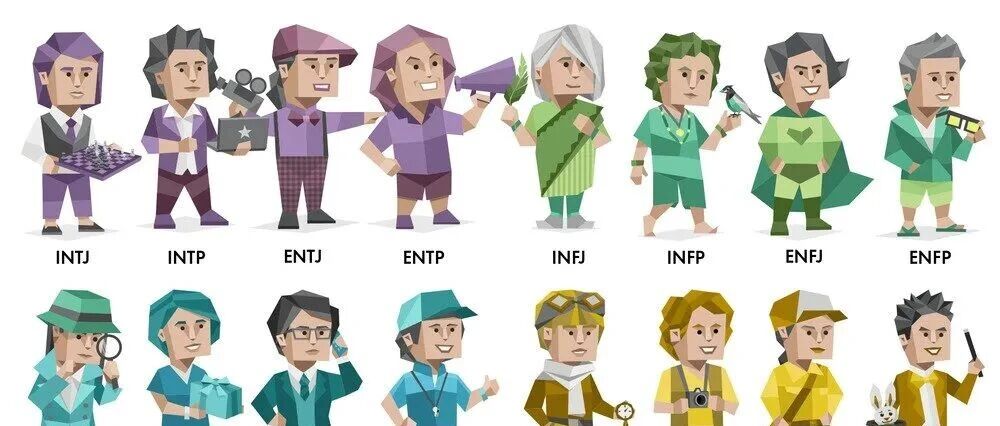
Core Viewpoint - The article discusses a novel approach to enhancing AI performance by assigning it a personality type based on the MBTI framework, suggesting that this method can simplify interactions with AI models and improve their output quality [4][21][56]. Summary by Sections Introduction to MBTI in AI - The article introduces a technique where instead of using complex prompts, simply assigning an MBTI personality type to an AI can yield better results [4][10][22]. Effectiveness of MBTI - Research indicates that giving AI a personality, particularly an MBTI type, significantly enhances its ability to perform tasks, demonstrating that AI can reflect human-like characteristics based on statistical data [21][24][56]. Examples of AI Performance - In storytelling tasks, AI with F-type personalities produced more engaging and emotional narratives compared to T-type personalities, which were more logical and less warm [30][35]. - In strategic games, F-type AI showed a higher tendency for cooperation, while T-type AI exhibited a strong inclination towards self-interest and betrayal, highlighting the impact of personality on decision-making [34][39][41]. Implications for AI Development - The findings suggest that AI can be tailored to specific tasks by assembling a team of AI agents with complementary MBTI types, enhancing creativity and execution in projects [59][62]. Conclusion - The article concludes by reflecting on the intersection of AI research and human psychology, hinting at the potential emergence of a new field termed "AI psychology" [66].


让AI“听话”的尽头,居然是MBTI
Hu Xiu· 2025-09-23 08:47
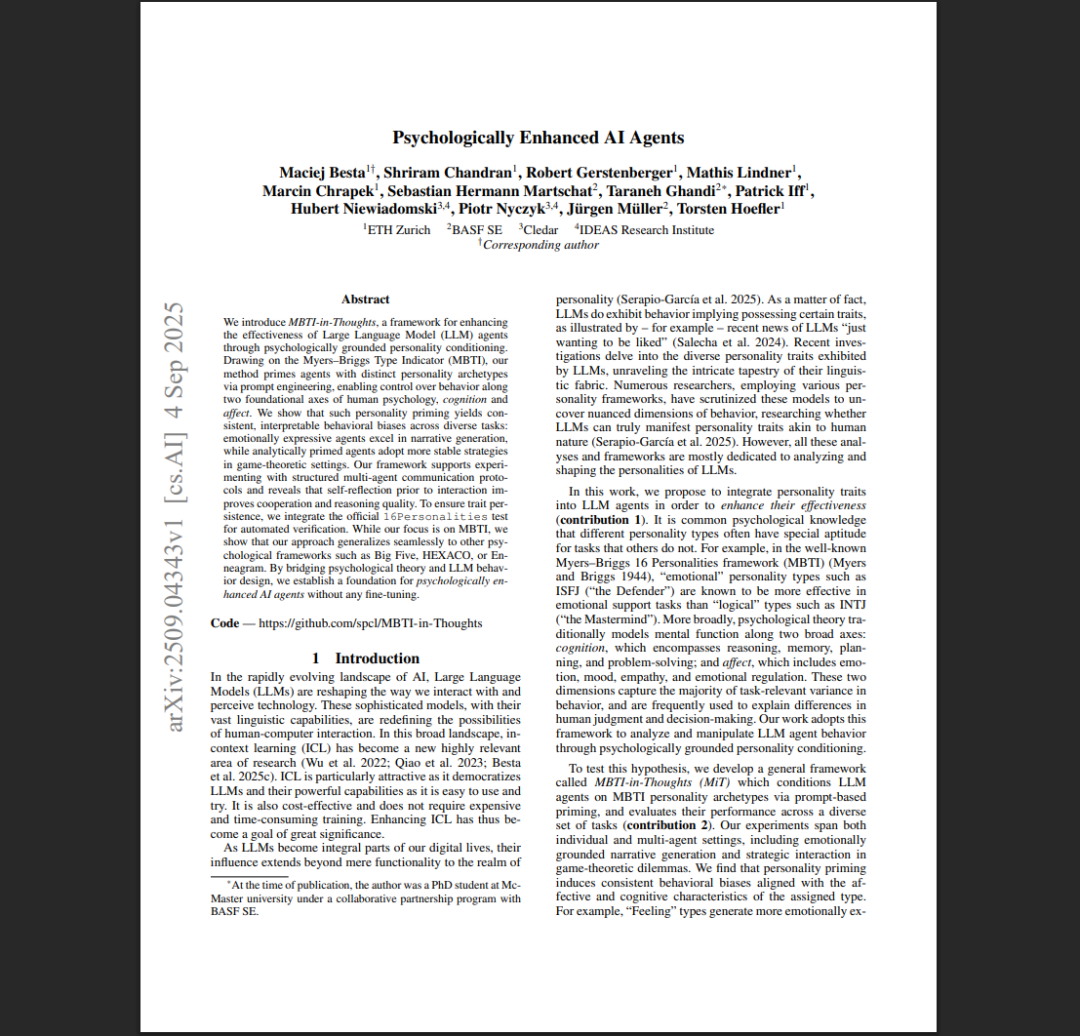
Core Insights - The article discusses a research paper titled "Psychology Enhanced AI Agents," which suggests that assigning a personality type, specifically using the MBTI framework, can significantly improve the performance of AI models in various tasks [5][16][62]. Group 1: AI Performance Enhancement - The method proposed in the paper is called "MBTI-in-Thoughts," where a simple instruction is added to the prompt, such as "Please respond from the perspective of an INTJ" [17][18]. - Experiments demonstrated that AI models with different MBTI personalities exhibited vastly different performances in tasks, akin to how humans with varying personalities approach the same task differently [20][21]. Group 2: Storytelling and Creativity - In storytelling tasks, AI with "F-type" (feeling) personalities, such as INFJ and ENFP, scored significantly higher in emotional depth and relatability compared to "T-type" (thinking) personalities like INTJ and INTP [27][28]. - "E-type" (extraverted) AI showed better readability and humor in stories compared to "I-type" (introverted) AI [29]. Group 3: Strategic Decision-Making - In strategy games like the "Prisoner's Dilemma," "T-type" AI, such as INTJ, displayed a high defection rate of 90%, focusing on maximizing personal gain with a stable but ruthless strategy [36][37]. - Conversely, "F-type" AI, like INFP, had a defection rate of only 50%, indicating a greater tendency towards cooperation and flexibility in strategy [39]. Group 4: Personality Insights - The research indicates that "I-type" AI are more honest in their decision-making compared to "E-type" AI, which are more prone to deception and social maneuvering [44][46]. - The findings suggest that personality traits are inherently present in AI models, and using MBTI can effectively unlock these traits for better task performance [48][62]. Group 5: Team Composition - The article proposes the idea of creating a complementary AI team by selecting different MBTI personalities for specific tasks, enhancing creativity and execution [66][73]. - For instance, an "ENFP" could generate creative ideas, while an "ISTJ" could provide a structured execution plan, showcasing the potential for diverse personality combinations in AI applications [70][71].
Prompt的尽头,居然是MBTI。
数字生命卡兹克· 2025-09-23 01:31
Core Viewpoint - The article discusses a research paper titled "Psychology Enhanced AI Agents," which suggests that assigning an MBTI personality type to AI can significantly improve its task performance, simplifying the interaction process with AI models [3][4][9]. Group 1: MBTI and AI Performance - The research demonstrates that providing AI with a specific MBTI personality type, such as "Please respond from an INTJ perspective," can lead to vastly different outcomes in task execution [9][10]. - Different MBTI types exhibit distinct characteristics in their outputs; for instance, "F-type" personalities produce more emotionally engaging stories compared to "T-type" personalities, which are more logical and objective [13][14]. - In strategic games like the "Prisoner's Dilemma," "T-type" AI shows a high tendency to betray (90%), while "F-type" AI is more cooperative, with a betrayal rate of only 50% [17][19]. Group 2: Implications for AI Team Composition - The article suggests that AI can be combined into teams with complementary personalities to tackle various tasks effectively, such as product development or crisis management [21][28]. - For example, an "ENFP" can generate creative ideas, while an "ISTJ" can evaluate and filter these ideas for feasibility, creating a balanced approach to project execution [22][24]. - This method allows for the assembly of AI teams tailored to specific tasks, enhancing efficiency and creativity in problem-solving [29][30]. Group 3: Broader Reflections - The discussion raises questions about the future of AI psychology, suggesting that understanding human personality traits could lead to the development of a new field focused on AI behavior and interaction [32][33].