双基金模式

Search documents
商业不动产REITs启动申报!财通资管叶晓明:新年三主线掘金新资产
券商中国· 2026-01-07 08:22
Core Viewpoint - The recent announcement by the China Securities Regulatory Commission (CSRC) regarding the pilot program for Commercial Real Estate Investment Trusts (REITs) marks a significant shift from the design phase to market practice, indicating a strong demand for such financial instruments in the market [2][3]. Group 1: Market Demand and Structure - There is a substantial and urgent demand for commercial real estate REITs, with many state-owned enterprises, local government enterprises, and quality private commercial operators preparing to apply for projects [2]. - The commercial real estate REITs are expected to evolve into a mature form encompassing "all categories" and "all assets," moving beyond the previous focus on infrastructure [3]. - The market is anticipated to experience "structured expansion" rather than mere quantity growth, with a focus on mature, stable cash flow assets [3]. Group 2: Key Considerations for Establishment - Three critical issues must be addressed when establishing commercial real estate REITs: asset quality, governance mechanisms, and valuation models [4]. - It is essential to select assets with clear ownership, mature operations, and abundant cash flow to avoid introducing high-risk projects into the market [4]. - A robust governance structure is necessary to clarify the responsibilities and rights among fund managers, operational management, and original rights holders, protecting the interests of small investors [4]. Group 3: Financial Strategies and Innovations - The financial institution is focusing on integrating investment and financing activities related to commercial real estate REITs, aiming to cover a wide range of entities from state-owned to large private companies [5]. - Companies are shifting from merely recovering funds to strategic capital restructuring, learning from successful models like Singapore's dual-fund approach [5][6]. - The institution has already launched several REITs products and is actively pursuing multiple public REITs project applications [6]. Group 4: Investor Behavior and Market Dynamics - The introduction of commercial real estate REITs is expected to change investor logic, positioning REITs as "equity assets with dividend attributes" rather than fixed-income assets [7]. - REITs can provide sustainable cash flow and are seen as a stable investment option with low correlation to other asset classes, which is particularly appealing in a low-interest-rate environment [7]. Group 5: Future Outlook - By 2026, the REITs market is projected to balance "stock activation" and "high-quality development," with a focus on three main lines: core consumer assets, new assets supported by policy, and potential assets with improved operational efficiency [9][10]. - Core consumer assets, similar to mature shopping centers in Singapore, are expected to generate continuous cash flow and serve as a stabilizing force in the REITs market [9]. - New assets like affordable rental housing and data centers will benefit from policy support and align with national strategic development directions [10].


企业积极备战商业不动产REITs
Zheng Quan Shi Bao· 2025-12-09 23:54
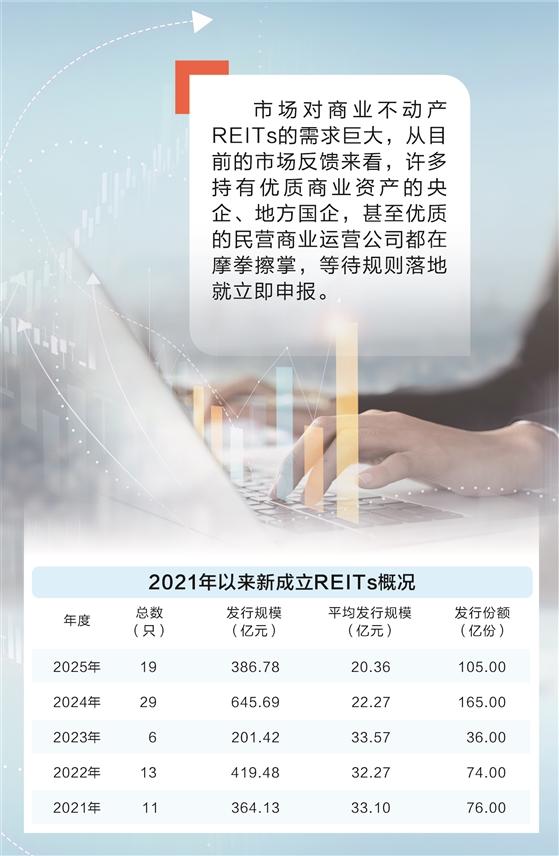
Core Insights - The imminent launch of commercial real estate REITs (Real Estate Investment Trusts) is generating significant market interest, with expectations to activate a trillion-yuan level of existing real estate assets and enhance capital market efficiency [1][4] - Investors are advised to view REITs as equity assets with dividend attributes rather than fixed-income assets, focusing on long-term returns [2][6] - The introduction of commercial real estate REITs marks a shift towards a more comprehensive and mature C-REITs market, complementing existing infrastructure REITs [2][3] Industry Developments - The commercial real estate sector in China is preparing for the launch of REITs, with many state-owned and private enterprises ready to submit applications once regulations are finalized [1][5] - The approval process for commercial real estate REITs is expected to accelerate under the guidance of the China Securities Regulatory Commission (CSRC), differing from previous oversight by the National Development and Reform Commission (NDRC) [4][5] - The market has seen a rapid development of infrastructure REITs, with 78 products established and a total issuance scale exceeding 200 billion yuan over the past four years [1] Investment Dynamics - Commercial real estate REITs provide a new exit strategy for real estate developers, facilitating a transition from development to asset management [2][3] - The market is witnessing a shift in the core demands of original equity holders from merely recovering funds to strategic capital restructuring, inspired by Singapore's dual-fund model [5][6] - The increasing institutionalization of REITs, with over 95% of holders being institutional investors, indicates a strong demand for stable dividend-yielding assets amid a low-interest-rate environment [7] Management Challenges - Fund managers will face heightened competition and must evolve from passive to active management, focusing on asset optimization and risk management [6][7] - The volatility of commercial real estate REITs may exceed that of infrastructure REITs, necessitating enhanced investor education and communication strategies [7] - The growth of REITs is expected to drive value across various financial services, including investment banking, research, and wealth management [6]
翘首以盼规则落地 企业积极备战商业不动产REITs
Zheng Quan Shi Bao· 2025-12-09 17:52
Core Insights - The commercial real estate REITs (Real Estate Investment Trusts) market in China is set to open, attracting significant attention from various market participants, including state-owned enterprises and private companies, who are preparing to submit applications once regulations are finalized [1][2][6] Group 1: Market Overview - Since 2021, the REITs market has seen rapid growth, with 78 products established and a total issuance scale exceeding 200 billion yuan [3] - The demand for commercial real estate REITs is substantial, with many companies eager to participate as soon as the regulatory framework is in place [2][6] Group 2: Investment Logic - Investors are advised to view REITs as equity assets with dividend attributes rather than fixed-income assets, focusing on long-term returns [4] - The introduction of commercial real estate REITs marks a shift towards a more comprehensive and mature C-REITs market, complementing existing infrastructure REITs [4][5] Group 3: Regulatory and Structural Changes - The approval process for commercial real estate REITs is expected to accelerate under the guidance of the China Securities Regulatory Commission, contrasting with previous oversight by the National Development and Reform Commission [6] - The core demand from original equity holders has evolved from merely recovering funds to a more strategic capital restructuring approach, learning from models like Singapore's dual-fund system [7] Group 4: Fund Management Challenges - Fund managers will face increased scrutiny and need to enhance their active management capabilities, moving away from passive management models [10] - The institutionalization of REITs is evident, with over 95% of holders being institutional investors, indicating a strong demand for stable dividend-yielding assets [10]