双层运营架构

Search documents
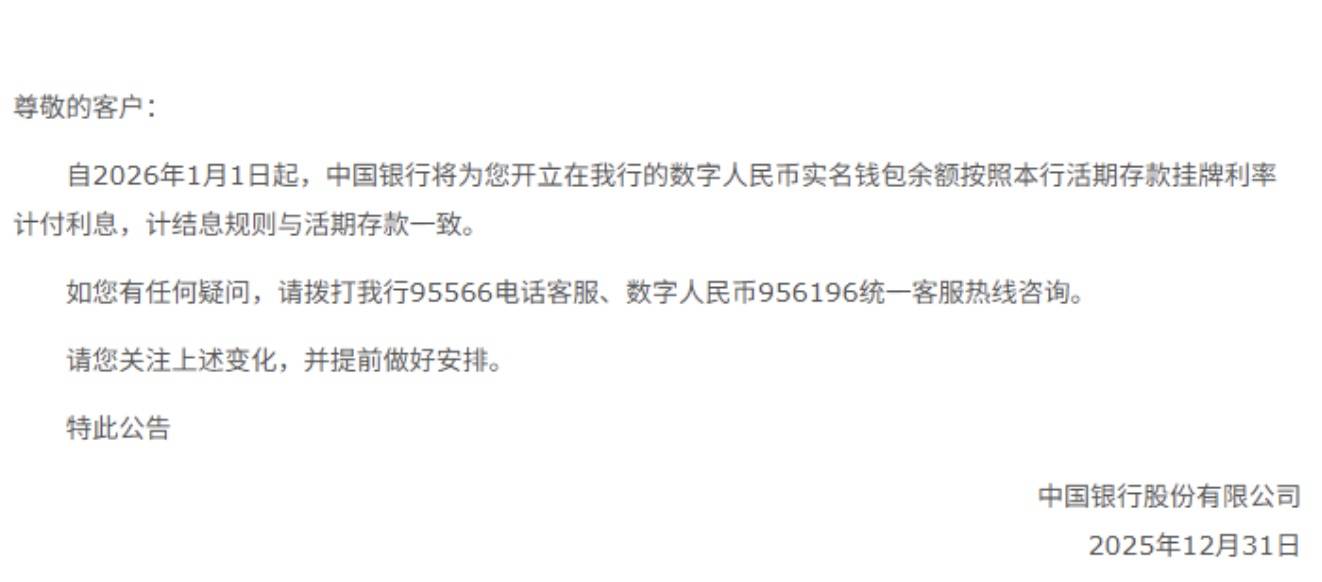
六大行集体公告:数字人民币将计付利息
Sou Hu Cai Jing· 2025-12-31 10:18
Group 1 - The six major state-owned banks in China will start paying interest on the balances of real-name digital RMB wallets at the same rate as demand deposits from January 1, 2026, marking a significant shift in the digital currency landscape [1][2] - The People's Bank of China has introduced a new action plan to enhance the management and service system for digital RMB, which will officially launch on January 1, 2026, transitioning digital RMB from a "digital cash era" to a "digital deposit currency era" [1][4] - The definition of digital RMB has been updated to include the payment system and clarify the dual-layer operational structure, where the central bank issues digital RMB to operating institutions, which then exchange it with the public [3][4] Group 2 - The new digital RMB will have characteristics of commercial bank liabilities, transitioning from being a direct liability of the central bank to a liability of commercial banks, thus allowing wallet balances to earn interest and be covered by deposit insurance [4][5] - The action plan optimizes the dual-layer operational structure, assigning responsibilities to the central bank for rule-making and infrastructure, while commercial banks will manage customer wallets and ensure compliance, thus transforming their role from cost centers to profit centers [5][6] - The action plan integrates digital RMB into the traditional monetary control system, allowing bank-operated digital RMB to be included in the reserve requirement framework, which will enhance liquidity in the banking system [6][7] Group 3 - As of November 2025, the digital RMB pilot has processed 3.48 billion transactions with a total value exceeding 16.7 trillion yuan, indicating strong adoption and usage [7]





手持数字人民币却不生息,未来可以这样升级
Di Yi Cai Jing· 2025-09-17 05:35
Core Viewpoint - The evolution of currency forms is driven by technological advancements and economic development, leading to the necessity of central bank digital currency (CBDC) as an upgrade to legal tender [1][2][3] Group 1: Historical Context and Currency Evolution - Historical changes in currency forms include the transition from barter to shell money, metal currency, and the first paper currency in the Song Dynasty, culminating in the current need for CBDC due to advancements in digital economy and payment technologies [1] - The competition between state-issued and privately issued currencies has historically impacted the stability of financial systems, necessitating a unified legal tender to mitigate risks associated with multiple currency issuers [1] Group 2: Role of Central Banks - Central banks act as lenders of last resort, providing liquidity to banks and ensuring the safety of collateral assets through stringent regulations and deposit insurance mechanisms [2] - The evolution of the currency system reflects a shift from private to state credit, with the stability and liquidity of legal tender being paramount principles regardless of technological changes [2] Group 3: Digital Currency Development - To align with the digital economy and ensure the singularity of the RMB, China is advancing the issuance of legal digital currency, known as digital RMB, and upgrading financial infrastructure [3] - The digital RMB has progressed through theoretical research, closed-loop trials, and open trials since 2014, with applications in various sectors such as retail, hospitality, education, and public services [3] Group 4: Framework and Implementation - The digital RMB operates under a macro framework where it is a direct liability of the central bank, requiring 100% reserve backing, which necessitates enhancing its currency derivation capacity as the economy grows [3][4] - Commercial banks are responsible for wallet management, fund security, payment services, and compliance, while the digital RMB's current structure should align responsibilities with rights and benefits [3] Group 5: Future Directions - Upgrading the measurement framework of digital RMB is essential to ensure that the money supply aligns with economic growth and price expectations, while also enhancing the engagement of commercial banks and users [4]
穆长春:老百姓手握不生息资产会失去货币的时间价值
Sou Hu Cai Jing· 2025-09-14 11:56
Core Insights - The digital renminbi is currently classified as M0 (cash) and does not earn interest, which may lead to a loss of time value for idle assets held by individuals and businesses [2][3] Group 1: Digital Renminbi Development - The People's Bank of China (PBOC) has made significant progress in the pilot implementation of the digital renminbi, necessitating reforms and upgrades in both theory and practice [2] - The digital renminbi operates under a 100% reserve requirement, meaning that funds deposited into digital wallets are returned to the central bank [2] - There is a need to enhance the monetary derivation capacity of the digital renminbi as the economy develops [2] Group 2: Monetary Framework and Historical Context - Upgrading the measurement framework of the digital renminbi is essential to align the money supply with economic growth and price expectations, while also increasing the engagement of commercial banks and users [3] - Historical changes in currency forms have been driven by technological advancements and economic development, highlighting the need for a legal digital currency to maintain monetary unity and financial system security [4] - The dual-layer operational structure of the digital renminbi is designed to address the integration of central bank and commercial bank currencies, ensuring the maintenance of monetary unity and financial safety [4]