数字存款货币时代

Search documents
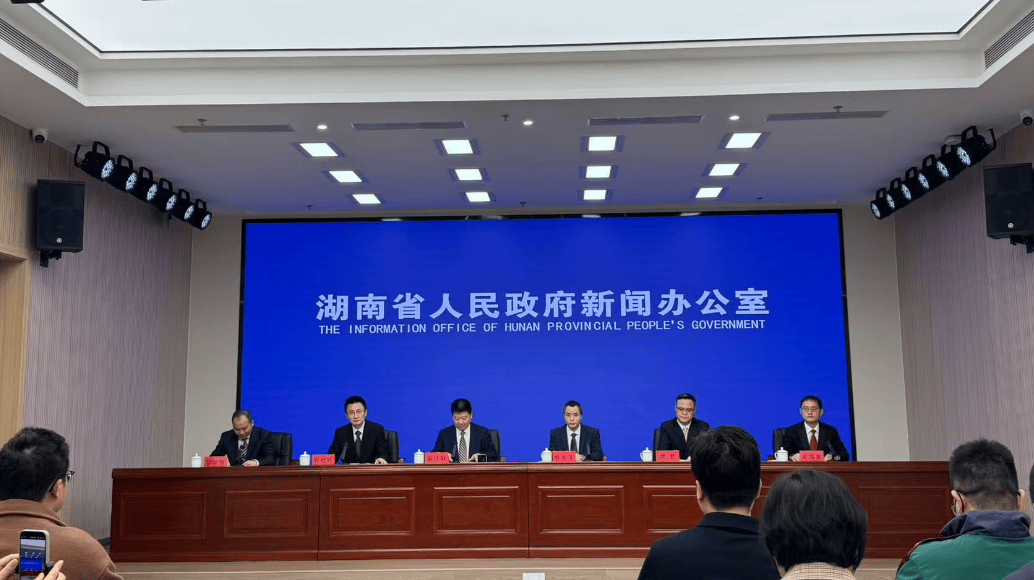
湖南已累计开立数字人民币钱包2538万个
Sou Hu Cai Jing· 2026-02-04 05:33
Group 1 - The core point of the news is the significant growth and promotion of digital RMB in Hunan Province, with a focus on increasing merchant adoption and transaction volume [1][3] - By the end of 2025, the number of merchants supporting digital RMB payments reached 607,000, with a total of 25.38 million wallets opened and a cumulative transaction amount of 56.7 billion yuan [1] - The People's Bank of China Hunan Branch, in collaboration with local governments and banks, invested 15 million yuan in promotional activities, resulting in a consumption boost of 3.5 billion yuan [3] Group 2 - Starting January 1, 2026, a new generation of digital RMB measurement framework, management system, operational mechanism, and ecosystem will be officially implemented, marking the transition from digital cash to "digital deposit currency" [3] - The People's Bank of China Hunan Branch aims to enhance the use of digital RMB in various sectors such as retail, public services, transportation, healthcare, and tourism, thereby injecting more financial momentum into the high-quality development of Hunan's economy [3]


“2.0版”数字人民币上新!如何影响你我生活?
Bei Jing Ri Bao Ke Hu Duan· 2026-01-13 00:29
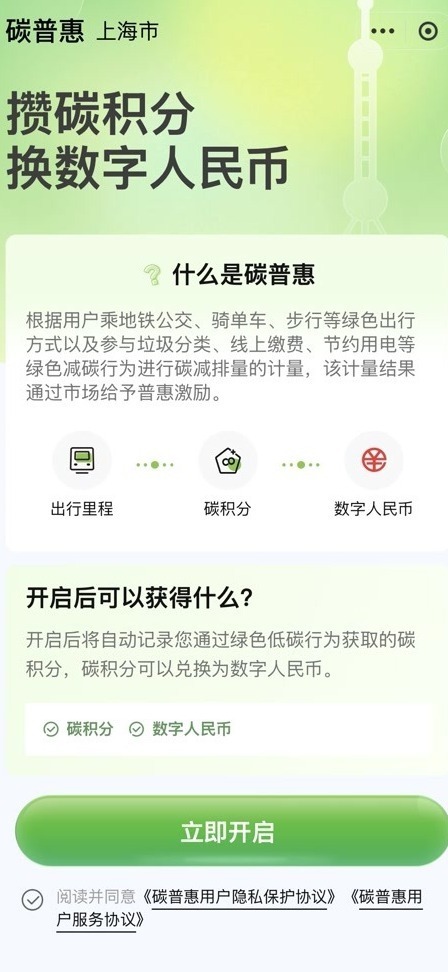
Core Insights - The digital RMB has undergone significant updates with the launch of version 2.0, introducing features like interest on wallet balances and the "Carbon Benefit" program, enhancing its role in the financial system [1][5][9] Group 1: Digital RMB 2.0 Features - The upgraded digital RMB App now includes a wallet balance interest feature, allowing users to earn interest on their balances starting January 1, 2026, at a rate of 0.05% [5][9] - The "Carbon Benefit" program has been launched, enabling users to earn carbon credits through low-carbon activities, which can be converted into digital RMB [2][4] Group 2: Financial Integration and User Benefits - The digital RMB is being integrated into the banking deposit system, becoming a crucial infrastructure in the financial ecosystem [1][9] - Users can now benefit from a "money-making" feature, where idle funds in their digital RMB wallets can generate interest, providing a new avenue for value growth [5][10] Group 3: Future Developments and Recommendations - The digital RMB management center plans to expand low-carbon scenarios and increase participation across multiple cities, aiming to build a collaborative service network [4][10] - Analysts suggest that the transition to a "deposit currency" will facilitate easier access to global banking payment systems, enhancing its use in cross-border trade and investment [11]
数字人民币利息怎么算?
Jing Ji Ri Bao· 2026-01-11 09:09
Core Viewpoint - The digital renminbi has officially transitioned from the "digital cash era" to the "digital deposit currency era" as of January 1, with the introduction of interest on digital renminbi balances through the upgraded digital renminbi App version 2.0 [1] Group 1: Interest Calculation - The interest on digital renminbi will be calculated similarly to that of demand deposits, with the current interest rate set at 0.05% as per the announcements from the ten designated operating institutions [1] - The ten designated operating institutions for digital renminbi include major banks such as Industrial and Commercial Bank of China, Agricultural Bank of China, Bank of China, and others [1] Group 2: Eligibility for Interest - Only real-name digital renminbi wallets are eligible to earn interest, as wallets opened using just a mobile phone number cannot ensure accurate account verification for interest calculation and payment [2] - Interest settlement dates are set for March 20, June 20, September 20, and December 20 each year, with users able to check their interest amounts in the digital renminbi App after these dates [2] Group 3: Future Financial Products - The transition to a digital deposit currency will enable banks to utilize digital renminbi deposits as a funding source, potentially leading to the development of more deposit, wealth management, and credit products [3] - This shift is expected to enhance banks' motivation to promote digital renminbi, creating a comprehensive ecosystem of "payment + finance" [3]
数字人民币利息怎么算?丨快问快答
Sou Hu Cai Jing· 2026-01-11 03:57
Core Viewpoint - The digital renminbi has officially transitioned from the "digital cash era" to the "digital deposit currency era" as of January 1, with the launch of the upgraded digital renminbi App 2.0, which now offers interest on deposits [1] Group 1: Interest Calculation - The interest on digital renminbi will be calculated similarly to that of demand deposits, with the current interest rate set at 0.05% as announced by the ten designated operating institutions [2] - The ten designated institutions include major banks such as Industrial and Commercial Bank of China, Agricultural Bank of China, Bank of China, and others [2] Group 2: Eligibility for Interest - Only real-name digital renminbi wallets are eligible to earn interest, as wallets opened using just a mobile phone do not allow for accurate account verification and interest calculation [3] - Interest will be credited on specific dates: March 20, June 20, September 20, and December 20, and users can check their interest amounts in the digital renminbi App after these dates [3] Group 3: Future Financial Products - The introduction of interest-bearing digital renminbi deposits is expected to enhance banks' motivation to promote these products, potentially leading to the development of more deposit, wealth management, and credit products [4] - This shift aims to create a comprehensive ecosystem that integrates payment and financial services [4]
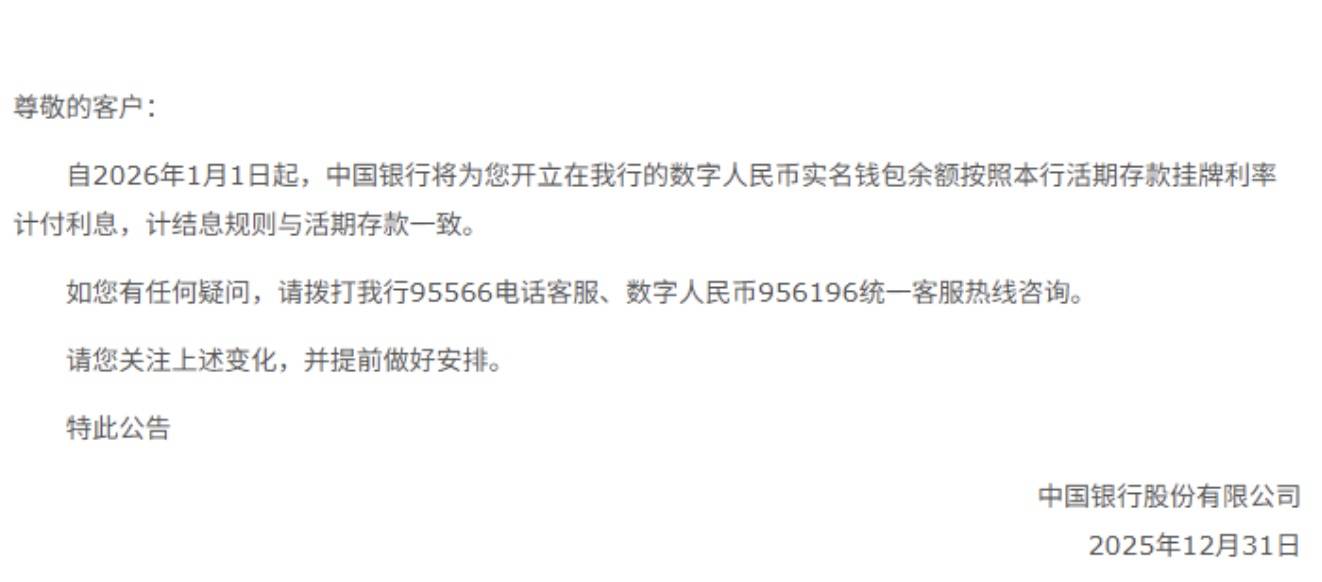
六大行集体公告:数字人民币将计付利息
Sou Hu Cai Jing· 2025-12-31 10:18
Group 1 - The six major state-owned banks in China will start paying interest on the balances of real-name digital RMB wallets at the same rate as demand deposits from January 1, 2026, marking a significant shift in the digital currency landscape [1][2] - The People's Bank of China has introduced a new action plan to enhance the management and service system for digital RMB, which will officially launch on January 1, 2026, transitioning digital RMB from a "digital cash era" to a "digital deposit currency era" [1][4] - The definition of digital RMB has been updated to include the payment system and clarify the dual-layer operational structure, where the central bank issues digital RMB to operating institutions, which then exchange it with the public [3][4] Group 2 - The new digital RMB will have characteristics of commercial bank liabilities, transitioning from being a direct liability of the central bank to a liability of commercial banks, thus allowing wallet balances to earn interest and be covered by deposit insurance [4][5] - The action plan optimizes the dual-layer operational structure, assigning responsibilities to the central bank for rule-making and infrastructure, while commercial banks will manage customer wallets and ensure compliance, thus transforming their role from cost centers to profit centers [5][6] - The action plan integrates digital RMB into the traditional monetary control system, allowing bank-operated digital RMB to be included in the reserve requirement framework, which will enhance liquidity in the banking system [6][7] Group 3 - As of November 2025, the digital RMB pilot has processed 3.48 billion transactions with a total value exceeding 16.7 trillion yuan, indicating strong adoption and usage [7]



交通银行将给数字人民币计付利息
Xin Hua Cai Jing· 2025-12-31 05:53
Group 1 - The core point of the article is that from January 1, 2026, Bank of Communications will pay interest on the balances of digital RMB wallets opened by customers, based on the bank's announced current deposit rates [1] - Digital RMB interest payment marks the transition from cash-type version 1.0 to deposit currency-type version 2.0 [1] - The People's Bank of China has issued an action plan to strengthen the management and service system of digital RMB, indicating a shift from the digital cash era to the digital deposit currency era [1]

将从“数字现金时代”迈入“数字存款货币时代”
Jin Rong Shi Bao· 2025-12-30 01:58
Core Viewpoint - The digital renminbi is transitioning from the "digital cash era" to the "digital deposit currency era," with a new management and service framework set to be implemented on January 1, 2026 [1][13]. Group 1: Key Features of the Action Plan - The digital renminbi wallet balances will earn interest, currently at the rate of demand deposits [2][4]. - The new framework allows banks to manage digital renminbi wallet balances autonomously, with deposit insurance providing equivalent safety to traditional deposits [2][8]. - The transition from central bank liabilities to commercial bank liabilities enhances the motivation for financial institutions to innovate [2][6]. Group 2: Systematic Changes and Upgrades - The core upgrade involves multiple enhancements in currency attributes, management models, infrastructure, and incentive mechanisms [3][7]. - The digital renminbi will now be classified as a commercial bank liability, allowing it to earn interest and thus increasing user motivation to hold it [4][12]. - The new system is designed to support various technological innovations and better meet diverse scenario demands [7][12]. Group 3: Rationale Behind the Changes - The changes address challenges posed by modern digital payment tools to central bank monetary control and the risks of financial disintermediation [5][8]. - The previous lack of interest on digital renminbi holdings diminished user motivation, which the new plan aims to rectify [5][8]. - The transition to a commercial bank liability structure is expected to enhance the integration of digital renminbi into the existing financial system [5][12]. Group 4: Optimization of the Dual-Layer Architecture - The action plan optimizes the dual-layer architecture, clarifying responsibilities between the central bank and commercial banks [9][10]. - The central bank will set business rules and technical standards, while commercial banks will manage customer wallets and ensure compliance [9][10]. - This structure aims to balance innovation and stability, ensuring the continuity of the monetary system while facilitating digital payment innovations [9][10]. Group 5: Regulatory and Measurement Framework - The action plan establishes a measurement framework for digital renminbi, integrating it into the reserve requirement system [11][12]. - Digital renminbi wallet balances will be classified according to liquidity, aligning them with traditional monetary systems [11][12]. - This integration is expected to enhance macroeconomic control effectiveness and improve the attractiveness of digital renminbi for users [12].
新华财经早报:12月30日
Xin Hua Cai Jing· 2025-12-29 23:23
Group 1: Tariff Adjustments - The State Council Tariff Commission announced the "2026 Tariff Adjustment Plan," which will implement provisional import tariffs lower than the most-favored-nation rate on 935 items starting January 1, 2026 [2] Group 2: Digital Currency Development - The People's Bank of China introduced a plan to enhance the management and service system for digital RMB, transitioning from a cash-based model to a deposit currency model [3] Group 3: Market Regulation - The State Administration for Market Regulation emphasized the need to deepen fair competition governance and strengthen anti-monopoly enforcement, particularly focusing on platform economy regulation [3] Group 4: State-Owned Enterprises Performance - Data from January to November shows that state-owned enterprises had total operating revenue of 7,562.576 billion yuan, a year-on-year increase of 1.0%, while total profits decreased by 3.1% to 371.945 billion yuan [3] Group 5: Global Trade Tensions - The China Council for the Promotion of International Trade reported that the global trade friction index was at 104 in October, with a year-on-year decrease of 7.3% in the monetary value of trade friction measures [3] Group 6: Fund Management Industry - As of the end of November, there were 165 public fund management institutions in China, managing a total net asset value of 37.02 trillion yuan, reflecting an increase of 58.068 billion yuan compared to the end of October [3] Group 7: Insurance Asset Management - The China Banking and Insurance Asset Management Association released guidelines aimed at standardizing data classification and enhancing data security management in the insurance asset management industry [3] Group 8: Corporate Announcements - Various companies announced significant financial activities, including: - Caixin Securities received approval for a public bond issuance of up to 15 billion yuan [8] - Changan Automobile plans to raise up to 6 billion yuan for new energy vehicle projects [8] - Jiuxin Airlines intends to purchase 25 Airbus A320 aircraft for 4.1 billion USD [8]