双销模式

Search documents
长城直营变革:坦克撤出魏牌渠道 魏牌All in直营
2 1 Shi Ji Jing Ji Bao Dao· 2025-10-20 23:04
Core Insights - The company is transitioning to a fully direct sales model for its Wei brand, phasing out the previous dealership model and rebranding existing stores to "Wei Brand New Energy" [1][5] - The shift aims to enhance brand identity and streamline operations, positioning Wei as the closest brand to new energy vehicle manufacturers within the Great Wall Automotive system [1][5] - The direct sales strategy is part of a broader trend among automotive companies to adopt dual sales models, balancing direct sales with traditional dealership networks [2][3] Group 1: Direct Sales Model - Great Wall Automotive has decided to fully embrace a direct sales model, moving away from the dual sales approach that included traditional dealerships [2][3] - The transition to direct sales is intended to improve customer experience and brand image, with a focus on connecting directly with consumers [5][6] - The company plans to expand its direct sales outlets significantly, targeting second and third-tier cities to capture new market segments [6] Group 2: Brand and Market Strategy - The Wei brand will become the sole focus of the direct sales channel, with the Tank brand being withdrawn from this model [1][5] - The company has reported significant sales growth for the Wei brand, with a 63% year-on-year increase in September deliveries and a 96% increase in cumulative deliveries from January to September [6] - The strategic shift aims to position Wei in competitive markets against emerging players, while also addressing the high costs associated with direct sales operations [6][7] Group 3: Challenges and Organizational Changes - The dual sales model presents challenges in maintaining consistent pricing between direct sales and dealership networks, which can lead to internal competition [3] - Transitioning to a fully direct sales model requires significant changes in organizational processes, decision-making, and corporate culture, which poses a greater challenge for traditional automakers [7]

21独家|坦克撤出魏牌渠道,魏牌将在10月底全面转向直营
2 1 Shi Ji Jing Ji Bao Dao· 2025-10-17 15:47
Core Insights - The article discusses the transition of Great Wall Motors' Wei brand to a fully direct sales model, phasing out the existing dealership system and rebranding "长城智选" stores to "魏牌新能源" [2][8] - This shift aims to enhance brand identity and streamline operations, positioning Wei as the closest brand to new energy vehicle startups within Great Wall's ecosystem [2][8] Group 1: Direct Sales Model Implementation - Great Wall Motors will fully adopt a direct sales model for the Wei brand by the end of October, terminating the existing dealership model [2] - The transition includes the complete withdrawal of the Tank brand from the Wei sales channel, allowing stores to focus solely on Wei products [2][8] - The direct sales strategy is part of a broader initiative to improve customer experience and brand positioning, as articulated by company executives [7][8] Group 2: Market Strategy and Expansion - The Wei brand is expanding its direct sales presence, with plans to increase the number of direct sales stores to 500 across over 300 cities, focusing on second and third-tier markets [9] - In September, Wei delivered 11,000 vehicles, marking a 63% year-on-year increase, and a total of 64,000 vehicles delivered from January to September, representing a 96% growth [9] - The strategic shift aims to capture market share in areas where competitors like Li Auto and Aito have not yet solidified their presence [9] Group 3: Challenges and Financial Implications - The transition to a direct sales model has led to increased sales expenses, which rose by 63.31% to 5.036 billion yuan in the first half of 2025, while net profit decreased by 36.39% [9][10] - The direct-to-consumer (DTC) model requires a significant organizational transformation, which poses challenges for traditional automakers compared to simply establishing direct sales outlets [10]

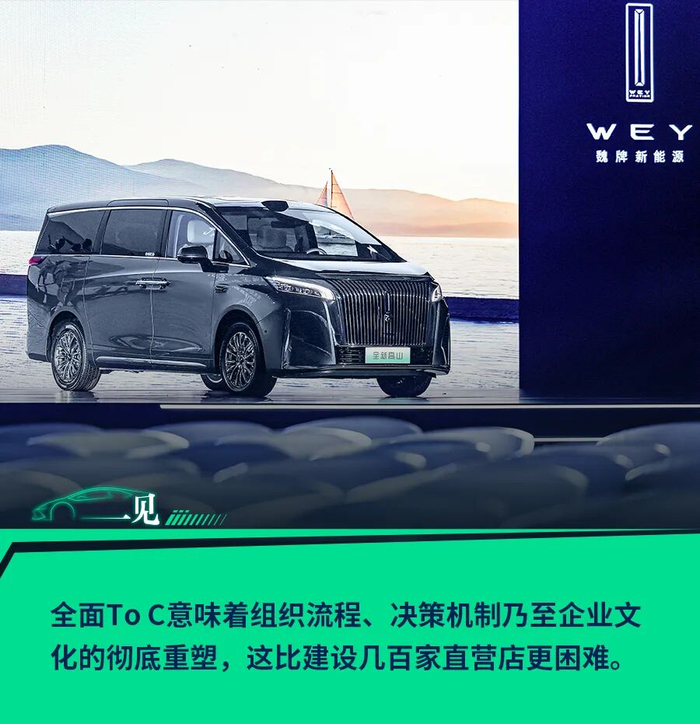
坦克撤出魏牌渠道,魏牌将在10月底全面转向直营
2 1 Shi Ji Jing Ji Bao Dao· 2025-10-17 15:35
Core Insights - Great Wall Motors is transitioning to a fully direct sales model for its Wei brand, phasing out the existing dealer network and rebranding "长城智选" stores to "魏牌新能源" [2][3] - The shift aims to enhance brand identity and streamline operations, positioning Wei as the closest brand to new energy vehicle startups within Great Wall's ecosystem [2][8] - The company plans to expand its direct sales presence significantly, targeting second and third-tier cities to capture new market segments [9] Group 1: Direct Sales Model Transition - Great Wall Motors will completely adopt a direct sales model for the Wei brand by the end of October, ending the dealer model [2] - The transition is part of a broader strategy initiated in April last year, which aimed to reduce inventory pressure on dealers by shifting high-end models to direct sales [4][6] - The direct sales model is expected to improve customer experience and brand image, as articulated by company executives [8] Group 2: Market Expansion and Performance - As of May, Great Wall has established over 430 user centers across 110 cities for Wei brand sales and services, with plans to expand to 500 stores covering over 300 cities [9] - Wei brand's sales performance has been strong, with a 63% year-on-year increase in September, delivering 11,000 vehicles [9] - The direct sales model has led to a significant rise in sales expenses, with a 63.31% increase to 5.036 billion yuan in the first half of 2025, while net profit decreased by 36.39% [9] Group 3: Challenges and Strategic Implications - The dual sales model previously employed posed challenges in price control between direct sales and dealer networks, leading to potential internal competition [5][6] - The transition to a fully direct sales model aims to eliminate pricing conflicts and enhance market penetration [7] - The shift to a direct-to-consumer (DTC) approach requires a fundamental transformation in organizational processes and corporate culture, which is more complex than merely establishing direct sales outlets [10]