
反内卷工作

Search documents
光伏企业,如何不被白银绑架?
Huan Qiu Lao Hu Cai Jing· 2026-02-02 07:46
Core Viewpoint - The photovoltaic (PV) industry is facing significant challenges due to soaring silver prices, which have become a major external variable impacting the industry's cost structure and operational viability [1][5][20]. Group 1: Silver Price Impact - As of January 26, silver prices have surged to over 27,600 yuan per kilogram, leading to a dramatic increase in the cost of silver used in PV cells, which now accounts for 64% of the total cost of battery cells [2][5]. - The price of silver has increased from over 7,000 yuan to more than 27,000 yuan per kilogram over the past year, creating a critical situation for the PV industry [5][12]. - The rising costs of silver and other materials have resulted in a significant increase in the overall cost structure of PV components, with silver paste costs rising by 77% and aluminum frame costs increasing by 8% [8][10]. Group 2: Industry Response and Strategies - The PV industry must establish a flexible pricing mechanism linked to silver prices to mitigate the financial strain on midstream companies, ensuring that costs are shared across the supply chain [18][19]. - Companies are encouraged to adopt strategies similar to those in other industries facing raw material price volatility, such as vertical integration, long-term contracts, and material substitution [9][20]. - The industry should focus on technological advancements to reduce silver consumption, with short-term goals to lower silver usage in PV cells and long-term objectives to develop silver-free technologies [21][22][24]. Group 3: Collaborative Efforts - The China Photovoltaic Industry Association is urged to take a leading role in coordinating industry responses to the silver price crisis, including establishing a dynamic pricing platform and promoting collaborative purchasing strategies [26][17]. - A unified approach to pricing and cost-sharing across the entire PV supply chain is essential to prevent financial distress among midstream companies and ensure the industry's sustainability [20][25]. - The establishment of a silver price dynamic warning platform and the development of standards for silver consumption in PV products are recommended to enhance market stability and quality assurance [26].


崔东树:前11月汽车行业收入达10万亿元 11月单月利润率回升至4.4%
Zhi Tong Cai Jing· 2025-12-27 10:12
Core Insights - The automotive industry in China generated a revenue of 100,223 billion yuan from January to November 2025, reflecting an 8.1% year-on-year increase, with costs rising by 9% to 88,405 billion yuan and profits increasing by 7.5% to 4,403 billion yuan, resulting in a profit margin of 4.4% [2][13] - In November 2025, the automotive sector's revenue reached 11,445 billion yuan, a 9.7% increase year-on-year, with costs at 10,162 billion yuan (up 11.4%) and profits at 508 billion yuan (up 39.2%), marking a significant recovery in profit margin compared to October [2][13] - The automotive industry's profit margin remains lower than the average profit margin of 6% for downstream industrial enterprises, indicating ongoing pressure on profitability despite recent improvements [2][11] Industry Performance - The overall industrial sector achieved a revenue of 125.34 trillion yuan from January to November 2025, with a year-on-year growth of 1.6%, while the profit margin for industrial enterprises was 5.29%, showing a slight decline [4] - State-owned enterprises have shown strong performance, with their profit share reaching 30%, while private enterprises have lower profit margins at around 4% [5] Automotive Production Trends - The automotive production in 2025 reached 3,109 million units from January to November, marking an 11% increase year-on-year, with significant growth in the production of new energy vehicles [12][13] - The production of new energy vehicles reached 1,453 million units, a 27% increase, while the penetration rate rose to 47% [12][13] Profitability Challenges - The automotive industry is facing significant profitability pressures, with a sales profit margin of only 4.3% in 2024, which is substantially lower than historical averages [3][13] - The rising costs of upstream materials, particularly lithium carbonate, and the challenges in battery production are contributing to the declining profit margins for automotive companies [13]
招商银行:监管部门指导下 业界开展反内卷工作
Xin Lang Cai Jing· 2025-09-01 05:35
Group 1 - The core viewpoint is that under the guidance of regulatory authorities, the banking industry is working to avoid chaotic competition, which will lead to more rational pricing and help stabilize interest margin levels [1] - A senior executive from China Merchants Bank indicated that while there is still downward pressure on interest margins measured quarterly, the hope is that the extent of the decline compared to the previous year will narrow [1]

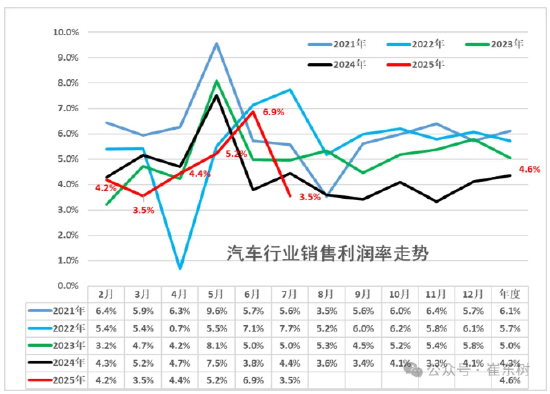
崔东树:1至7月汽车行业收入同比增长8%,利润率4.6%仍处历史次低位
Xin Lang Ke Ji· 2025-08-29 06:23
Core Insights - The "Two New" policy continues to show effects, with the consumption of old products for new ones significantly boosting related industries and supply chains [1][2] - The automotive industry is projected to produce 18.08 million vehicles in 2025, reflecting an 11% year-on-year increase [1] - The automotive sector's revenue for January to July 2025 reached 591.93 billion yuan, an 8% increase year-on-year, while costs also rose by 8% to 520.56 billion yuan [1] - Profit for the automotive industry during the same period was 27.37 billion yuan, a slight increase of 0.9% year-on-year, with a profit margin of 4.6% [1] - The profit margin for the automotive industry in July 2025 dropped to 3.5%, a significant decline from 4.4% in July 2024 [1][2] Automotive Industry Performance - The automotive industry's sales profit margin for 2024 is projected to be 4.3%, significantly lower than historical averages [2] - The automotive industry experienced a revenue of 82.75 billion yuan in July 2025, a 5% year-on-year increase, while costs also increased by 5% to 72.76 billion yuan [1] - The profit for July 2025 was 2.93 billion yuan, representing a 17% year-on-year decline [1] - The automotive industry's profit margin for January to July 2025 was 4.6%, which is better than 2024 but still at a historical low [2] Historical Data Overview - In 2023, the cumulative production of vehicles was 3.011 million, with a unit revenue of 335,000 yuan and a unit cost of 291,000 yuan [4] - The cumulative production for 2025 until July was 808,000 units, with a unit revenue of 327,000 yuan and a unit cost of 288,000 yuan [4] - The unit profit for July 2025 was 12,000 yuan, indicating a decrease compared to previous months [4]
招商宏观:如果限产措施从行业自律层面上升至国家部委层面 那么价格水平回升的斜率将更加陡峭
Sou Hu Cai Jing· 2025-08-12 03:27
Group 1 - The core viewpoint of the report indicates that measures to address the price war have not yet fully taken effect, with both CPI and PPI showing weak year-on-year performance [1] - Looking ahead, if CPI and PPI continue to improve on a month-on-month basis, the year-on-year growth rate is expected to gradually improve in the second half of the year due to the impact of a low base [1] - If production restriction measures escalate from industry self-discipline to national ministry level, the slope of price level recovery will become steeper [1] Group 2 - Overall, the first data on foreign trade and prices for the second half of the year reflects a situation that is better than expected, with stable growth in exports and continuous improvement in import demand [1] - The rebound in month-on-month price growth reflects the effects of previous policies [1] - The continuation of policies aimed at increasing residents' income and reducing burdens in the second half of the year will help alleviate the impact of declining investment demand on the economy [1]