反身性效应

Search documents
预测市场辩论: 更健康的金融市场,还是升级版的赌场?
Xin Lang Cai Jing· 2026-01-18 15:20
Core Viewpoint - The concept of a "healthier prediction market" as described by Vitalik Buterin is largely idealized and does not reflect the current reality of these markets, which rely heavily on subsidies and face structural issues that undermine their effectiveness [1][4]. Group 1: Mechanisms and Structural Issues - Prediction markets depend on converting private information into public knowledge, primarily through subsidies from venture capital-backed market makers, which is a model that is not sustainable in the long term [1]. - Market makers struggle to hedge inventory risks and can only provide liquidity in markets with abundant historical data, such as sports and political events, leaving markets with significant "hidden private knowledge" without liquidity [2]. - The design of Conditional Token Framework (CTF) prevents subsidies from reaching these less liquid markets, masking failures and creating a façade of sophistication that does not extend beyond easily modeled areas [2]. Group 2: Pricing and Trading Behavior - The notion of "price boundaries" is superficial; users prioritize profit over probability calibration, leading to concentrated trading activity around settlement times and exacerbating speculative behavior [3]. - The accuracy of a platform should be measured by whether events with a displayed probability of 70% actually occur at that rate over a long-term sample, rather than just whether a specific event happens to align with its displayed probability [3]. Group 3: Market Dynamics and Speculation - A lack of speculation can deteriorate market conditions, as healthy financial markets require diverse participation to foster liquidity and information flow [4]. - When liquidity is thin, every transaction is perceived as an "information trade," increasing adverse selection risks and prompting market makers to withdraw, further thinning the market [4]. Group 4: Comparison with Traditional Markets - Many negative aspects of prediction markets are also present in traditional stock markets, such as the potential for manipulation by influential actors [5]. - The true value of prediction markets lies in their ability to provide an environment for expressing opinions that is more conducive to truth-seeking compared to social media, where individuals can spread panic without accountability [6].
高盛交易员的市场观察:这个夏天真正的主角是中国股市
美股IPO· 2025-08-31 01:54
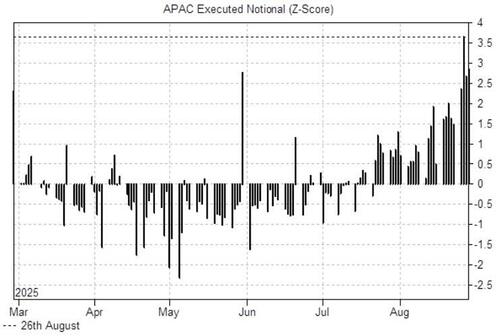
Group 1 - The core viewpoint is that the Chinese stock market has become an unexpected highlight in the summer of 2025, outperforming expectations with the Shanghai Composite Index breaking a ten-year high and retail investor financing nearing the peak levels of 2015 [1][2][5] - The Chinese stock market remains undervalued with a low holding ratio, while trading momentum continues to strengthen, potentially creating a self-reinforcing effect [3][5] - The A-share market has seen a record of 12 consecutive days with trading volumes exceeding 20 trillion yuan, marking the longest historical record, and Goldman Sachs' Asia-Pacific business recorded its largest single-day trading volume this week [3] Group 2 - In the U.S. market, the expectation of interest rate cuts has become a key driver for stock market increases, with an 85% probability of the Federal Reserve starting to cut rates in September [4] - Despite a 4.8% year-on-year growth in S&P 500 companies' Q2 revenues, sales growth has slowed when adjusted for exchange rates, particularly among small and medium-sized companies [4] - The European market has experienced structural changes this summer, with the risk premium gap between core and peripheral countries narrowing, particularly between Italian BTPs and French OATs [6]



高盛交易员的市场观察:这个夏天真正的主角是中国股市
Hua Er Jie Jian Wen· 2025-08-30 08:51
Group 1: Chinese Stock Market - The Chinese stock market has significantly outperformed expectations this summer, becoming one of the most surprising trading opportunities in the market [1][2] - The market remains undervalued with low net long positions, while trading momentum continues to strengthen, potentially creating a self-reinforcing effect [2][4] - The Shanghai Composite Index has reached a 10-year high, and retail investor financing balances are nearing the peak levels seen during the 2015 market bubble [2][4] Group 2: U.S. Stock Market - The expectation of interest rate cuts has been a key driver for the U.S. stock market's rise, with an 85% probability that the Federal Reserve will begin cutting rates in September [5] - Despite a 4.8% year-over-year revenue growth for S&P 500 companies in Q2, sales growth has slowed when adjusted for exchange rates, particularly for small-cap companies [5] - Managing liquidity risk will be crucial for both the Federal Reserve and investors as the year progresses, especially with the potential end of quantitative tightening (QT) in October [5] Group 3: European Market - There has been a structural change in the European market this summer, with the risk premium between core and peripheral countries narrowing, particularly between Italian BTPs and French OATs [6][7] - Political instability in Europe adds uncertainty to the market, with potential risks from political events in France and the Netherlands [7] - European bank stocks have risen by 52% this year, prompting investors to consider how to protect their gains amid changing political and interest rate conditions [7]