古建保护

Search documents
因地制宜保护好“沉默的遗产”
Jing Ji Ri Bao· 2026-02-10 22:18
Core Viewpoint - Shanxi province is home to 28,027 immovable ancient buildings, forming the most complete ancient architectural system in China, with over 94% of lesser-known buildings located in rural areas, highlighting the need for their protection and preservation [1][2]. Group 1: Challenges in Protection - Lesser-known ancient buildings face numerous challenges in protection, including scattered distribution, complex property rights, and a lack of resources such as funding, personnel, and technical expertise [1]. - The protection of these buildings is often reliant on local government and community involvement, which can be inconsistent and under-resourced [2]. Group 2: Community Involvement and Responsibility - A five-level responsibility system has been established in Shanxi, assigning specific caretakers for each ancient building, ensuring that every site has a dedicated "guardian" [2]. - Local community members, often familiar with the area, conduct regular inspections of ancient buildings, reporting any issues promptly, which enhances the protection efforts [2]. Group 3: Social Participation and Funding - Since the implementation of the "Civilization Guardian Project," 473 cultural heritage sites have been adopted by social entities, attracting over 540 million yuan in funding, demonstrating a successful model of public-private partnership in heritage protection [2]. - This model not only alleviates financial burdens on the government but also fosters a sense of collective responsibility among the public for cultural heritage preservation [2]. Group 4: Technological Integration in Protection - Shanxi has initiated a digital protection project for ancient architectural murals, allocating 20 million yuan annually for data collection to support restoration efforts [3]. - The shift from reactive to proactive protection measures, including disaster warning systems and research on damage mechanisms, has significantly improved the preservation rates of ancient wooden structures [3]. Group 5: Effective Preservation Strategies - The preservation of the "Little Western Heaven" temple exemplifies the successful integration of traditional repair techniques with modern protection concepts, emphasizing the importance of regular maintenance over emergency repairs [3]. - Shanxi's approach to ancient building protection demonstrates that tailored strategies, community involvement, and technological advancements can effectively safeguard cultural heritage [3].
建勇:让古建“活”在当下
Xin Lang Cai Jing· 2026-02-07 19:44
Core Viewpoint - The article highlights the dedication and expertise of Che Jianyong, a key figure in the preservation and restoration of ancient architecture in Beijing, particularly at the Temple of Heaven, emphasizing the importance of precise techniques and community involvement in cultural heritage protection [1][4]. Group 1: Background and Experience - Che Jianyong began his career in 1999 at the Temple of Heaven, initially lacking knowledge in ancient architecture but quickly developed a passion for it through hands-on experience and mentorship [2]. - His early exposure to ancient architectural restoration involved studying traditional techniques and participating in the preparation of repair cost estimates, which deepened his understanding of the field [2]. Group 2: Restoration Techniques - The restoration of the Circular Mound Altar's ground was Che's first project, marking the beginning of his focus on the protection of brick and tile damage [3]. - Che emphasizes that ancient building restoration should be data-driven rather than based on intuition, leading to the development of experimental models to optimize repair materials and techniques [3]. - He advocates for a "slow treatment" approach to restoration, ensuring that interventions do not compromise the historical authenticity of the structures [3]. Group 3: Cultural Heritage Supervision - In 2024, Che was appointed as a cultural heritage protection supervisor for the Beijing Central Axis, adding responsibilities to enhance public understanding and participation in heritage preservation [4]. - The increase in visitor numbers at the Temple of Heaven presents challenges in balancing visitor experience with the protection of ancient structures, prompting the development of a "dynamic protection" strategy [4]. - Che's team employs digital technologies like 3D scanning and VR to present historical information engagingly to the public [5]. Group 4: Community Engagement - Che promotes the idea that cultural heritage protection requires collective societal effort, encouraging community involvement in understanding and preserving ancient architecture [5]. - He aims to educate visitors about ancient building knowledge and encourages them to participate in volunteer activities to contribute to heritage protection [5].
山西应县运用人工智能监测千年木塔 机器狗,如何参与古建保护
Ren Min Ri Bao· 2025-07-08 21:56
Core Insights - The article highlights the innovative use of robotic technology, specifically a machine dog developed by Lenovo, in the preservation of ancient architecture, particularly the ancient wooden pagoda in Yingxian County, Shanxi Province [1][2]. Group 1: Technological Innovation - The machine dog is utilized for high-precision scanning and data collection of the Yingxian Wooden Pagoda, which is the oldest existing wooden structure in China, built in 1056 [1]. - The machine dog integrates advanced technologies such as deep learning algorithms, multi-modal sensing systems, and bionic motion control, enhancing the efficiency and accuracy of data collection compared to traditional manual methods [1][2]. Group 2: Preservation Efforts - The collaboration between local government and Tsinghua University aims to address challenges in traditional preservation methods, such as insufficient precision and potential damage from contact measurements [1]. - The Tsinghua University team has successfully completed high-precision 3D digital modeling of the pagoda's structure using the machine dog, providing comprehensive support for further analysis and protection strategies [1]. Group 3: Future Applications - Future applications of the machine dog include real-time monitoring for fire and decay, with capabilities to detect temperature changes and internal conditions of wooden components using X-ray imaging [2]. - The ongoing digital preservation efforts include creating a digital twin of the pagoda, allowing visitors to experience virtual reality simulations of the historical site [2].

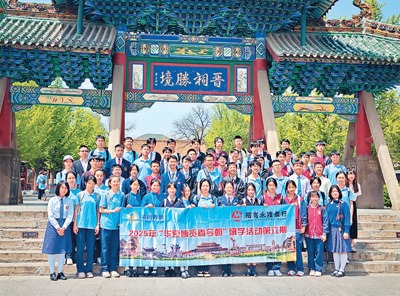
香港青少年行读三晋探寻中华文脉
Ren Min Ri Bao Hai Wai Ban· 2025-05-09 22:04
Core Points - The article discusses a recent educational exchange program called "Hua Xia Bo Lan Kan Jin Zhao," where Hong Kong students visited Shanxi Province to explore Chinese cultural heritage and ancient architecture [5][11]. Group 1: Event Overview - The program lasted for one week and involved 32 students and teachers from over 10 secondary schools in Hong Kong visiting various historical sites in Shanxi, including Yungang Grottoes and Hanging Monastery [5][11]. - The initiative aims to deepen the understanding of Chinese culture among Hong Kong youth and foster friendships between students from both regions [9][12]. Group 2: Cultural Exploration - Students were impressed by the architectural marvels such as the Buddhist temple at Foguang Mountain, showcasing the intricate design and historical significance of Tang Dynasty structures [6][10]. - The Hanging Monastery, built during the Northern Wei period, has become a popular tourist destination, especially after being featured in the game "Black Myth: Wukong" [6][11]. Group 3: Educational Activities - The exchange included interactive sessions where Hong Kong students learned about traditional crafts like paper-cutting and engaged in discussions about ancient architecture and its preservation [8][10]. - Students from Shanxi acted as guides, sharing insights about local history and architecture, which facilitated deeper cultural exchanges [9][12]. Group 4: Program Impact - The program has been running since 2023, with over 500 Hong Kong youths participating in various cultural and educational activities across multiple provinces [11][12]. - Teachers noted improvements in students' communication and organizational skills through these immersive experiences [12].