咖啡市场精细化运营

Search documents
9块9咖啡价格战熄火?2025年咖啡相关企业注册量同比增长20.22%|封面有数
Xin Lang Cai Jing· 2026-02-04 04:02
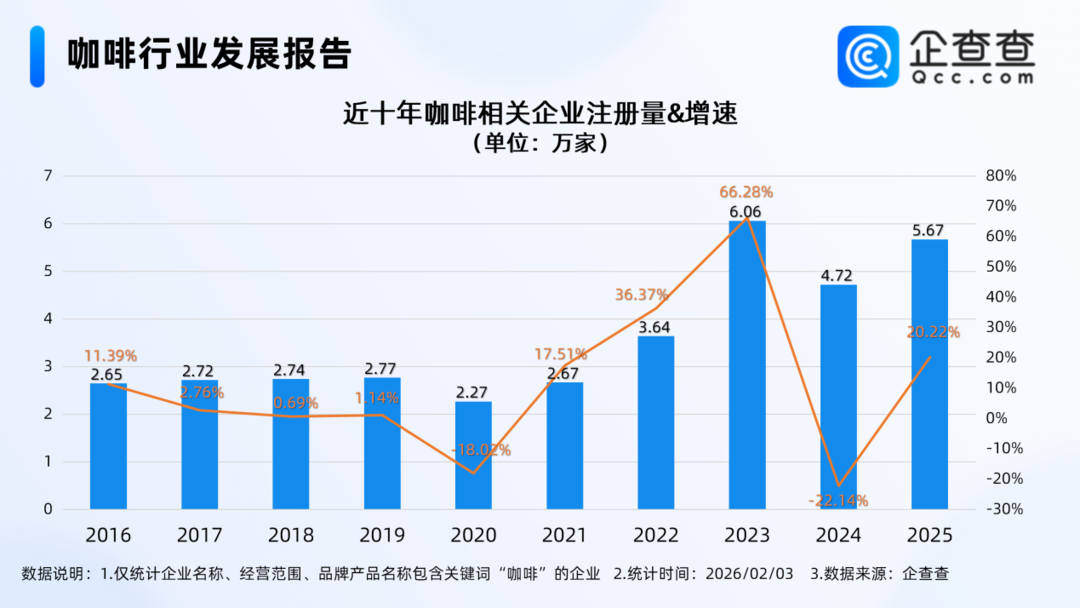
Core Insights - Kudi announced the end of its 9.9 yuan all-you-can-drink promotion starting February 1, marking a shift in strategy after nearly two years of low-price competition in the Chinese coffee market [1] - Analysts suggest that brands will now focus on refined operations, user retention, and increasing repurchase rates, prioritizing long-term profitability over mere scale [1] Industry Overview - As of February 3, there are 263,800 coffee-related enterprises in China, with a consistent growth trend in registrations over the past decade [3] - It is projected that 56,700 coffee-related enterprises will be registered in 2025, representing a year-on-year growth of 20.22% [3] - In the current year, 4,100 coffee-related enterprises have already been registered [3] Company Formation Trends - The majority of existing coffee-related enterprises were established in the last three years, with those aged 1-3 years making up 31.40% of the total [5] - Enterprises established within the last year account for 20.89% of the total [5] Regional Distribution - Coffee-related enterprises are predominantly located in the East China region, accounting for 29.94% of the total [7] - The Southwest and South China regions follow, with 22.53% and 20.81% of enterprises, respectively [7] - Other regions have less than 10% representation in coffee-related enterprises [7]


9块9咖啡价格战熄火,2025年咖啡相关企业注册量同比增长20.22%
Qi Cha Cha· 2026-02-04 03:10
Core Insights - The price war initiated by Kudi's 9.9 yuan all-you-can-drink promotion has ended, allowing Chinese coffee brands to focus on refined operations and user retention rather than just scale [1] Group 1: Current Market Landscape - As of February 3, there are 263,800 existing coffee-related enterprises in China, with a projected registration of 56,700 new coffee-related companies in 2025, representing a year-on-year growth of 20.22% [2] - In the current year, 4,100 coffee-related enterprises have already been registered [2] Group 2: Company Establishment Trends - Most coffee-related enterprises have been established in the last three years, with those operating for 1-3 years making up 31.40% of the total [3] - Additionally, 20.89% of coffee-related enterprises have been established within the past year [3] Group 3: Regional Distribution - Coffee-related enterprises are predominantly located in the East China region, accounting for 29.94% of the total [4] - The Southwest and South China regions follow, with 22.53% and 20.81% of coffee-related enterprises, respectively [4]
9块9的咖啡自由结束了?
36氪· 2026-02-02 09:39
Core Viewpoint - The article discusses the evolving landscape of the Chinese coffee market, highlighting the end of Kudi's 9.9 yuan unlimited drink promotion and its implications for pricing strategies among coffee brands in China [5][11][16]. Group 1: Market Dynamics - The Chinese coffee market has rapidly developed over the past decade, with a market size reaching hundreds of billions and over 100 million coffee users established [7]. - Kudi's pricing strategy has significantly influenced consumer perceptions, establishing a price anchor of 9.9 yuan for quality coffee [10][9]. - The end of Kudi's promotion marks a shift in the competitive landscape, where price is no longer the sole competitive factor, leading to a focus on brand and product differentiation [8][28]. Group 2: Competitive Landscape - Major coffee brands in China, including Luckin and Kudi, have entered the "ten-thousand store era," with Luckin surpassing 30,000 stores and Kudi rapidly expanding to over 18,000 stores within two years [24][27]. - The competitive environment is shifting towards refined operations, emphasizing user retention and profit maximization rather than just scale [31]. - The emergence of a supply crisis due to adverse weather in Brazil is expected to increase coffee prices, providing a basis for price adjustments that consumers may accept [31]. Group 3: Future Projections - The number of coffee drinkers in China is projected to grow from 130 million in 2023 to 260 million by 2026, indicating a robust market expansion [23]. - The Chinese fresh coffee market is expected to grow from 151.5 billion yuan in 2023 to 383.6 billion yuan by 2028, with a compound annual growth rate of 20.4% [23]. - The current pricing adjustments and market dynamics may present an opportunity for the entire coffee industry in China to upgrade and adapt to new consumer expectations [31].

9块9的咖啡自由结束了?
东京烘焙职业人· 2026-02-02 09:31
Core Viewpoint - The article discusses the significant changes in the Chinese coffee market, particularly focusing on the price adjustments made by Kudi Coffee, which has ended its 9.9 yuan unlimited drink promotion, impacting the pricing landscape for coffee in China [4][11][16]. Group 1: Market Dynamics - Kudi Coffee's price adjustment marks a pivotal moment in the Chinese coffee market, as it had previously established a strong price anchor for consumers, making 9.9 yuan a common expectation for quality coffee [5][9][10]. - The rapid growth of the Chinese coffee market has been driven by local brands like Luckin and Kudi, with the market size reaching hundreds of billions and over 100 million coffee users established in just a decade [6][24]. - The end of Kudi's promotional pricing signals a shift from price competition to a focus on brand and product differentiation among coffee chains, as they enter a new era of refined operations [7][29]. Group 2: Competitive Landscape - The competitive landscape in the Chinese coffee market has evolved, with major brands like Luckin and Starbucks entering the "ten-thousand store era," indicating a saturation of the market and a need for brands to focus on customer retention and product quality [26][28][31]. - Kudi Coffee, which was founded in 2022, has rapidly expanded its presence, reaching over 18,000 stores globally within two years, showcasing the aggressive growth strategies employed by new entrants in the market [25][23]. - The article highlights that the leading coffee brands are now prioritizing operational efficiency and customer loyalty over mere expansion, as the market matures and consumer preferences evolve [31]. Group 3: Future Outlook - The Chinese coffee market is projected to continue its rapid growth, with the number of coffee drinkers expected to rise from 130 million in 2023 to 260 million by 2026, driven by the popularity of freshly brewed coffee [24]. - The market is anticipated to grow from 151.5 billion yuan in 2023 to 383.6 billion yuan by 2028, with a compound annual growth rate of 20.4% [24]. - A global coffee supply crisis, exacerbated by adverse weather in Brazil, is expected to lead to increased coffee prices, providing a basis for price adjustments that consumers may accept, thus presenting an opportunity for the industry to upgrade [31].