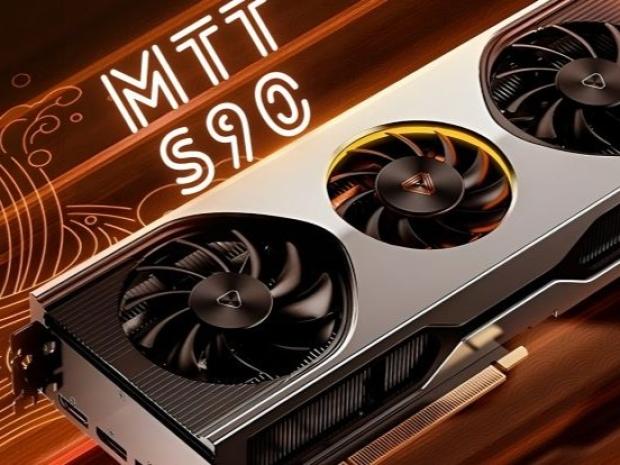
国产 GPU

Search documents
国产GPGPU四小龙将齐聚资本市场,光纤光缆边际向好
Shanxi Securities· 2025-12-23 10:30
Investment Rating - The report maintains an investment rating of "Leading the Market - A" for the communication industry [1]. Core Insights - The domestic GPGPU sector is expected to be a focal point in the capital market in 2026, with companies like Moer Thread and Muxi Co. recently entering the market, and Biran Technology and Tian Shu Zhixin passing the Hong Kong Stock Exchange hearing [5][17]. - The demand for data center optical fibers is anticipated to surge, with early signs of price increases in the market, as domestic and international manufacturers report a 15% price rise in common cable fibers [10][20]. - The report highlights the rapid development of supernode servers as a key beneficiary segment for domestic GPUs, suggesting investment opportunities in upstream components such as copper connections and network interface chips [9][19]. Summary by Sections Industry Dynamics - Moer Thread held its first developer conference, unveiling a new architecture and several products, including the "Huagang" architecture, which supports FP4 to FP64 precision calculations, with a 50% density increase and a 10-fold efficiency improvement [6][17]. - Muxi Co. achieved a market capitalization exceeding 280 billion after its debut on the Sci-Tech Innovation Board, positioning itself as a strong competitor in the domestic GPGPU market [7][18]. - Biran Technology has passed the Hong Kong Stock Exchange hearing, with its BR100 series achieving peak performance at the PFLOPS level, and it has secured sales agreements valued at 1.24 billion [8][19]. - Tian Shu Zhixin has a broad customer base across various sectors, with GPU shipments reaching 15,700 units in the first half of 2025 and revenues of 324 million [8][19]. Market Overview - The overall market saw a slight decline during the week of December 15-19, 2025, with the Shanghai Composite Index rising by 0.03% while the Shenzhen Component Index and the ChiNext Index fell by 0.89% and 2.26%, respectively [12][22]. - The top-performing sectors included liquid cooling, optical cables, and satellite communications, with weekly gains of 15.85%, 11.88%, and 10.73% [12][22]. Investment Recommendations - The report suggests focusing on companies in the following sectors: - Domestic supernodes: Unisplendour, ZTE, Inspur, Huaqin Technology, Huafeng Technology, Xinke Materials, Shengke Communication, and Heshun Petroleum [22]. - Commercial aerospace: Shanghai Hanxun, Xinke Mobile, Fenghuo Communication, Mengsheng Electronics, Haige Communication, and Qian Zhao Optoelectronics [22]. - Optical fibers and cables: Zhongtian Technology, Hengtong Optic-Electric, Changfei Fiber, Yongding Co., Taichen Optoelectronics, Shijia Photonics, and Changxin Bochuang [22].
摩尔线程上市首日市值破3000亿,投资人赚麻了
Sou Hu Cai Jing· 2025-12-05 07:18
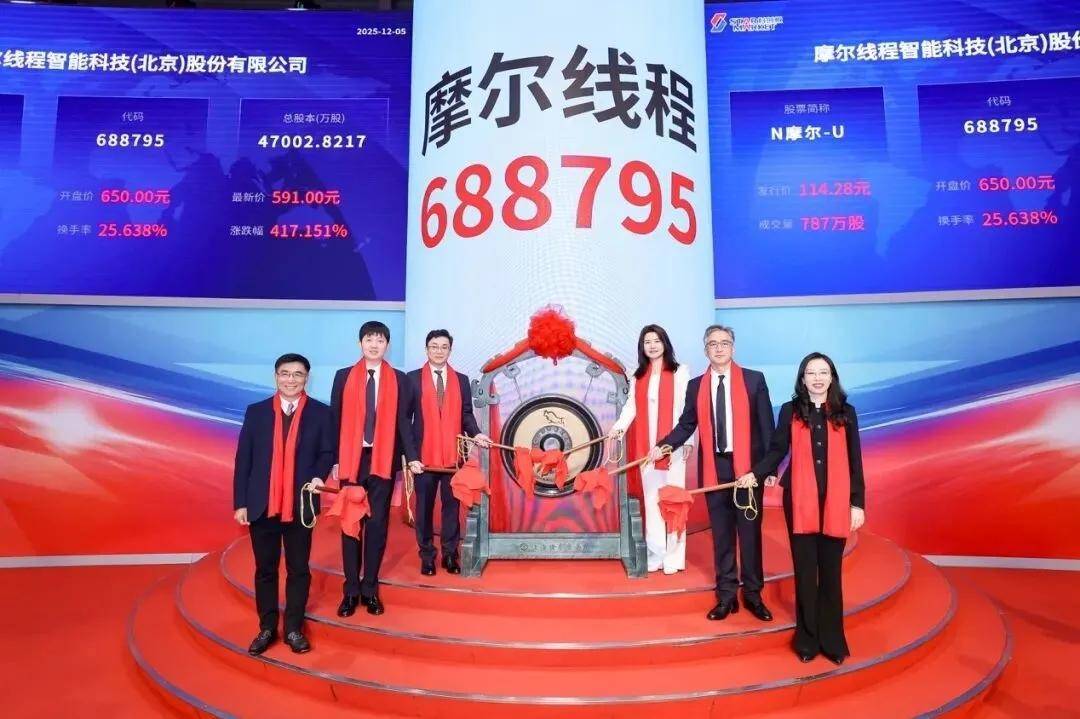
Core Viewpoint - The listing of Moore Threads on the STAR Market marks a significant milestone for China's semiconductor industry, positioning it as the first fully functional GPU company to enter the capital market, further solidifying the narrative of a "Chinese version of Nvidia" [1]. Group 1: Market Performance - On its debut, Moore Threads opened at 650 CNY per share, a 468.78% increase from the issuance price of 114.28 CNY, with an intraday high of 688 CNY, leading to a market capitalization exceeding 305.5 billion CNY [3]. - Early investors in Moore Threads, such as Peixian Qianyao Technology, saw returns as high as 6021 times their initial investment, highlighting the lucrative potential of the domestic GPU sector [3]. Group 2: Industry Context - Both Moore Threads and another GPU company, Muxi, achieved public listing within five years, breaking the typical 12-15 year timeline for tech companies [4]. - The year 2020 marked the beginning of domestic GPU development, with many talents from overseas chip giants returning to start businesses, including key figures from Nvidia and AMD [4]. Group 3: Technological Advancements - Moore Threads has invested over 4.3 billion CNY in R&D from 2022 to June 2025, with its MTT S5000 supporting trillion-parameter model training, matching the efficiency of international counterparts [5]. - Muxi's new C700 chip is expected to rival Nvidia's H100, with mass production anticipated in 2027 [5]. Group 4: Revenue Growth - Moore Threads' revenue is projected to grow from 0.46 million CNY in 2022 to 4.38 million CNY in 2024, reflecting a compound annual growth rate (CAGR) of 208.44% [5]. - Muxi's revenue is expected to surge from 42.64 thousand CNY to 743 million CNY over the same period, with a CAGR exceeding 4000% [5]. Group 5: Market Dynamics - The rise of domestic GPU companies is reshaping the global AI computing landscape, driven by significant demand for AI computing power and the exit of Nvidia from the Chinese market due to export controls [4][5]. - The STAR Market has created a favorable environment for hard-tech companies, with the anticipated explosion of AI computing demand in 2025 providing a critical funding window [4].

一篇文章告诉你:国产 GPU 背后的技术和商业路线异同
3 6 Ke· 2025-11-04 03:32
Core Insights - The narrative of domestic GPUs has shifted from media hype to financial scrutiny, indicating a new phase where companies must demonstrate financial viability and operational capabilities through IPOs [1] - Companies in the domestic GPU sector are now competing not just on technology but also on their ability to sustain operations and deliver products [1] Company Summaries Moer Technology - Moer Technology is positioned as a potential leader in the domestic GPU market, with its IPO approved by the China Securities Regulatory Commission, aiming to raise approximately 8 billion RMB for core projects [2] - The company is pursuing a "fully functional GPU" strategy, targeting various applications including AI training and general computing, with a founding team that includes members from NVIDIA [2][3] - Despite significant revenue growth projections, the company faces challenges with substantial net losses and a high-pressure business model focused on rapid expansion and ecosystem development [5] Muxi Co., Ltd. - Muxi Co., Ltd. aims to raise around 3.9 billion RMB for the development of high-performance GPUs and AI inference GPUs, with its IPO application recently approved [6][8] - The company is focused on creating a general-purpose GPU system that encompasses graphics rendering and AI applications, with existing orders amounting to several billion RMB [6] - Muxi's strategy emphasizes serving high-end computing scenarios rather than consumer graphics, which may position it well in the domestic market [8] Birun Technology - Birun Technology focuses on general-purpose GPUs and data center computing, with a clear strategy to target cloud training and inference rather than traditional desktop graphics [9] - The company has developed its first general-purpose GPU chip, BR100, utilizing innovative packaging technologies to enhance performance in AI training scenarios [9][10] - Birun has completed multiple rounds of financing, raising over 5 billion RMB, and is preparing for an A-share listing [10] Suiyuan Technology - Suiyuan Technology specializes in AI training acceleration cards, focusing solely on this segment without diversifying into consumer graphics [13] - The company has developed its second-generation training card, T20, optimized for large model training, and is working on a new inference acceleration card [13][14] - Suiyuan's business model emphasizes real workload testing and a self-developed software stack tailored to local AI engineering needs [14] Hanbo Semiconductor - Hanbo Semiconductor aims to establish a foothold in data center inference and specific AI acceleration scenarios before expanding to broader applications [16] - The company is developing a matrix of inference cards with a focus on low power consumption and compatibility across various industry frameworks [16] - Hanbo is in the process of initiating an A-share listing, positioning itself as a versatile player in the domestic GPU landscape [16] Glandfi - Glandfi takes a unique approach by focusing on building bridges between system software and GPU microstructures, rather than following conventional GPU narratives [17] - The company prioritizes foundational work in drivers and compatibility layers, aiming to create versatile computing units capable of running various applications [17] - Glandfi's strategy involves gradual development and real-world testing, with plans to transition into AI applications in the future [17] Industry Outlook - The upcoming wave of IPOs for domestic GPU companies signifies a critical juncture where these firms must prove their capabilities in real-world applications and financial sustainability [19]