
国家基本药物制度

Search documents
新版基药管理办法落地,产业加速向临床价值导向转型
2 1 Shi Ji Jing Ji Bao Dao· 2026-02-13 00:11
Core Viewpoint - The newly issued "National Essential Drug Directory Management Measures" aims to update and optimize the essential drug list in response to the evolving needs of the healthcare sector and to ensure the availability of essential medications for citizens [3][5][8]. Summary by Sections Regulatory Framework - The updated measures incorporate legal policy foundations, including the "Basic Medical and Health Promotion Law" and the "Drug Administration Law," to enhance the management of essential drugs [5]. - The essential drug directory has been established since 1982, with several updates, the last being in 2018, which included 685 drugs [4][5]. Directory Structure Optimization - The new measures categorize essential drugs into chemical drugs, biological products, and traditional Chinese medicine, aligning with clinical pharmacological classifications [6]. - The emphasis is on including high-quality drugs that represent clinical mainstream treatments, rather than just low-cost options, to support tiered medical services [6][10]. Dynamic Adjustment Mechanism - The adjustment cycle for the essential drug directory is set to be no longer than three years, with provisions for timely updates as necessary [6]. - The measures stress the importance of clinical value and safety for drugs to be included in the directory, which is crucial for long-term business development [6][9]. Monitoring and Evaluation - A comprehensive evaluation system will be established to monitor the use of essential drugs, focusing on safety, effectiveness, economic viability, and innovation [7]. - The evaluation results will serve as a core evidence basis for future adjustments to the directory [7]. Industry Impact - The new measures are expected to accelerate industry transformation, pushing companies towards a clinical value-oriented approach [8][9]. - The inclusion of innovative drugs, particularly those with significant clinical efficacy and reasonable pricing, will create market opportunities for domestic pharmaceutical companies [9][10]. - The essential drug directory will increasingly focus on selecting high-value clinical drugs, marking a shift from merely ensuring supply to prioritizing clinical effectiveness [10].

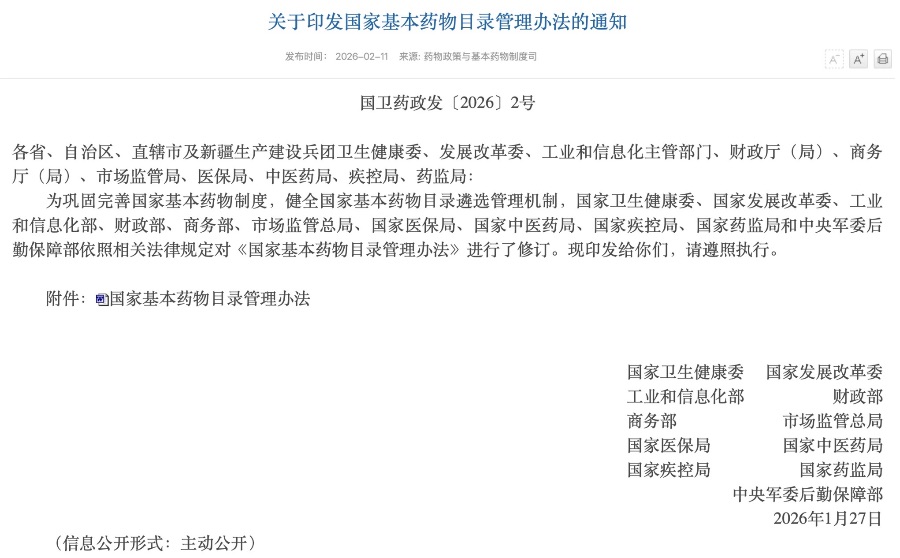
基药目录管理办法时隔11年首次修订
第一财经· 2026-02-12 03:21
Core Viewpoint - The newly revised "National Essential Medicines Directory Management Measures" emphasizes the importance of clinical value in the selection of essential medicines and establishes a rigid adjustment cycle of no more than three years for the essential medicines directory [3][5][6]. Group 1: Essential Medicines Directory - The essential medicines are defined as those that meet basic healthcare needs, are suitable for the current national conditions, are reasonably priced, and can be fairly accessed [5]. - The previous version of the essential medicines directory had not been updated since 2018, which included 685 varieties of medicines [5]. - The new management measures stress the importance of timely adjustments to the directory, with a principle of regular evaluation and dynamic management [5][6]. Group 2: Clinical Value and Selection Process - The revised management measures highlight the need to prioritize clinical value in the selection of essential medicines, with a focus on including more innovative drugs that meet clinical needs [6][7]. - The selection process for the essential medicines directory does not accept applications from companies; instead, it is determined by a coordination mechanism involving 11 departments [6][7]. Group 3: Coordination with Other Policies - The new management measures aim to improve coordination with other healthcare policies, including medical insurance and centralized procurement [8][11]. - The previous requirement for all grassroots medical institutions to use essential medicines has been removed to allow for more flexibility in drug selection [10]. - Future adjustments to the essential medicines directory will consider various factors, including public health needs, disease spectrum changes, and clinical evaluations [12].

新基药目录要来了?管理办法提出与集采等政策衔接
Yang Shi Wang· 2026-02-11 22:58
Core Viewpoint - The new "National Essential Medicines Directory Management Measures" aims to improve the management mechanism of essential medicines, aligning with policies on supply, tiered diagnosis and treatment, centralized procurement, and reimbursement [1][4]. Group 1: Key Revisions in the New Measures - The new measures propose six areas of revision, including enhancing the directory management mechanism and emphasizing the clinical value of medicines based on changes in disease spectrum, clinical application practices, and new drug approvals [1][4]. - The directory formulation process involves establishing an expert database, consulting experts for technical evaluations, and conducting comprehensive reviews to finalize the directory [3][6]. Group 2: Historical Context and Current Status - The current essential medicines directory, last updated in 2018, includes 685 varieties of medicines, with 417 chemical and biological products and 268 traditional Chinese medicines [4]. - The new measures signal a significant change in the essential medicines directory, although the updated list has not yet been published. The directory will undergo regular assessments and adjustments, ideally every three years [4][5]. Group 3: Industry Implications - Pharmaceutical companies are particularly interested in the criteria for updating the essential medicines list, especially regarding the integration of centralized procurement policies [5][6]. - The status of a medicine as part of the essential medicines directory can significantly impact its market access and the competitive landscape for pharmaceutical companies [5][6].
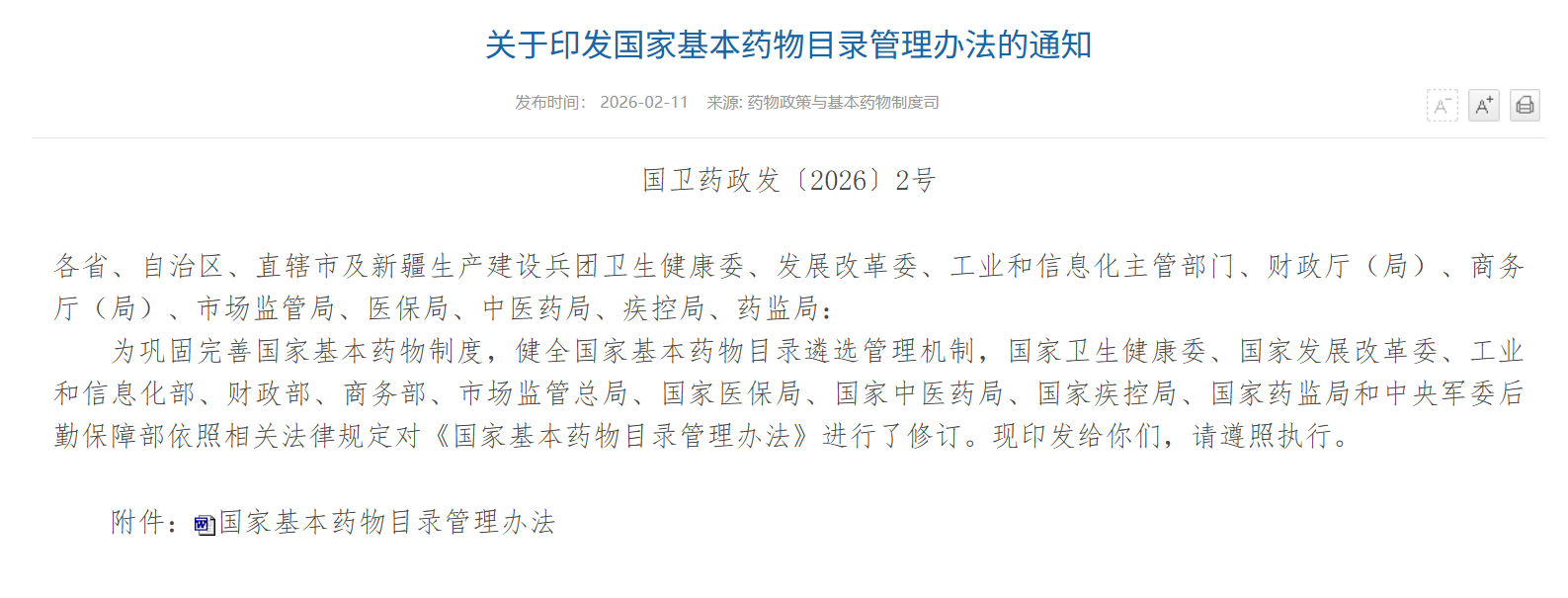
新版《国家基本药物目录管理办法》发布
Xin Lang Cai Jing· 2026-02-11 20:52
Core Viewpoint - The newly revised "National Basic Drug Directory Management Measures" aims to enhance the national basic drug system, ensuring the availability and accessibility of essential medications for public health needs, marking the first comprehensive update since 2015 [1] Group 1: Overview of the New Measures - The revision includes improvements in legal policy basis, directory structure optimization, management mechanism enhancement, emphasis on clinical value of drugs, standardization of dynamic adjustment mechanisms, and strengthening of monitoring and evaluation [1] - The core of the basic drug system is to select an appropriate number of essential drug varieties to meet the basic medication needs for disease prevention and treatment [1] Group 2: Selection and Adjustment of Basic Drugs - The dynamic adjustment of the basic drug directory will be based on clinical application practices, changes in drug standards, and the introduction of new drugs, adhering to principles such as prioritizing essential drugs and ensuring quality [2] - The basic drug directory will include chemical drugs, biological products, and traditional Chinese medicine, with special provisions for pediatric medications [2] Group 3: Focus on Pediatric Medications and Healthcare System Integration - The new measures incorporate pediatric medications into the basic drug management framework, addressing the specific needs of children [3] - Medical institutions are no longer required to stock all basic drugs, allowing for a more flexible approach in primary healthcare settings, which can now include some non-basic drugs to facilitate better integration with higher-tier hospitals [3] Group 4: Monitoring and Evaluation Framework - The National Health Commission will enhance the monitoring and clinical evaluation system focused on basic drugs, providing evidence and technical support for the dynamic optimization of the basic drug directory [4] - There will be a commitment to ensure that the selection process is transparent and that evaluation standards are scientific and evidence-based, allowing for timely inclusion of essential and cost-effective drugs [3][4]
新版国家基本药物目录管理办法公布
Xin Hua She· 2026-02-11 11:34
Core Viewpoint - The National Health Commission and other departments have revised the management measures for the National Essential Medicines List to enhance the selection and management mechanism of essential medicines in China [1][2] Group 1: Revision of Management Measures - The revised management measures include the addition of legal policy bases and a rational optimization of the list structure, categorizing essential medicines into chemical drugs, biological products, and traditional Chinese medicine [1] - The classification of chemical drugs and biological products is primarily based on clinical pharmacology, while traditional Chinese medicine is classified according to its functions [1] Group 2: Management Mechanism Improvement - The management mechanism for the essential medicines list is improved to align with policies on supply and use, hierarchical diagnosis and treatment, centralized procurement, and payment reimbursement [1] - The National Health Commission will identify the classification of renamed or differently named essential medicines according to established procedures [1] Group 3: Emphasis on Clinical Value - The revision emphasizes the clinical value of medicines, considering changes in disease spectrum, clinical application practices, changes in drug standards, and the introduction of new drugs [1] - The adjustments to the types and quantities of essential medicines will be made based on the needs of basic medical services, the level of medical insurance, and the assurance of drug supply [1] Group 4: Dynamic Adjustment Mechanism - A dynamic adjustment mechanism is established to strengthen the functional positioning of essential medicines, with a principle that the adjustment cycle should not exceed three years, and adjustments can be organized as necessary [2] - The country will enhance monitoring and evaluation, establishing a comprehensive evaluation system focused on essential medicines to support dynamic optimization of the list and management policies [2] Group 5: Importance of the Essential Medicines System - The essential medicines system is fundamental to the national drug supply guarantee system and is a key management arrangement for critical clinical drugs necessary for disease prevention and treatment [2] - This system is an important part of the health governance mechanism that collaborates with basic medical and insurance systems, reflecting international practices for ensuring residents' basic medication needs [2]
《国家基本药物目录管理办法》政策解读
Yang Shi Wang· 2026-02-11 11:01
Core Viewpoint - The National Health Commission and 11 other departments have jointly issued the "National Essential Drug Directory Management Measures" to enhance the management mechanism of the national essential drug directory, ensuring the basic medical and health service drug needs of citizens [1] Group 1: National Essential Drug System - The National Essential Drug System is a fundamental part of the national drug supply security system, focusing on key clinical drugs necessary for disease prevention and treatment [2] - The system is designed to work in conjunction with basic medical and health systems and basic medical insurance systems, ensuring residents' essential drug needs are met [2] - The establishment of this system has played a significant role in improving drug supply security, promoting the rational use of drugs, and ensuring equitable access to essential medications [2] Group 2: Development and Historical Evolution - The concept of essential drugs was first proposed by the WHO in 1975, with the first essential drug list published in 1977 [3] - As of 2025, there have been 24 updates to the adult version and 10 updates to the children's version of the essential drug list, with the current adult list containing 523 drugs and the children's list containing 374 drugs [3] - China first published its essential drug list in 1982 and has made several updates since, with the current version from 2018 listing 685 drug varieties [3] Group 3: Background and Basis for Revision - The original management measures were issued in 2009 and revised in 2015, playing a crucial role in the selection and management of essential drugs [4] - Recent legal frameworks, including the Basic Medical and Health Promotion Law and the revised Drug Administration Law, have established a legal basis for the selection and management of essential drugs [4] - The revision aims to further standardize the management mechanism of the national essential drug directory and support the implementation of the Healthy China strategy [4] Group 4: Main Content of the Revised Management Measures - The revised management measures include six main aspects, such as increasing legal policy basis and optimizing the directory structure [5][6] - The directory will categorize essential drugs into chemical drugs, biological products, and traditional Chinese medicine based on clinical pharmacology and functional classification [5][6] - A dynamic adjustment mechanism will be established to ensure regular evaluations and updates of the essential drug list, with a maximum adjustment cycle of three years [6] Group 5: Selection and Adjustment Procedures - The management measures outline a clear procedure for the formulation of the essential drug directory, including the establishment of an expert database and a multi-step evaluation process [7] - Experts will conduct technical evaluations based on clinical needs and evidence-based medicine to propose a selection list, which will undergo further review and approval [7] Group 6: Monitoring and Evaluation System - A two-tiered drug use monitoring and clinical evaluation system has been established, covering all public hospitals and over 99% of government-run grassroots medical institutions [8] - The evaluation process includes multiple dimensions such as safety, effectiveness, and accessibility, providing technical support for drug selection and policy formulation [8] - Future efforts will focus on enhancing the application of monitoring and evaluation results to optimize the essential drug directory and improve management policies [8]