国家基本药物

Search documents
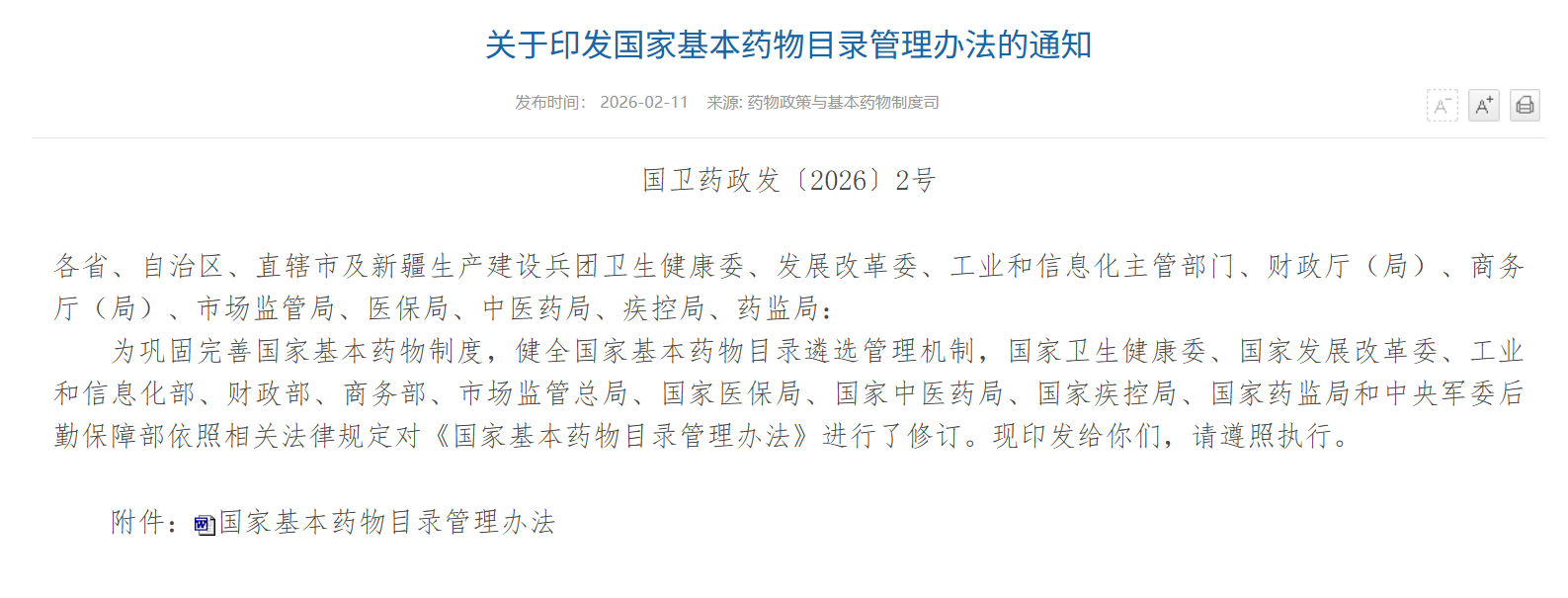
基药目录管理办法时隔11年首次修订
第一财经· 2026-02-12 03:21
Core Viewpoint - The newly revised "National Essential Medicines Directory Management Measures" emphasizes the importance of clinical value in the selection of essential medicines and establishes a rigid adjustment cycle of no more than three years for the essential medicines directory [3][5][6]. Group 1: Essential Medicines Directory - The essential medicines are defined as those that meet basic healthcare needs, are suitable for the current national conditions, are reasonably priced, and can be fairly accessed [5]. - The previous version of the essential medicines directory had not been updated since 2018, which included 685 varieties of medicines [5]. - The new management measures stress the importance of timely adjustments to the directory, with a principle of regular evaluation and dynamic management [5][6]. Group 2: Clinical Value and Selection Process - The revised management measures highlight the need to prioritize clinical value in the selection of essential medicines, with a focus on including more innovative drugs that meet clinical needs [6][7]. - The selection process for the essential medicines directory does not accept applications from companies; instead, it is determined by a coordination mechanism involving 11 departments [6][7]. Group 3: Coordination with Other Policies - The new management measures aim to improve coordination with other healthcare policies, including medical insurance and centralized procurement [8][11]. - The previous requirement for all grassroots medical institutions to use essential medicines has been removed to allow for more flexibility in drug selection [10]. - Future adjustments to the essential medicines directory will consider various factors, including public health needs, disease spectrum changes, and clinical evaluations [12].


基药目录管理办法时隔11年首次修订,突出药品临床价值
Di Yi Cai Jing· 2026-02-12 03:02
Core Viewpoint - The new management measures for the National Essential Medicines List emphasize the selection of drugs based on their clinical value and establish a rigid adjustment cycle of no more than three years for the list [1][2][3] Group 1: Essential Medicines List Management - The revised management measures state that the essential medicines should meet basic medical needs, be suitable for current national conditions, and ensure supply and affordability [2] - The previous version of the management measures had not been updated since 2018, with the current list containing 685 drug varieties [2] - The new measures highlight the importance of timely adjustments to the essential medicines list, with a focus on dynamic management and regular evaluations [2][3] Group 2: Clinical Value and Drug Selection - The new management measures stress the importance of clinical value in drug selection, aiming to include more innovative drugs that meet clinical needs [3][5] - The selection process for the essential medicines list does not accept applications from companies; instead, it is determined by a coordination mechanism involving 11 departments [3][5] Group 3: Coordination with Other Policies - The revised measures aim to improve coordination with other healthcare policies, including medical insurance and centralized procurement [6][8] - The management measures have removed the requirement for all grassroots medical institutions to exclusively use essential medicines, allowing for more flexibility in drug selection [7] - Future adjustments to the essential medicines list will consider various factors, including public health needs, disease spectrum changes, and drug safety monitoring [9]
国家新版基药目录调整在即,11部门联合发文强化政策衔接
Huan Qiu Wang· 2026-02-12 02:08
Core Viewpoint - The release of the "National Essential Medicines Directory Management Measures" signals an important adjustment to the national essential medicines list, which has not been updated for eight years, indicating a shift in the drug supply assurance system in China [1][3][5] Group 1: Key Aspects of the New Measures - The new measures improve the directory management mechanism, linking essential medicines supply with tiered diagnosis and treatment, centralized procurement, and reimbursement policies [3] - The selection of drugs will focus on clinical value and will be dynamically adjusted based on changes in disease spectrum, clinical application practices, drug standards, and newly approved drugs [3] - The directory will include only drugs approved by the National Medical Products Administration and those produced according to national standards, with specific exclusions for certain types of drugs [3][4] Group 2: Implications for the Pharmaceutical Industry - The current essential medicines directory, last updated in 2018, includes 685 varieties, and the new measures suggest that many newly approved drugs may soon be included, enhancing market opportunities for innovative drug companies [4][5] - The adjustment of the essential medicines list is expected to emphasize economic evaluations and cost-effectiveness, prompting pharmaceutical companies to adjust their R&D and pricing strategies [5] - The ability of generic drug companies to enter the essential medicines directory through centralized procurement will be crucial for maintaining market share, indicating a significant shift in market competition dynamics [5]
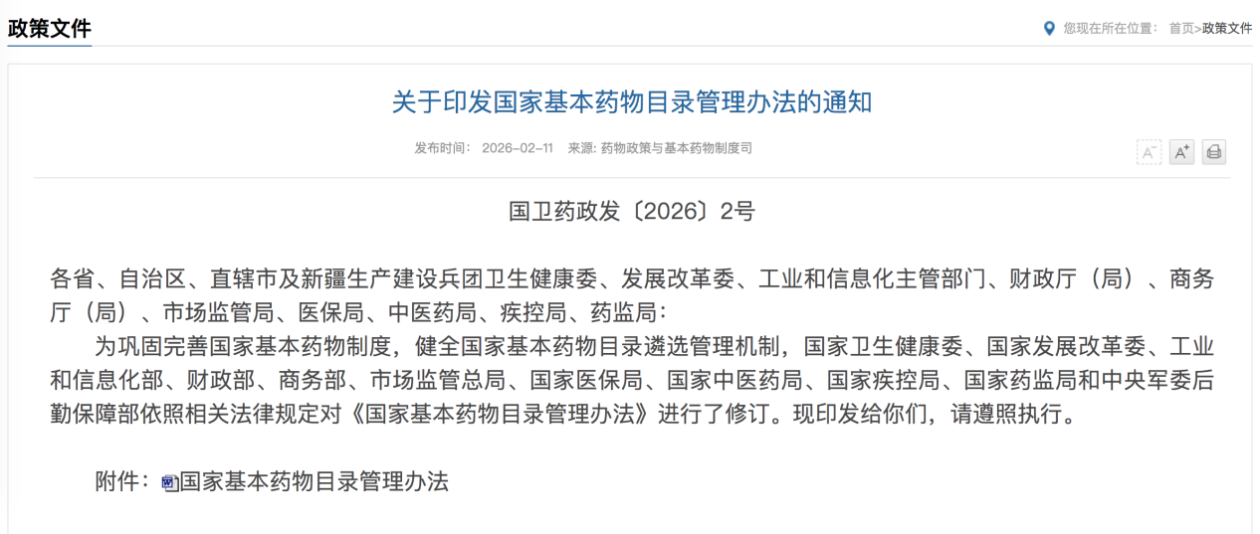
新基药目录要来了?管理办法提出与集采等政策衔接
Yang Shi Wang· 2026-02-11 22:58
Core Viewpoint - The new "National Essential Medicines Directory Management Measures" aims to improve the management mechanism of essential medicines, aligning with policies on supply, tiered diagnosis and treatment, centralized procurement, and reimbursement [1][4]. Group 1: Key Revisions in the New Measures - The new measures propose six areas of revision, including enhancing the directory management mechanism and emphasizing the clinical value of medicines based on changes in disease spectrum, clinical application practices, and new drug approvals [1][4]. - The directory formulation process involves establishing an expert database, consulting experts for technical evaluations, and conducting comprehensive reviews to finalize the directory [3][6]. Group 2: Historical Context and Current Status - The current essential medicines directory, last updated in 2018, includes 685 varieties of medicines, with 417 chemical and biological products and 268 traditional Chinese medicines [4]. - The new measures signal a significant change in the essential medicines directory, although the updated list has not yet been published. The directory will undergo regular assessments and adjustments, ideally every three years [4][5]. Group 3: Industry Implications - Pharmaceutical companies are particularly interested in the criteria for updating the essential medicines list, especially regarding the integration of centralized procurement policies [5][6]. - The status of a medicine as part of the essential medicines directory can significantly impact its market access and the competitive landscape for pharmaceutical companies [5][6].