国家资本投资

Search documents
半年出手5次,美国国资到底投了啥?
Hu Xiu· 2025-10-21 23:15
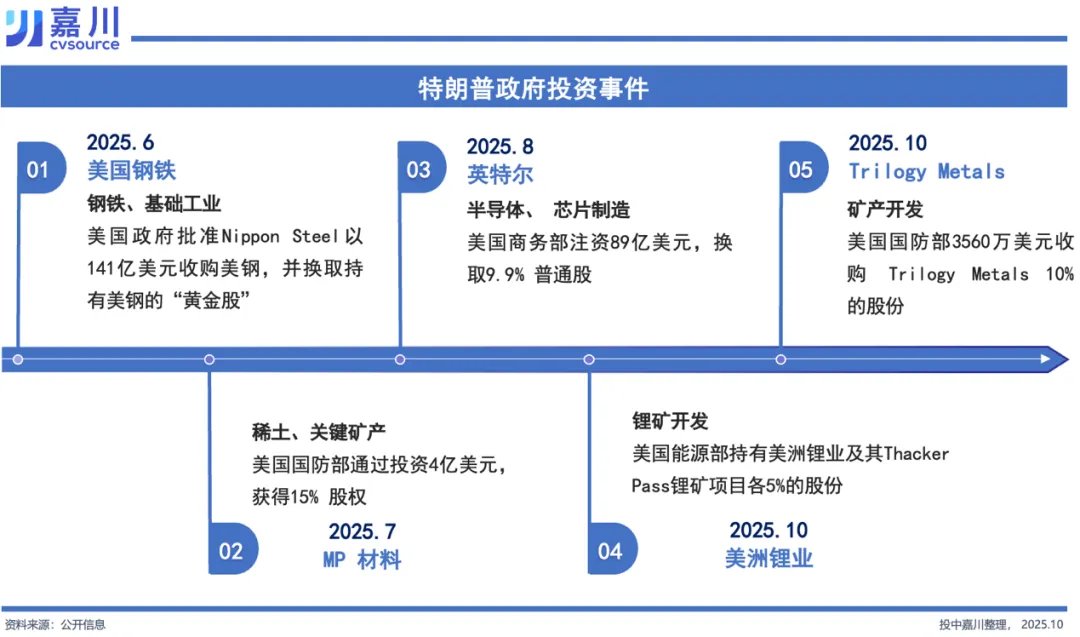
Core Viewpoint - The U.S. government, under Trump's administration, has shifted its approach to industrial policy by directly acquiring equity stakes in private companies, particularly in critical sectors like semiconductors, rare earths, and steel, as a strategic response to geopolitical challenges [2][4][17]. Group 1: Government Investments - Since January, the Trump administration has made five significant investments in key manufacturing sectors, marking a transition from traditional subsidies to direct equity stakes [4][13]. - The first transaction occurred in June, where the U.S. government approved Nippon Steel's $14.1 billion acquisition of U.S. Steel, gaining "golden shares" that provide control over critical decisions [8]. - In July, the government invested $400 million in MP Materials, acquiring 15% of the company, which is the only U.S. firm capable of rare earth mining and processing [9][14]. - In August, the government invested $8.9 billion in Intel for a 9.9% stake, aiming to bolster domestic chip production [10][11]. - In October, the government acquired 5% stakes in Lithium Americas and Trilogy Metals, focusing on lithium mining to support the electric vehicle industry [12][13]. Group 2: Funding Sources - The funding for these investments primarily comes from previously approved budgets, such as the $400 billion Inflation Reduction Act, which allocated $53 billion for semiconductor support [14][16]. - The Department of Commerce, Department of Energy, and Department of Defense have emerged as the main federal agencies facilitating these equity investments [16]. - The funds utilized are not new but rather reallocated from existing congressional appropriations, indicating a strategic shift in how government support is structured [16]. Group 3: Strategic Implications - The investments reflect a broader strategy to reduce reliance on foreign supply chains, particularly from China, by securing domestic production capabilities in critical materials and technologies [17][20]. - The U.S. aims to establish a complete supply chain for rare earths and lithium, which are essential for defense and clean energy technologies, thereby enhancing national security [18][19]. - The investment in Intel is particularly significant as it seeks to ensure that the U.S. retains control over advanced semiconductor manufacturing, which is currently heavily reliant on foreign production [19].