土地托管

Search documents
黑龙江绥棱:土地“入托” “钱景”广阔
Xin Hua She· 2025-12-23 13:22
Core Viewpoint - The article highlights the successful implementation of land trusteeship in Heilongjiang Province's Suiling County, which has significantly improved agricultural efficiency and farmer income through the consolidation of small plots into larger, more manageable units [1][2][3]. Group 1: Land Trusteeship Implementation - In 2024, the village of Shuanghe will promote a land trusteeship model covering 3,800 acres, allowing for more efficient farming practices [1]. - The average annual yield per hectare has increased by 2,000 to 3,000 jin, resulting in an additional profit of over 1,600 yuan based on current grain prices [1]. - The total area under trusteeship in the village has reached 15,412 acres, with a per-hectare dividend of 18,000 yuan, an increase of 3,000 yuan from the previous year [2]. Group 2: Economic Benefits and Efficiency - The consolidation of land has led to reduced costs for seeds, fertilizers, and pesticides by approximately 300 to 400 yuan per hectare compared to individual farming [2]. - Unified sales of grain post-harvest have allowed farmers to sell corn at prices 0.05 to 0.1 yuan higher than market rates [2]. - The village's collective income has exceeded 3 million yuan, with per capita annual income surpassing 30,000 yuan, and fixed assets exceeding 58 million yuan [3]. Group 3: Technological Advancements - The introduction of large machinery with automated driving systems has improved operational efficiency, with a precision error of less than 2 centimeters during spring plowing [3]. - The cooperative model has enabled access to technical support from research institutions and universities, enhancing agricultural practices [2][3]. Group 4: Policy Support and Future Plans - The 20th Central Committee's Fourth Plenary Session emphasizes the need for moderate-scale agricultural operations and improved agricultural service systems, aligning with Suiling County's initiatives [3][4]. - By 2025, the area under land trusteeship in Suiling County is projected to reach 1.431 million acres, accounting for over 68% of total arable land, with a goal of increasing grain production by 8.56 million jin [3][4].
【省农业农村厅】土地托管 农民省心又增收
Shan Xi Ri Bao· 2025-07-27 23:40
Core Insights - The article highlights the successful implementation of land trusteeship in Shaanxi, which has led to increased income for farmers, efficient agricultural practices, and rural development [3][7]. Group 1: Land Trusteeship Model - Shaanxi has actively explored the land trusteeship model, consolidating fragmented farmland into larger units managed by professional service organizations, addressing labor shortages and land fragmentation [3][4]. - In Wangyi District, a total of 288 households received 580,000 yuan in dividends, showcasing the financial benefits of this model [2][3]. Group 2: Economic Benefits - Farmers in Yixing Village benefit from a guaranteed minimum dividend of 350 yuan per mu, ensuring income stability regardless of crop yield fluctuations [4]. - The cost of agricultural inputs has decreased by 20% due to centralized procurement, while the average yield per mu has increased, demonstrating the economic advantages of the trusteeship model [4][6]. Group 3: Agricultural Efficiency - The implementation of the trusteeship model has led to a reduction in input usage, with average seed and fertilizer usage decreasing significantly, resulting in lower operational costs [6]. - In Gaotai Village, the average wheat yield increased from 4,000 kg to over 4,800 kg per mu after adopting the trusteeship model, highlighting improved agricultural efficiency [5][6]. Group 4: Rural Revitalization - The article discusses the broader impact of agricultural socialization services in promoting rural revitalization, with over 37,000 agricultural service organizations established in Shaanxi, serving 2.64 million households [7]. - The innovative agricultural service systems developed in response to local challenges have significantly improved crop yields and reduced labor burdens for farmers [7].
“叫我‘麦贩子’的乡亲少了”(三夏进行时)
Ren Min Ri Bao· 2025-06-22 22:10
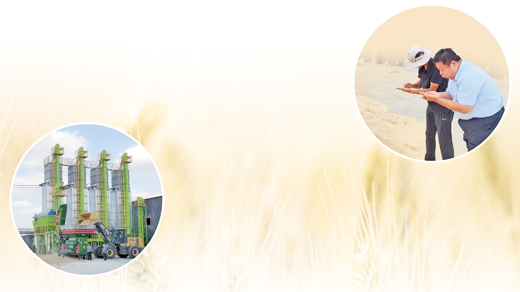
Core Viewpoint - The article highlights the successful agricultural practices and cooperative model implemented by Zhao Peiguo, which has led to increased wheat yields and better pricing for local farmers in Shandong Province [2][3][4]. Group 1: Agricultural Practices - Zhao Peiguo's cooperative provides comprehensive services including planting, irrigation, fertilization, and harvesting, which contribute to higher grain yields [6]. - The cooperative has promoted the cultivation of high-quality wheat varieties, with 12 new varieties developed and 3 million acres of quality wheat planted [4]. - Farmers are encouraged to follow scientific methods for soil testing and fertilization, leading to improved crop quality and yields [6][11]. Group 2: Pricing and Contracts - Zhao Peiguo offers contracts that guarantee higher prices for wheat compared to market rates, ensuring farmers receive fair compensation [3][10]. - The cooperative's pricing strategy is based on quality indicators such as protein content, with prices potentially exceeding market rates by 0.1 yuan per pound [5][10]. - The cooperative has built trust with farmers by consistently honoring contracts, even during market downturns, which has led to increased participation in the cooperative model [9][10]. Group 3: Technological Advancements - The cooperative has invested in new drying technology, which reduces grain loss during the drying process to below 0.1%, enhancing efficiency and quality [13][15]. - The new intelligent drying equipment, subsidized by the government, helps farmers save time and reduce labor costs associated with traditional drying methods [13][14]. - The cooperative emphasizes the importance of modern storage techniques to ensure grain safety and quality, utilizing advanced methods to prevent spoilage [15]. Group 4: Community Engagement - Zhao Peiguo has transformed his image from a "grain dealer" to a trusted community member by actively engaging with farmers and providing them with agricultural knowledge [11][12]. - The cooperative conducts training sessions for farmers, helping them understand new agricultural policies and best practices [16]. - The cooperative's success has led to a shift in local perceptions, with more farmers willing to collaborate and trust the cooperative's services [11][12].