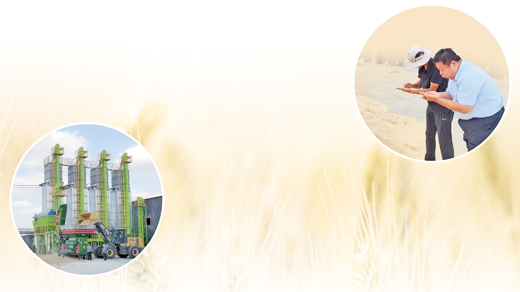
优质专用小麦

Search documents
我国粮食总产量连续两年超1.4万亿斤,折射大国农业韧性强
Ren Min Ri Bao· 2026-02-26 01:40
Core Viewpoint - China's grain production has reached a stable new level for two consecutive years, with a total output of 14.2975 trillion jin (approximately 9.5 billion tons) by 2025, reflecting the resilience of the country's agriculture [1][2]. Group 1: Grain Production Growth - China's grain production increased from 13.657 trillion jin in 2021 to 14.2975 trillion jin in 2025, with over 20% of the world's grain produced in China [1][2]. - Per capita grain availability rose from 483 kg in 2021 to over 500 kg currently, indicating improved food security for the population [1]. Group 2: Policy and Technological Support - The central government's policies prioritize national food security, with continuous financial support directed towards disaster prevention and production stability [3]. - A robust disaster response mechanism has shifted grain production from being heavily reliant on weather to a more controlled and technology-driven approach [3]. Group 3: Technological Advancements - Innovations in agricultural technology, such as the use of four-legged robots and intelligent breeding robots, have significantly contributed to increased productivity [4]. - By 2025, the contribution rate of agricultural technology progress is expected to exceed 64%, enhancing the efficiency of grain production [4]. Group 4: Future Potential - Grain yield per mu (approximately 0.067 hectares) is projected to increase by 4.4 kg year-on-year, with single yield improvements contributing over 90% to the growth in grain production [5]. - The integration of high-quality farmland, improved seed varieties, and effective farming practices is expected to further strengthen the foundation of grain production [5].
站在更高起点挺起中部脊梁
Jing Ji Ri Bao· 2025-12-12 22:59
Group 1 - The central region's rise is crucial for national stability and development, showcasing significant progress in various industries such as optoelectronics, engineering machinery, and agriculture [1][2] - The central region is positioned as a strategic support point, linking eastern and western regions, and enhancing the efficiency of the national unified market [2] - The region faces challenges including insufficient innovation capabilities, a lack of integration within the industrial system, and the need for improved regional collaboration [2] Group 2 - The focus is on establishing a nationally influential technology innovation hub, enhancing regional innovation centers, and promoting high-quality industrial clusters in sectors like optoelectronics and new energy vehicles [3] - Key reforms are needed to optimize the business environment and promote rural revitalization, particularly in food security and agricultural technology [3] - Enhancing the hub function and openness of the central region is essential for it to become a vital node in the national unified market, with plans for comprehensive transportation networks and international logistics [4]
“叫我‘麦贩子’的乡亲少了”(三夏进行时)
Ren Min Ri Bao· 2025-06-22 22:10
Core Viewpoint - The article highlights the successful agricultural practices and cooperative model implemented by Zhao Peiguo, which has led to increased wheat yields and better pricing for local farmers in Shandong Province [2][3][4]. Group 1: Agricultural Practices - Zhao Peiguo's cooperative provides comprehensive services including planting, irrigation, fertilization, and harvesting, which contribute to higher grain yields [6]. - The cooperative has promoted the cultivation of high-quality wheat varieties, with 12 new varieties developed and 3 million acres of quality wheat planted [4]. - Farmers are encouraged to follow scientific methods for soil testing and fertilization, leading to improved crop quality and yields [6][11]. Group 2: Pricing and Contracts - Zhao Peiguo offers contracts that guarantee higher prices for wheat compared to market rates, ensuring farmers receive fair compensation [3][10]. - The cooperative's pricing strategy is based on quality indicators such as protein content, with prices potentially exceeding market rates by 0.1 yuan per pound [5][10]. - The cooperative has built trust with farmers by consistently honoring contracts, even during market downturns, which has led to increased participation in the cooperative model [9][10]. Group 3: Technological Advancements - The cooperative has invested in new drying technology, which reduces grain loss during the drying process to below 0.1%, enhancing efficiency and quality [13][15]. - The new intelligent drying equipment, subsidized by the government, helps farmers save time and reduce labor costs associated with traditional drying methods [13][14]. - The cooperative emphasizes the importance of modern storage techniques to ensure grain safety and quality, utilizing advanced methods to prevent spoilage [15]. Group 4: Community Engagement - Zhao Peiguo has transformed his image from a "grain dealer" to a trusted community member by actively engaging with farmers and providing them with agricultural knowledge [11][12]. - The cooperative conducts training sessions for farmers, helping them understand new agricultural policies and best practices [16]. - The cooperative's success has led to a shift in local perceptions, with more farmers willing to collaborate and trust the cooperative's services [11][12].