地缘政治事件对市场的影响

Search documents
全球股市经历恐慌3月
第一财经· 2026-03-21 01:12
Core Viewpoint - The capital markets are experiencing significant turbulence due to the ongoing Middle East conflict, with global stock markets declining for three consecutive weeks, marking the worst performance in nearly a year. Energy prices are surging, raising inflation concerns, and traditional safe-haven assets like U.S. Treasuries are being sold off, leading to a substantial rise in yields. Even gold has not provided a safe haven, with prices dropping below $4,500 [3]. Group 1 - Historical data suggests that markets often bottom out approximately three weeks after a crisis begins, with the S&P 500 index typically reaching its lowest point around this timeframe. The median maximum drawdown from previous geopolitical events is about -6%, while the average is around -8% [5]. - A research firm indicates that market sentiment is likely to shift soon, with the current turmoil potentially peaking in the coming days. The simultaneous decline of gold and stocks suggests forced liquidations are occurring, and the market is transitioning from expecting rate cuts to pricing in the possibility of rate hikes [7]. - The recent bombings of oil and gas facilities in the Middle East and significant reductions in Qatar's natural gas production indicate that worst-case scenarios are materializing, which may signal a peak in market uncertainty [7]. Group 2 - Future oil price movements are crucial for stabilizing risk assets. Analysts from Bank of America suggest that the market is nearing a capitulation point, with a significant buy signal occurring when 88% of global indices fall below their 50-day and 200-day moving averages [9]. - The S&P 500 index has reached this level, but a further decline of 3% to 5% is needed to trigger a major buying opportunity. Additionally, a cash allocation in investor portfolios reaching 5% could signal another buying opportunity [10]. - The surge in oil prices, driven by the U.S.-Iran conflict and attacks on Middle Eastern energy facilities, has led to significant market losses, with Brent crude futures up two-thirds year-to-date [10]. Group 3 - The recent market correction began last October when the Federal Reserve started cutting rates while the stock market was at a high. Analysts note that significant corrections often end when the leading sectors become oversold, which is currently happening in sectors like Bitcoin and software [11]. - Future investment themes include a bull market in commodities shifting from gold to metals and energy, a preference for international stocks and mid-cap U.S. stocks over highly leveraged large-cap stocks, and a focus on consumer stocks that may benefit from policies aimed at low-income voters [11].


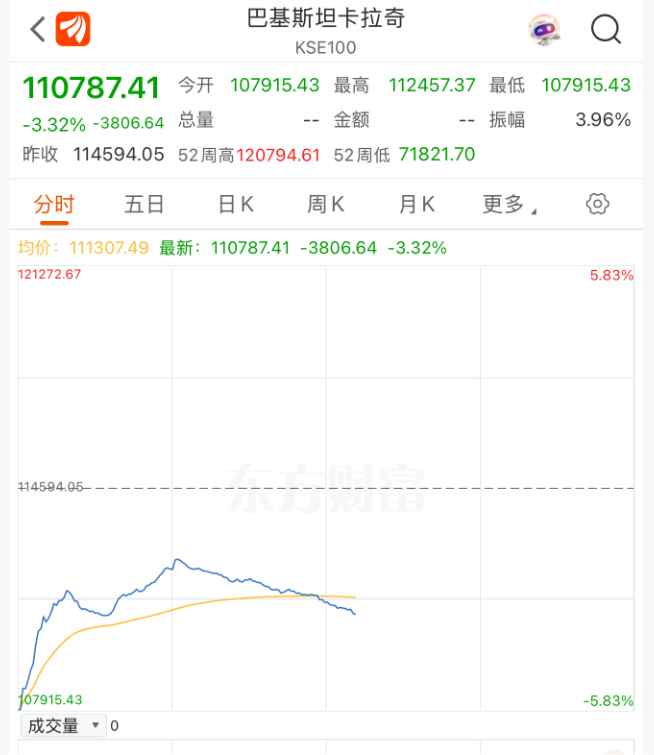
巴基斯坦股市一度暴跌
Zhong Guo Ji Jin Bao· 2025-05-07 08:13
Core Viewpoint - The recent military conflict between India and Pakistan has led to significant market reactions, particularly in Pakistan's stock market, which experienced a drop of over 5%, marking its lowest level since December 4 of the previous year [2]. Group 1: Market Reactions - Pakistan's stock market fell over 5% due to military strikes by India on nine locations within Pakistan, resulting in 26 deaths and 46 injuries [2]. - Following the initial drop, Pakistan's stock market recovered most of its losses, indicating some resilience [2]. - In contrast, Indian assets remained stable despite the conflict, with historical trends suggesting that Indian markets often recover quickly from geopolitical tensions [4][6]. Group 2: Economic Context - Pakistan is currently facing its worst monthly performance in two years for its stocks and dollar bonds, as the country grapples with an economic crisis and relies on a $7 billion International Monetary Fund loan program [6]. - The recent military actions have raised concerns about foreign investment in India, especially as the country had just announced a free trade agreement with the UK [7]. Group 3: Sector Performance - The A-share military industry sector surged in response to the India-Pakistan conflict, with several stocks hitting the daily limit up [7]. - Specific stocks such as Chengxi Aviation and Aerospace Changfeng saw significant increases, with gains of 19.96% and 17.05% respectively [8].