垂直SaaS

Search documents
1万亿美元蒸发背后:垂直软件的护城河,正在被大模型重写
Hua Er Jie Jian Wen· 2026-02-18 06:41
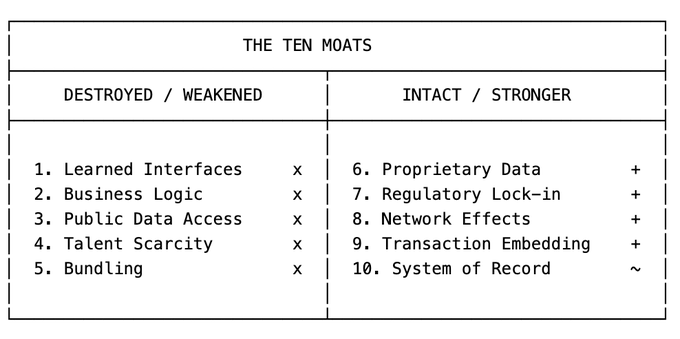
Core Insights - The article discusses how large language models (LLMs) are systematically dismantling the competitive advantages of vertical SaaS companies, leading to a significant market reevaluation of their value [1][11][40] - It highlights the drastic changes in the software landscape, where traditional barriers to entry are being lowered, resulting in increased competition and reduced pricing power for established players [41][44] Group 1: Disruption of Traditional Moats - "Usability" is no longer a competitive advantage as LLMs simplify complex software interfaces into conversational formats, eliminating the need for extensive training [1][14] - Business logic that once required years of coding can now be encapsulated in simple Markdown documents, drastically reducing the time for competitors to replicate workflows [2][20] - Companies relying on organizing public data for profit are at risk as LLMs can inherently understand and process these documents, commoditizing their business model [3][25] Group 2: Talent and Development Changes - The scarcity of talent that once posed a barrier to entry is diminished as domain experts can now directly translate their knowledge into software without needing programming skills [4][26] - The development process has shifted from requiring specialized engineers to being accessible to anyone with domain expertise, allowing for rapid iteration and deployment of software solutions [20][22] Group 3: Market Dynamics and Competition - The competitive landscape is shifting from a few dominant players to a fragmented market with hundreds of new entrants, leading to a collapse in pricing structures [7][41] - The threat of "pincer movement" from both AI-native startups and established horizontal platforms entering vertical markets is intensifying competition [45][49] Group 4: Value of Proprietary Data - Companies with exclusive, non-replicable data will see their value increase, as LLMs enhance the utility of such data rather than diminish it [5][32] - Proprietary data becomes a critical asset in the AI era, providing companies with significant pricing power and competitive advantage [5][32] Group 5: Regulatory and Compliance Barriers - Certain regulatory and compliance requirements create structural barriers that LLMs cannot easily penetrate, ensuring the stability of companies operating in heavily regulated industries [6][35] - Companies embedded in transaction processes are less vulnerable to disruption from LLMs, as their operational frameworks are essential for revenue generation [37][39] Group 6: Long-term Implications - The overall result of these changes is a significant reduction in barriers to entry, allowing new competitors to emerge rapidly and challenge established firms [40][41] - The market is beginning to differentiate between companies with genuine competitive advantages and those that are vulnerable to LLM-driven commoditization [56]


1万亿美元蒸发背后:垂直软件的护城河,正在被大模型重写
硬AI· 2026-02-18 06:41
Core Insights - The article discusses how large language models (LLMs) are systematically dismantling the traditional moats that vertical SaaS companies relied on for survival, leading to a harsh market revaluation of software stocks [1][12][52]. Group 1: Disruption of Traditional Moats - "Usability" is no longer a moat, as LLMs simplify complex software interfaces into conversational formats, eliminating the steep learning curves associated with traditional platforms like Bloomberg [2][3]. - Business logic that once required extensive coding can now be encapsulated in simple Markdown files, drastically reducing the time needed to replicate workflows from years to weeks [4][26]. - Companies that relied on organizing public data for profit are at risk, as LLMs can inherently understand and process these documents, diminishing the value of information asymmetry [5][30]. Group 2: Value of Proprietary Data - Companies holding exclusive, non-replicable data (e.g., Bloomberg's real-time trading data) will see their value increase, as LLMs will enhance the demand for such unique data [6][40]. - Regulatory compliance and transaction embedding remain strong moats, as LLMs cannot bypass regulatory requirements or replace the need for established financial infrastructures [7][47]. Group 3: Changing Competitive Landscape - The competitive landscape is shifting from a few dominant players to a multitude of competitors, as the barriers to entry have lowered significantly due to LLMs [8][9]. - The threat of "pincer movement" is emerging, with numerous AI-native startups entering vertical markets while horizontal platforms like Microsoft are also encroaching into these spaces [10][60]. Group 4: Long-term Implications - The article emphasizes that the market's valuation adjustments are not due to immediate revenue loss but rather a reassessment of the pricing power and moats that previously justified high valuations [56][58]. - The transition is expected to be gradual, with existing contracts and customer relationships providing some buffer against immediate impacts [56][57].

被市场错杀的“赚钱机器”?机构集体唱多ServiceTitan(TTAN.US),大摩看涨46%
智通财经网· 2026-01-21 08:33
Core Viewpoint - Morgan Stanley analyst Josh Bell upgraded the stock rating of software company ServiceTitan (TTAN.US) from "Hold" to "Overweight," raising the target price from $125 to $131, indicating a 46% upside potential from the current price of $89.59. The stock has seen a decline of over 10% in the past week. The new products launched by ServiceTitan, particularly the Pro product line and the MAX program, are expected to open up broader growth prospects for the company [1][3]. Company Overview - ServiceTitan is a leading vertical SaaS company focused on providing comprehensive digital management solutions for traditional blue-collar industries such as plumbing, electrical work, HVAC, and roofing. The company addresses inefficiencies in the home services industry by offering a fully integrated system that streamlines processes from customer order to on-site service and mobile payment [1][2]. Industry Positioning - ServiceTitan has transcended its initial tool-based identity and is widely regarded as the "operating system for the blue-collar industry." Its platform integrates core functions such as marketing, sales strategy, personnel scheduling, financial auditing, inventory management, and employee training, providing customized support in vertical markets [2]. Growth Potential - The company has demonstrated strong revenue growth of 26.49% and maintains a solid current ratio of 4.14, indicating robust short-term liquidity. Despite not being profitable in the past 12 months, with a diluted EPS of -$3.51, Morgan Stanley views ServiceTitan as an undervalued growth stock with significant potential for profit margin expansion [3][4]. Product Strategy - The recently launched MAX program represents a strategic upgrade from a "point tool" to a "full suite" product offering. This program integrates key professional features across various domains, providing high-touch implementation support and change management services to accelerate the adoption of AI technologies among clients [4][5]. Market Sentiment - Despite a general downturn in SaaS stocks, ServiceTitan is positioned to capture significant market share due to its extensive proprietary data set in the blue-collar industry. The company is systematically integrating AI into its workflows, establishing a strong competitive moat [5][6]. Analyst Ratings - ServiceTitan has garnered attention from multiple analysts, with Freedom Capital Markets reaffirming a "Buy" rating and setting a target price of $155, while TD Cowen raised its target price from $150 to $160, citing strong subscription revenue and total transaction volume. Goldman Sachs initiated coverage with a neutral rating and a target price of $117, recognizing the company's potential in a digitally underserved market [6][7].
喝点VC|a16z合伙人:语音交互将成为AI应用公司最强大的突破口之一,巨头们在B2C市场已落后太多
Z Potentials· 2025-04-01 03:49
Core Insights - The article discusses the evolution and potential of AI voice products, highlighting the shift from traditional voice assistants like Siri and Alexa to more advanced AI-driven interactions that can provide a more human-like experience [3][4][5]. Group 1: Historical Context and Breakthroughs - AI voice products have historically been limited in functionality and user engagement, often feeling robotic and lacking true intelligence [3][4]. - Recent advancements in large language models and speech technologies have enabled more natural and engaging voice interactions, making voice a powerful interface for AI applications [4][7][12]. - The report from a16z suggests that voice interaction will become a primary way for consumers to engage with AI, marking a significant shift in how AI applications are accessed [4][5]. Group 2: Trust and Integration - Trust is crucial for the success of AI voice models, and companies must focus on building this trust through effective design and integration capabilities [5][19]. - The competitive advantage in AI voice technology may lie in the ability to integrate with existing systems and improve through self-learning data models, particularly in vertical markets [5][42]. Group 3: Market Trends and Opportunities - Over 20% to 25% of recent Y Combinator companies are developing products based on AI voice technology, indicating a growing interest and investment in this area [20][22]. - The trend is shifting towards more verticalized applications of AI voice technology, as companies explore how to create industry-specific solutions that leverage voice agents [24][25]. Group 4: Consumer and Business Applications - AI voice agents are increasingly being used in high-cost, low-accessibility services such as mental health support and educational technology, providing significant opportunities in the B2C market [45][46]. - In the B2B space, AI voice agents are seen as a way to reduce costs and improve efficiency in industries with high telephone communication needs, such as healthcare and finance [27][28]. Group 5: Pricing Models and Market Dynamics - Current pricing models for AI voice services are evolving, with experimentation in per-minute billing, platform fees, and outcome-based pricing becoming more common [39][40][41]. - The competitive landscape is expected to be intense, with companies needing to differentiate themselves through unique product offerings and effective market strategies [43][44]. Group 6: Future Directions and Consumer Engagement - The article emphasizes the importance of emotional expression in AI voice interactions, suggesting that enhancing this aspect could significantly improve user experience [15][19]. - There is a growing recognition that AI can enhance rather than replace human interactions, particularly in areas where emotional intelligence is critical [34][36].