
基金营销合规

Search documents
德邦基金董事长离任 此前公司曾陷入基金营销风波
Bei Ke Cai Jing· 2026-02-14 06:53
Group 1 - The core point of the news is the leadership change at Debon Fund, with Zuo Chang stepping down as chairman and Wu Xiaochun taking over the role, aimed at optimizing the company's governance structure [1] - Debon Fund currently manages 34 products, including active equity, index-enhanced, fixed income, and money market funds, with a total public asset management scale of 69.7 billion yuan as of December 31, 2025 [1] - The company emphasized that the core teams in investment research, sales, and operations remain stable, ensuring that all fund products are operating normally and that client funds and interests are not affected [1] Group 2 - A regulatory report indicated that a certain fund company, referred to as D Fund, faced penalties for collaborating with unqualified internet influencers to market high-risk products to unsuitable investors [2] - D Fund was ordered to rectify its practices and had its public fund product registration suspended, with accountability measures taken against its general manager and other responsible personnel [2] - Earlier in January, Debon Fund was reported to have a single-day inflow of 12 billion yuan, but the company clarified that it does not disclose intra-day fund size data, which is confirmed only after end-of-day settlement [2]
某基金公司违规营销,或改变基金营销格局
Xin Lang Cai Jing· 2026-02-01 02:28
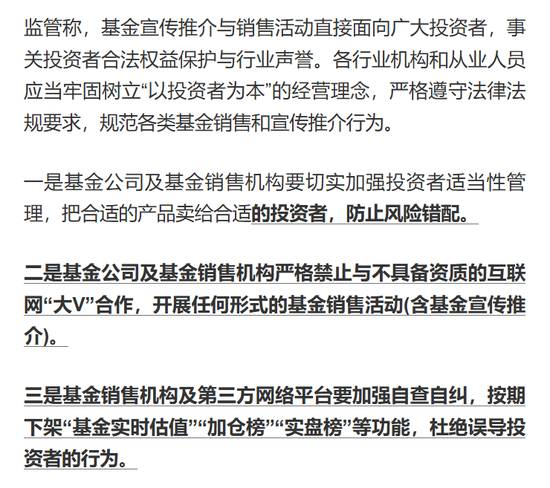
Core Viewpoint - The rise of internet marketing in the financial sector, particularly in fund sales, has led to both opportunities and challenges, including regulatory scrutiny due to improper marketing practices by some fund companies [1][35][36]. Group 1: Internet Marketing in Finance - The proliferation of 4G and 5G has facilitated the growth of internet marketing across various industries, including finance, where fund companies have leveraged these technologies for promotion and investor education [1][34]. - Fund products, like other consumer goods, can be marketed effectively online, but they are unique financial products that carry the risk of loss, making responsible marketing essential [1][35]. Group 2: Regulatory Concerns - Recent incidents of improper marketing by a fund company have prompted regulatory responses, highlighting the need for compliance in financial product promotion [1][35][36]. - The regulatory framework emphasizes the importance of selling suitable products to appropriate investors and prohibits unqualified influencers from participating in fund marketing [2][37]. Group 3: Role of Influencers and Advisors - Unqualified influencers, referred to as "Big Vs," are banned from engaging in fund marketing due to the potential for misleading investors [8][42]. - Fund companies are assessing whether influencers are qualified professionals, with some influencers considering obtaining advisory licenses to comply with regulations [44][47]. Group 4: Future Trends and Compliance - The industry anticipates that the implementation of new regulations will lead to a clearer separation between advisory roles and marketing activities, reducing conflicts of interest [19][66]. - There is a growing trend for influencers to focus on investor education, brand building, and team development rather than promoting specific fund products [58][69].

别让“擦边球”营销侵蚀公募基金信任基石
Zheng Quan Shi Bao· 2026-01-18 18:45
Core Viewpoint - The recent influx of significant funds into a certain fund company's product has raised concerns about potential violations in collaboration with online influencers, highlighting the operational pressures and conflicts of interest arising from rapid scale growth in the fund industry [1][2]. Group 1: Industry Concerns - The rapid rise of internet third-party sales platforms has fundamentally reshaped the fund marketing ecosystem, leading to new marketing scenarios that may blur compliance boundaries [1][2]. - Some fund companies have formed partnerships with financial content creators that lack transparency, potentially undermining market fairness and investor rights [2][3]. - The reliance on online influencers for marketing can create a speculative market atmosphere, contradicting the principles of long-term investment and rational decision-making that the fund industry should promote [2][3]. Group 2: Risks of Current Practices - Unreported benefit arrangements in these collaborations could violate regulatory requirements, damaging market integrity and investor knowledge [2]. - Large inflows can disrupt fund operations, diluting existing holders' returns and increasing liquidity risks during market downturns [2][3]. - The pursuit of rapid scale through questionable marketing practices can lead to significant reputational risks and long-term development challenges for companies [3]. Group 3: Call for Compliance and Responsibility - Trust is fundamental to the public fund industry, built on compliance, transparency, and accountability [2][4]. - The current market skepticism emphasizes the urgency of clarifying compliance boundaries and reinforcing responsibilities among market participants [2][4]. - Fund companies should prioritize protecting existing holders and adhere to risk management principles as a measure of their fiduciary duty [2][4]. Group 4: Sustainable Growth and Regulation - Healthy growth in the fund industry should be based on solid research capabilities, clear investment frameworks, and consistent performance, rather than short-term marketing tactics [3][4]. - Regulatory bodies need to proactively address new marketing methods that blur compliance lines, establishing clear rules and deterrents against violations [4][5]. - A collective effort from all market participants is essential to foster a healthier, more rational, and sustainable industry ecosystem [4][5].