复杂系统

Search documents
AI Agent 很火,但 Agent Infra 准备好了吗?
Founder Park· 2025-12-25 09:04
Core Insights - The main users of Infra software are shifting from human developers to AI Agents, indicating a fundamental change in infrastructure requirements for AI applications [1] - The rise of "agent-native" infrastructure is predicted by 2026, necessitating platforms that can handle a massive influx of tool executions and adapt to new operational paradigms [1][2] - Current infrastructure is still designed for human-centric operations, lacking the necessary compatibility and optimization for AI Agents [1] Group 1: Infrastructure Requirements - The architecture of existing systems is based on a 1:1 response model, which is inadequate for the recursive task management required by AI Agents [1] - Future systems must address issues like cold start times, latency fluctuations, and concurrency limits to support the operational demands of AI Agents [1] - The transition from traditional software engineering to agent-based systems introduces a new level of complexity, where failures are often due to misinterpretations of developer intent rather than code bugs [4][6] Group 2: Agent Infrastructure Challenges - The definition and boundaries of Agent Infrastructure are not yet fully established, with varying complexities depending on the application scenario [11] - Common challenges include security, execution environment, and memory management, which are critical for the safe operation of autonomous Agents [12][13] - The need for a sandbox environment to limit the operational scope of Agents is emphasized, ensuring they operate within predefined boundaries to mitigate risks [12] Group 3: Application Scenarios - Current popular applications of AI Agents include customer service, research, and data analysis, with specific functionalities like coding and data processing being heavily utilized [17][18] - The cloud-based execution of code in a sandbox environment enhances security and scalability, allowing for safe and efficient operations [18] - The demand for seamless API compatibility is crucial for developers, as inconsistent APIs can hinder user experience and integration [20] Group 4: Future Opportunities - The democratization of computing through AI Agents opens new business models that were previously unfeasible due to high costs [26] - Key future focuses for Agent Infrastructure include enhancing debuggability, memory management, and low-latency performance to support more natural interactions [27][29] - The evolution of Agent Infrastructure is expected to transition from merely supporting Agent deployment to enabling intelligent evolution based on real-world data and performance feedback [31][32]


论抱团的必然性和必要性
猛兽派选股· 2025-11-08 03:52
Group 1 - The core viewpoint is that the hatred towards institutional clustering stems not from the act of clustering itself, but from the resentment of not being part of the profitable group [1] - There are three main types of clustering in the stock market: cash flow and dividend overflow clustering based on safety margin, profit and valuation overflow clustering based on growth and reversal, and emotional and trading fund overflow clustering based on the strong getting stronger [1] - The formation of these distinct clustering styles is due to the necessity of discernibility in understanding phenomena, making these three types the most recognizable and acceptable [1] Group 2 - The desire for profit and value inclination inevitably leads to clustering behavior, which in turn creates significant market movements, making the stock market dynamic and engaging [2] - The stock market is a complex system, and understanding its foundational thinking and cognitive methods can be enhanced by reading popular science books on complex systems [2] - Economic behavior of individuals can be further explored through literature such as Mises' "Human Action" and von Neumann's "Game Theory" [2]

上银基金赵治烨:臻悦时光的价值派
Sou Hu Cai Jing· 2025-10-24 11:46
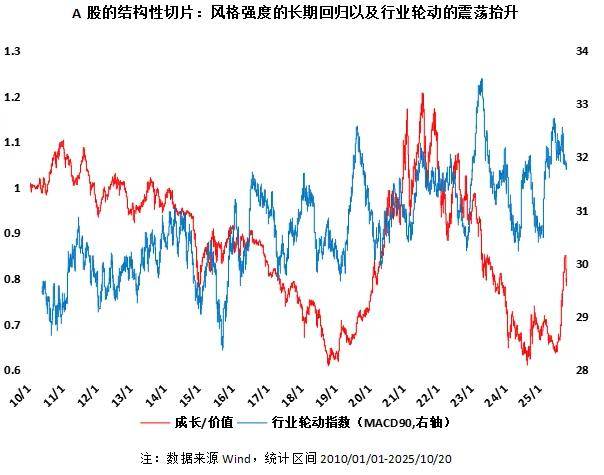
Group 1 - The core narrative of A-shares since September 24, 2024, is the historical mean reversion of growth style over a fifteen-year dimension, with high volatility and uncertainty exacerbated by the high rotation characteristics of the market [1] - The current investment feedback indicates that weak sectors like banks and coal may rebound in October, while strong sectors like TMT may begin to decline [1] - The ongoing main line of investment remains somewhat elusive, suggesting a complex market environment [1] Group 2 - The competition among different investment styles, referred to humorously as "Old Deng, Middle Deng, and Young Deng," highlights the need for A-share investors to consider whether to join the prevailing trend or stick to their convictions [2] - Active equity fund managers who adopt a balanced allocation strategy and can navigate through cyclical changes are particularly noteworthy in the current market context [2] Group 3 - The domestic active equity fund market is experiencing similar changes as the underlying market, with the rise and fall of market conditions determining the timing of key players [3] - The long-term performance of active equity funds, like that of Zhao Zhiyue from Shangyin Fund, demonstrates the importance of adapting to market cycles [7][10] Group 4 - Zhao Zhiyue's investment philosophy emphasizes a comprehensive understanding of market dynamics, recognizing that A-share investment principles are not linear and require a nuanced approach [11][13] - His successful long-term performance from 2016 to 2020, with a return of 105.68% for Shangyin New Emerging Value A, significantly outperformed the broader market [14] Group 5 - Zhao Zhiyue describes himself as a "pessimistic optimist," maintaining a long-term optimistic view while carefully assessing risks during investment decisions [18] - His investment strategy focuses on value and balanced approaches, aiming for sustainable long-term returns despite market volatility [18] Group 6 - The investment framework developed by Zhao Zhiyue incorporates a complex system view, acknowledging the interplay of various factors and the limitations of human cognition [20][21] - His approach to different sectors, such as cyclical and consumer industries, reflects a flexible and diversified investment strategy aimed at reducing net asset volatility [21] Group 7 - Looking ahead, Zhao Zhiyue remains focused on long-term stability rather than short-term gains, particularly in the context of the evolving technology sector [22] - His investment strategy for the semiconductor industry emphasizes a dual focus on domestic chip production and AI-related technologies, adapting to market changes and external pressures [22]