
外资增持人民币债券

Search documents
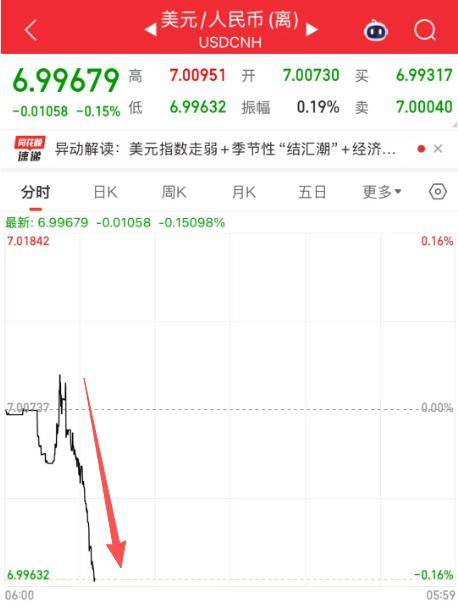
刚刚!人民币汇率正式破7,五大影响
Sou Hu Cai Jing· 2025-12-25 09:13
Core Viewpoint - The offshore RMB has strengthened significantly, breaking the 7.0 mark against the USD for the first time in 2024, reaching a high of 6.9968, marking a notable recovery since May 2023 [1][3]. Group 1: RMB Exchange Rate Movement - The RMB exchange rate has returned below 7 after two years and seven months, with the last occurrence being in May 2023 [3]. - Since April 2023, the RMB has entered a strong appreciation phase, allowing 1 million RMB to now exchange for 14.29 million USD, an increase of 8,322 USD compared to earlier this year [5]. Group 2: Factors Driving RMB Strength - The RMB's appreciation is attributed to multiple factors, including the weakening US economy, rising debt risks, and the Federal Reserve's interest rate cuts initiated in September and December [9]. - China's trade surplus has exceeded 1 trillion USD for the first time in history, indicating strong economic performance despite external pressures [11]. Group 3: Implications of RMB Appreciation - The appreciation of the RMB means it is worth more, making overseas spending cheaper for Chinese citizens, particularly for education and travel [12]. - For foreign buyers, RMB-denominated goods have become more expensive, while USD-denominated goods are cheaper for Chinese consumers [12]. - The capital market may see increased attractiveness due to RMB appreciation, potentially leading to capital inflows and foreign investment in the Chinese market [12]. Group 4: Impact on Monetary Policy - The current RMB exchange rate allows for more flexibility in monetary policy, potentially paving the way for interest rate cuts that were previously delayed to stabilize the exchange rate [15].

中国外汇市场韧性增强
Xin Hua Wang· 2025-08-12 06:20
Core Viewpoint - The resilience of China's foreign exchange market has strengthened in the first half of the year, with significant surpluses in both bank foreign exchange settlement and cross-border payments, indicating a stable outlook for the market in the second half of the year [1][2]. Group 1: Foreign Exchange Market Performance - In the first half of the year, the bank's foreign exchange settlement surplus reached 85.2 billion USD, and the surplus for cross-border payments was 83.4 billion USD, primarily driven by high surpluses in goods trade and direct investment [2]. - The foreign exchange settlement rate increased slightly, with a rate of 66% for customer purchases from banks, up 2 percentage points from the previous year [2]. - The foreign exchange deposit balance for enterprises remained stable at 695.1 billion USD, with a settlement rate of 67%, which is an increase of 0.4 percentage points compared to the same period last year [2]. Group 2: Foreign Exchange Derivatives and Risk Management - The scale of enterprises using foreign exchange derivatives for risk management grew by 29% year-on-year, significantly outpacing the growth rate of foreign exchange settlement, raising the hedging ratio to 26%, an increase of 4.1 percentage points from the previous year [3]. - The foreign exchange reserve stood at 3.0713 trillion USD at the end of June, with fluctuations in value due to the rising dollar index and falling prices of major financial assets [3]. Group 3: Foreign Investment in Chinese Bonds - Despite recent international market volatility, foreign investment in Chinese bonds is expected to continue steadily, with foreign holdings of Chinese bonds remaining stable and accounting for over 50% by central bank institutions [4][5]. - By the end of 2021, China had attracted nearly 820 billion USD in cross-border bond investments, representing about one-third of the total external bond investment in emerging markets [4]. Group 4: Support for Enterprises in Managing Exchange Rate Risks - The foreign exchange bureau is actively supporting enterprises, especially small and medium-sized enterprises, in managing exchange rate risks by reducing hedging costs and enhancing their risk management capabilities [7][8]. - In the first half of the year, enterprises utilized foreign exchange derivatives to manage risks amounting to 755.8 billion USD, with nearly 17,000 new enterprises engaging in hedging, most of which are small and medium-sized [8].