人民币汇率升值

Search documents
金融市场流动性与监管动态周报:人民币持续升值,可跟踪资金延续净流出-20260304
CMS· 2026-03-04 13:31
Core Insights - The report highlights the continuous appreciation of the RMB, driven by a weakening USD index, narrowing China-US interest rate differentials, and increased demand for currency settlement. It anticipates a slowdown in the pace of RMB appreciation but expects it to remain strong in the short term due to high settlement demand and optimistic economic growth expectations at the beginning of the year [2][4][20]. Market Liquidity - The secondary market has seen a continuous net outflow of tracked funds, with financing funds and ETFs experiencing slight net outflows. Specifically, financing funds had a net outflow of 83.5 billion RMB, and ETFs saw a net outflow of 360.2 billion RMB [4][39]. - The liquidity indicators show a decrease in public fund issuance to 8.8 million units, while the net issuance of ETFs has increased [3][39]. Currency Policy and Interest Rates - The People's Bank of China (PBOC) conducted a net withdrawal of 461.4 billion RMB in the open market, with a significant amount of reverse repos maturing in the coming week. The report notes an increase in short-term interest rates and a decrease in long-term bond yields [4][29]. - The PBOC has lowered the foreign exchange risk reserve requirement for forward sales from 20% to 0%, aiming to reduce costs for enterprises and stimulate foreign exchange demand [13][28]. Market Sentiment - The report indicates an increase in trading activity among financing funds, with the proportion of financing transactions in the A-share market rising to 11.2% [52]. The VIX index has also increased, reflecting a decline in market risk appetite [54]. - The report identifies a preference for cyclical sectors, with significant inflows into materials, power equipment, and electronics, while ETFs primarily experienced net redemptions [61]. Investor Preferences - The report notes that sectors such as non-bank financials, construction materials, and real estate saw net inflows, while sectors like electronics, computing, and media experienced net outflows [61]. The net buying in financing funds was highest in electronics (+173.6 billion RMB), non-ferrous metals (+95.0 billion RMB), and power equipment (+81.8 billion RMB) [61].
为什么人民币汇率升值加速
2026-03-01 17:22
Summary of Conference Call Records Industry Overview - The records discuss the Chinese currency, Renminbi (RMB), and its appreciation against the US dollar, influenced by macroeconomic factors and trade dynamics [1][2][3]. Key Points and Arguments Trade Surplus and Currency Strength - In 2025, China achieved a "dual surplus" of trade and foreign exchange settlements, with exports growing by 5.5% year-on-year, leading to a trade surplus exceeding $1 trillion, a historical high [1][2]. - The foreign exchange settlement surplus reached approximately $100 billion in both January and December, providing a solid foundation for RMB appreciation [1][2]. Impact of US Dollar Credibility - The credibility of the US dollar is declining due to geopolitical tensions, financial sanctions, and concerns over US fiscal expansion, leading to reduced holdings of dollar assets by sovereign funds [1][2][3]. Tariff Dynamics - The market has adjusted to a framework where tariff shocks are perceived as more likely but recover quickly, reducing the prolonged emotional impact of tariffs on the RMB exchange rate [1][3]. - A Supreme Court ruling in 2026 deemed tariffs imposed by the Trump administration illegal, resulting in a net decrease of about 10% in overall tariff levels compared to pre-ruling averages [1][3][4]. US-China Relations - Anticipation of a visit by Trump to China is expected to stabilize US-China relations in the short term, enhancing market risk appetite and supporting the RMB [1][4]. Foreign Investment Trends - Since late 2025, the A-share market has performed strongly, with continued foreign capital inflows, indicating increased demand for Chinese assets and providing cyclical support for the RMB [1][4]. Self-Reinforcing Mechanisms - As the RMB approaches the 6.8 level, a self-reinforcing mechanism may trigger, where exporters' incentives to convert foreign currency holdings increase, potentially leading to further appreciation [2][5]. - The structure of hedging by exporters may amplify exchange rate fluctuations, as financial institutions adjust their strategies in response to rising appreciation expectations [5]. Future Outlook and Policy Constraints - The RMB may not necessarily stop at 6.8, with potential for further depreciation depending on policy responses and macroeconomic conditions [6]. - The People's Bank of China may influence the pace of appreciation but is unlikely to reverse the overall trend. Recent measures include promoting cross-border RMB financing, which could exert mild depreciation pressure [6][7]. Directional Variables - The future direction of the RMB will depend on three main factors: the strength of export fundamentals, the credibility of the US dollar narrative, and any new disturbances in US-China relations [6][7]. Additional Important Content - The records highlight the complex interplay between trade dynamics, currency valuation, and geopolitical factors, emphasizing the need for continuous monitoring of these elements to assess future currency movements [1][2][3][4][5][6][7].
人民币汇率一路冲高 外贸企业直面汇率考验
Sou Hu Cai Jing· 2026-02-27 10:06
Group 1: Currency Exchange Rate Trends - The offshore and onshore RMB to USD exchange rates have both surpassed the 6.87 mark, with the offshore rate reaching 6.8619 and the onshore rate hitting 6.8649 on February 25, marking a new high since April 14, 2023 [2] - As of February 27, the offshore RMB to USD rate was reported at 6.8528, and the onshore rate at 6.8559 [4] - The RMB has appreciated significantly, with a cumulative increase of over 1400 basis points since early April 2025, and it is expected to continue fluctuating within a reasonable range [5][12] Group 2: Impact on Export Businesses - Export companies, particularly in low-value-added industries like steel, are facing pressure on profit margins due to the rising RMB, as even slight increases in the exchange rate can erode profits [5][10] - A case study from an export business shows that a USD 10,000 order, initially expected to yield a profit of approximately 10,500 RMB, saw profits shrink to 8,500 RMB due to exchange rate fluctuations [6] - The competitive nature of the steel market means that even minor price adjustments can significantly impact customer decisions, making it challenging for exporters to manage pricing amid currency fluctuations [5][10] Group 3: Central Bank Actions - The People's Bank of China announced a reduction in the foreign exchange risk reserve ratio for forward sales from 20% to 0%, effective March 2, 2026, to support businesses in managing exchange rate risks [3][8] - This policy change is expected to lower costs for financial institutions and encourage more companies to utilize forward foreign exchange tools to hedge against currency volatility [8] Group 4: Export Performance and Economic Resilience - Despite the appreciation of the RMB, China's export performance remains strong, with a total trade value of 45.47 trillion RMB in 2025, reflecting a 3.8% year-on-year growth [10] - The correlation between RMB appreciation and export performance is low, indicating that the Chinese economy is becoming more resilient to currency fluctuations [11] - Factors contributing to this resilience include a shift towards higher value-added products and increased use of foreign exchange hedging tools by exporters [11]


盘中成交超28亿元,30年国债ETF(511090)近13个交易日净流入8.19亿元
Sou Hu Cai Jing· 2026-02-27 06:33
Core Insights - The 30-year government bond ETF (511090) has seen active trading, with a turnover of 13% and a transaction volume of 2.871 billion yuan as of February 27, 2026, at 14:09 [1] - Over the past year, the average daily trading volume of the 30-year government bond ETF has been 8.108 billion yuan [1] - In the last 13 trading days, there have been net inflows on 9 days, totaling 819 million yuan [1] Market Trends - The 30-year government bond futures saw a slight decline of 0.01%, while the 10-year, 5-year, and 2-year contracts experienced minor increases of 0.02%, 0.01%, and 0.01% respectively as of February 27 [1] - The RMB exchange rate has entered a rapid appreciation phase, with both onshore and offshore RMB surpassing the 6.84 mark, reaching a nearly three-year high [1] - The strengthening of the RMB has positively impacted the offshore bond issuance environment, making offshore RMB bonds (dim sum bonds) increasingly attractive due to their local currency denomination, lower costs, and reduced exchange rate risks [1] Issuance Dynamics - In February alone, the issuance scale of dim sum bonds has exceeded 120 billion yuan [1] - Although Chinese dollar bonds benefit from lower repayment costs, they face rising hedging costs and exchange rate exposure risks, especially with the Federal Reserve entering a rate-cutting cycle [1] - The restructuring of the offshore debt market for Chinese entities has become a clear trend [1][2]
锐财经|人民币汇率持续走强
Ren Min Ri Bao Hai Wai Ban· 2026-02-27 03:28
Core Viewpoint - The recent appreciation of the Renminbi (RMB) against the US dollar has garnered significant attention, with both offshore and onshore RMB surpassing 6.84, marking the highest level since April 2023 [1][3]. Group 1: Factors Supporting RMB Appreciation - The weakening of the US dollar has led to a collective strengthening of non-USD currencies, including the RMB, primarily due to market expectations of continued interest rate cuts by the Federal Reserve [3]. - Increased demand for currency settlement from domestic enterprises has contributed to RMB appreciation, as companies are moving away from holding large amounts of USD in response to the RMB's strengthening [3][4]. - China's economic resilience, characterized by a strong trade surplus and enhanced manufacturing competitiveness, provides a solid internal foundation for the RMB's strength [4]. Group 2: Impacts of RMB Appreciation - RMB appreciation is expected to lower import costs for companies reliant on imported raw materials, thereby enhancing their purchasing power and reducing production costs [5]. - The attractiveness of RMB-denominated assets is likely to increase, drawing more foreign investors to Chinese stocks and bonds, which could promote cross-border capital flows [6]. - While RMB appreciation can boost capital market confidence and enhance purchasing power for consumers, it poses challenges for export-oriented companies, particularly small and medium-sized enterprises, due to potential exchange rate losses [7]. Group 3: Outlook on RMB Exchange Rate - Experts predict that the RMB exchange rate will likely continue to exhibit two-way fluctuations and moderate appreciation, with the People's Bank of China emphasizing a managed floating exchange rate system to maintain stability [8]. - The central bank aims to guide market expectations and prevent excessive fluctuations in the RMB exchange rate, ensuring its credibility in the global monetary system [8].

人民币汇率持续走强(锐财经)
Sou Hu Cai Jing· 2026-02-26 22:59
Core Viewpoint - The recent appreciation of the Renminbi (RMB) against the US dollar has garnered significant attention, driven by a weakening dollar and strong domestic economic fundamentals, with expectations of continued RMB strength in 2026 [2][3]. Group 1: Factors Supporting RMB Appreciation - The RMB has continued its upward trend since breaking the 7 yuan mark in December 2025, supported by a weakening US dollar due to market expectations of further interest rate cuts by the Federal Reserve [2]. - External factors, such as the criminal investigation into the Federal Reserve Chairman, have impacted the Fed's independence, contributing to the appreciation of non-USD currencies, including the RMB [2]. - Increased demand for currency settlement from domestic enterprises, driven by prior dollar holdings, has further propelled RMB appreciation [3]. Group 2: Economic Resilience and Trade Surplus - China's economic resilience is a crucial support for the RMB, with a trade surplus of approximately $1.2 trillion in 2025, contributing 32.7% to economic growth [3]. - The upgrading of export structures and enhanced manufacturing competitiveness have provided a solid internal foundation for the RMB's strength [3]. Group 3: Impacts of RMB Appreciation - RMB appreciation lowers import costs for companies reliant on imported raw materials, enhancing purchasing power and reducing procurement costs [4]. - The stable appreciation expectation increases the attractiveness of RMB-denominated assets, drawing more foreign investors to Chinese stocks and bonds [5]. - RMB appreciation boosts capital market confidence, leading to a revaluation of RMB-denominated assets and reducing costs for overseas shopping, studying, and travel for residents [5]. Group 4: Challenges for Export Enterprises - Export enterprises, particularly small and medium-sized ones, face challenges due to potential exchange rate losses from RMB appreciation against the dollar [6]. - The transition from nominal to real effective exchange rate appreciation may impact the competitiveness of exports [6]. Group 5: Future Outlook and Policy Measures - Experts predict that the RMB will likely continue to exhibit dual-directional fluctuations and moderate appreciation in 2026 [7]. - The People's Bank of China emphasizes maintaining a stable RMB at a reasonable equilibrium level, focusing on market supply and demand while managing expectations to prevent excessive fluctuations [7]. - Export enterprises are encouraged to enhance their international competitiveness and utilize currency hedging tools to manage risks effectively [7].

节后人民币对美元汇率较快升值
Sou Hu Cai Jing· 2026-02-26 20:13
Core Viewpoint - The Chinese yuan (RMB) has shown a strong performance post-Spring Festival, with both onshore and offshore RMB breaking the 6.84 mark against the US dollar, indicating a continued appreciation trend since late 2025 [1] Group 1: RMB Exchange Rate Performance - On February 25, both onshore and offshore RMB surpassed the 6.87 mark against the US dollar, continuing the upward trend [1] - Since the end of December 2025, the RMB has appreciated nearly 300 basis points against the US dollar, with both onshore and offshore rates increasing by over 1% [1] - The central parity rate of the RMB against the US dollar was reported at 6.9228, an increase of 93 basis points, marking the third consecutive day of appreciation [1] Group 2: Economic Context and Future Outlook - The improvement in China-US trade relations since November 2025 and a weaker US dollar have contributed to the appreciation of the RMB and other non-USD currencies [1] - Short-term expectations suggest that the RMB will remain strong due to a favorable external environment and continued robust export growth in the first quarter [1] - Market sentiment is currently high, and the likelihood of a significant rebound in the US dollar index is considered low in the near term [1] Group 3: Expert Insights - Analysts emphasize that the RMB exchange rate is influenced by multiple factors, including settlement demand, fundamental expectations, and the direction of the US dollar [2] - Market participants are advised to remain rational and avoid blindly betting on a one-sided market trend [2]
人民币汇率三连涨 离岸价升破6.83
2 1 Shi Ji Jing Ji Bao Dao· 2026-02-26 08:12
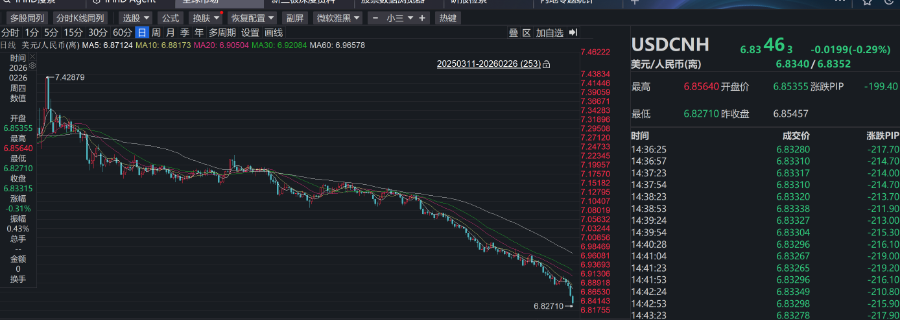
Core Viewpoint - The recent appreciation of the Renminbi (RMB) against the US dollar is attributed to a combination of factors, including a weakening US dollar and improved external economic conditions, leading to a significant increase in the RMB's value [3][4]. Group 1: RMB Exchange Rate Trends - The onshore and offshore RMB both surpassed the 6.84 mark against the US dollar, with the offshore RMB reaching a high of 6.8271, marking the highest level since April 2023 [1]. - The RMB's central parity rate against the US dollar was set at 6.9228, an increase of 93 basis points, marking the third consecutive day of upward adjustment [1]. - Since the beginning of February, the RMB has appreciated over 300 basis points against the US dollar, with both onshore and offshore rates showing an increase of more than 2% this year [3]. Group 2: Factors Influencing RMB Strength - The stabilization of China-US trade relations since late 2025 has contributed to the RMB's strong performance [3]. - The recent criminal investigation into Federal Reserve Chairman Jerome Powell has put pressure on the US dollar, leading to a general appreciation of non-USD currencies, including the RMB [3]. - The release of accumulated settlement demand from high export growth has accelerated the RMB's appreciation, with significant surpluses in bank settlement and sales recorded in December 2025 and January 2026 [4]. Group 3: Market Sentiment and Future Outlook - Analysts suggest that the current high market sentiment and the expectation of continued strong export growth in the first quarter will support the RMB's strength in the near term [4]. - The RMB's appreciation is viewed as a passive response to a weakening US dollar rather than a direct strengthening of the RMB itself [4]. - The People's Bank of China has emphasized the role of the exchange rate as a macroeconomic stabilizer, indicating a commitment to maintaining a stable RMB while allowing for flexibility [5].
人民币汇率三连涨,离岸价升破6.83
2 1 Shi Ji Jing Ji Bao Dao· 2026-02-26 08:02
Core Viewpoint - The recent appreciation of the Renminbi (RMB) against the US dollar is attributed to a combination of factors, including a weaker US dollar and improved external economic conditions, leading to a significant increase in the RMB's value over the past few days [3][4]. Group 1: RMB Exchange Rate Movement - The onshore and offshore RMB both surpassed the 6.84 mark against the US dollar, with the offshore RMB reaching a high of 6.8271, marking the highest level since April 2023 [1]. - The RMB's central parity rate against the US dollar was set at 6.9228, an increase of 93 basis points, marking the third consecutive day of upward adjustment [1]. - Since the beginning of February, the RMB has appreciated over 300 basis points against the US dollar, with both onshore and offshore rates showing an increase of more than 2% this year [3]. Group 2: Factors Influencing RMB Strength - The stabilization of Sino-US economic and trade relations since late 2025 has contributed to the RMB's strong performance [3]. - The recent criminal investigation into Federal Reserve Chairman Jerome Powell has put pressure on the US dollar, leading to a general appreciation of non-US currencies, including the RMB [3]. - The release of accumulated settlement demand from high export growth has accelerated the RMB's appreciation, with significant surpluses in bank customer settlement and sales recorded in late 2025 and early 2026 [4]. Group 3: Market Sentiment and Future Outlook - Analysts suggest that the current high market sentiment is a key factor supporting the RMB's strength, with expectations of continued robust export growth in the first quarter [4]. - The RMB's appreciation is viewed as a passive response to a weaker US dollar rather than a direct strengthening of the RMB itself [4]. - The People's Bank of China has emphasized the role of the exchange rate as a macroeconomic stabilizer, indicating a commitment to maintaining stability while allowing for flexibility [5].
人民币走强的新格局
Sou Hu Cai Jing· 2026-02-26 04:29
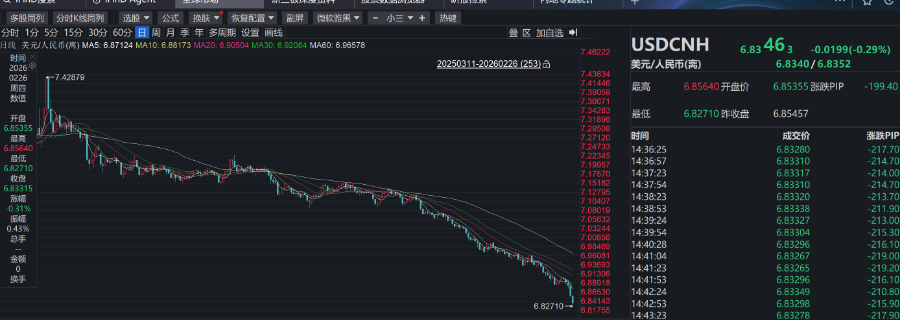
Core Insights - The recent strength of the Renminbi (RMB) reflects a combination of robust domestic economic fundamentals, adjustments in the external monetary landscape, and improved supply-demand dynamics in the foreign exchange market, marking a new phase characterized by fundamental support, two-way fluctuations, policy backing, and functional upgrades [3][6][10] Exchange Rate Performance - The RMB has shown a clear upward trajectory, with the exchange rate against the US dollar breaking the 7.0 mark at the end of December 2025 and maintaining a strong performance in early 2026, reaching new highs since April 2023 [4][5] - After the Spring Festival, the RMB appreciated further, with the onshore rate hitting 6.8804 and the offshore rate reaching 6.8760, both marking significant increases [4][5] Supply-Demand Dynamics - The foreign exchange market has seen a continuous improvement in supply-demand relationships, with significant surpluses in bank customer foreign exchange settlements, indicating accelerated demand for currency conversion by enterprises [5][6] - As of January 2026, China's foreign exchange reserves stood at $3.3991 trillion, reflecting stability and supporting the RMB's strength [5] Internal Economic Support - The resilience of the domestic economy, with a GDP growth of 5.0% in 2025, provides a solid foundation for the RMB's stability, supported by a record trade surplus of over $1.076 trillion [7][17] - The shift in corporate behavior towards currency conversion has amplified the effects of trade surpluses, with banks reporting record high settlement volumes in January 2026 [7] External Factors - The weakening of the US dollar has created favorable conditions for the RMB's appreciation, driven by internal policy uncertainties and external economic factors [8][9] - Improvements in Sino-US trade relations have also contributed to a more stable external environment for the RMB [9] Policy Framework - The People's Bank of China has upgraded the policy framework for the RMB, emphasizing its role as a macroeconomic stabilizer and enhancing its management to prevent excessive fluctuations [10][13] - The new policy direction aims to foster a stable expectation for the RMB, moving away from a focus solely on preventing extreme fluctuations [10] Market Impact - The RMB's strength has led to a positive correlation among the stock, bond, and foreign exchange markets, enhancing the attractiveness of RMB-denominated assets globally [14] - The appreciation of the RMB is expected to boost asset values, particularly in sectors favored by foreign investment, such as consumption and advanced manufacturing [14] Long-term Trends - The RMB's appreciation is seen as a reflection of China's high-quality economic development and the ongoing internationalization of the currency, with expectations for continued long-term appreciation [15][17] - The RMB is transitioning from a trade currency to an investment and reserve currency, indicating a significant shift in its role within the global monetary system [17][18]