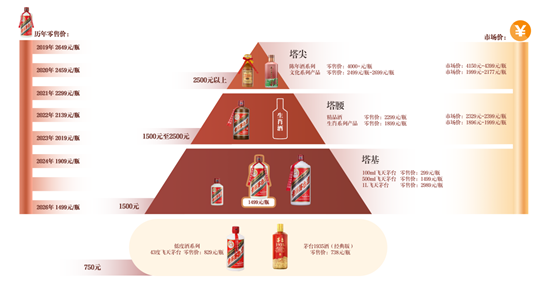
多价态并存的供给侧动态价格体系

Search documents
贵州茅台:切实推进营销体系市场化转型
Zheng Quan Ri Bao· 2026-01-13 16:49
Core Viewpoint - Guizhou Moutai Co., Ltd. is accelerating its market-oriented transformation in 2026, focusing on a consumer-centric and market-driven marketing system to adapt to changing market and consumption trends [1] Group 1: Market-Oriented Operation Plan - The company has approved the "2026 Guizhou Moutai Market-Oriented Operation Plan," which aims to enhance its marketing system in line with market demands [1] - Guizhou Moutai is recognized as a "barometer" of the liquor industry, and its initiatives are drawing significant attention from industry analysts [1] Group 2: Product Structure - The product structure will return to a "pyramid" model, with the base consisting of the flagship 53% vol 500ml Moutai liquor, supported by other specifications like 1000ml and 100ml [2] - "Waist" products will include premium and zodiac Moutai liquors, while "tip" products will focus on aged and cultural series, adjusting supply to maintain high-end product value [2] - The 43% vol 500ml Moutai liquor will target key consumption scenarios, regions, and younger demographics [2] Group 3: Operational Model - The operational model will shift from a traditional "self-sale + distribution" approach to a multi-dimensional marketing system that includes "self-sale + distribution + consignment + consignment" [2] Group 4: Channel Layout - Guizhou Moutai will establish a five-channel layout comprising wholesale, offline retail, online retail, dining, and private domain, integrating online and offline strategies [3] - The online platform will enhance efficiency and reach, while offline channels will focus on conversion and service [3] Group 5: Pricing Mechanism - The company will implement a market-oriented pricing mechanism, establishing a dynamic adjustment system for retail prices based on market conditions [3] - The price for the 53% vol 500ml Moutai liquor in 2026 is set at 1499 yuan per bottle, significantly lower than the 2649 yuan price in 2019 [3] - Pricing strategies will be based on a scientific assessment of channel profit margins and operational costs [3] Group 6: Dynamic Pricing System - Guizhou Moutai is seeking to navigate the challenges in the liquor industry by emphasizing a market-oriented transformation under the new chairman Chen Hua [4] - The "i Moutai" platform will serve as a key digital marketing tool, with the 53-degree flying Moutai liquor already selling out at the official price of 1499 yuan [4] - The new pricing system aims to create a flexible supply-side dynamic pricing structure, moving away from traditional pricing models [4] Group 7: Brand and Market Control - The company is strengthening terminal price control through direct sales channels to reduce speculation and reshape market order [5] - By leveraging digital tools to reach consumers, Guizhou Moutai aims to build a private brand traffic pool and minimize reliance on intermediaries [5]

打破传统意义的“出厂价”,贵州茅台公告构建全新零售价格体系
Xin Lang Cai Jing· 2026-01-13 09:25
Core Viewpoint - Guizhou Moutai has officially released its 2026 market-oriented operation plan, focusing on product system, operation model, channel layout, and pricing mechanism to enhance market adaptability and pricing flexibility [1][6]. Pricing Mechanism - The company will establish a dynamic pricing adjustment mechanism for its self-operated retail prices, which will be market-oriented and executed in its iMoutai app and self-operated stores [1][6]. - The retail prices announced are consistent with the current market transaction prices, indicating a commitment to transparency and market alignment [1][6]. Channel Profitability - Guizhou Moutai will base its pricing on self-operated retail prices to scientifically calculate channel profit margins, determining dealer contract prices, agency fees, and consignment commissions [3][8]. - The new pricing system breaks away from the traditional "factory price" model, creating a "multi-price coexistence" dynamic pricing system that considers product characteristics, channels, and operation models [3][8]. Sales Model - Current sales practices involve a "pick-up" method where consumers order products through iMoutai and collect them from nearby specialty stores, which earn a commission from the manufacturer [4][9]. - This model aims to stabilize product pricing and create a win-win situation for manufacturers, dealers, and consumers by reducing price volatility [4][9].