多巴胺消费

Search documents
人文经济激活消费新动能丨传统商厦“变身”动漫的“宝藏商场”
Xin Lang Cai Jing· 2026-02-11 04:17
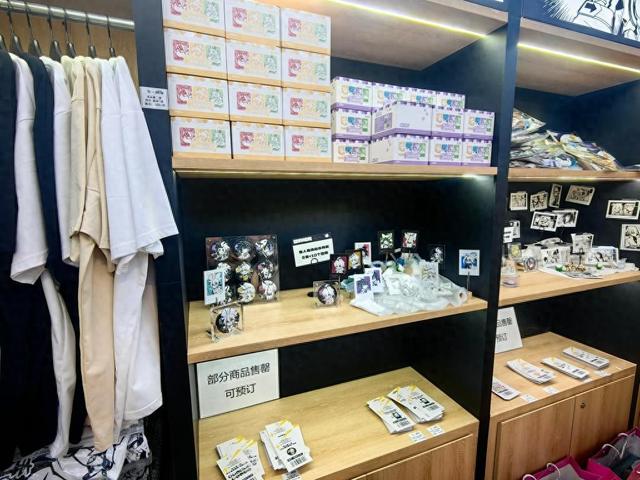
Core Insights - The transformation of the former Hualian Department Store into the Bailing ZX Creative Space targets the young consumer demographic, particularly the post-90s and post-00s generations, reflecting a shift in retail strategy to cater to this audience [1][7] - The success of the pop-up store featuring the original Chinese anime IP "Aotu World" demonstrates strong sales performance, with nearly 1 million yuan in revenue on the first day, indicating a competitive position against international IPs [1][2] - The Bailing ZX Creative Space integrates various retail formats, including exhibitions, gaming, and dining, creating an immersive shopping experience that appeals to younger consumers [7][9] Retail Strategy - The Bailing ZX Creative Space has successfully attracted over 80% of its consumers from the post-90s and post-00s demographics, showcasing its appeal to younger audiences [7] - The space has hosted approximately 450 events in its first year, with projections to exceed 1,300 events by 2025, indicating a strategy focused on engagement and community building [9] - The concept of "dopamine consumption" is emphasized, with limited products and pop-up stores driving consumer interest and engagement [9] Product Offering - The pop-up store features popular merchandise from "Aotu World," with many items selling out quickly, highlighting the strong demand for domestic anime products [2] - The "Animal Nebula" store offers unique plush toys and figurines, showcasing a creative approach to product design that resonates with consumers [5][6] - The focus on high-quality, detailed animal figurines has garnered attention both domestically and internationally, with significant sales expected to reach hundreds of millions by 2025 [5][6]

中国消费者(HA):中国仍在消费不足吗
Sou Hu Cai Jing· 2025-12-01 00:46
Core Conclusion - The notion of "insufficient consumption in China" is a distorted perception amplified by pricing and statistical methods. Bank of America provides extensive data showing that the true picture of Chinese consumption is not "volume shrinkage," but rather "high volume, low price." Total commodity consumption has reached or even surpassed that of the US, Japan, and South Korea; service consumption has met basic standards but still has gaps in quality. The main contradiction in the current market is the mismatch between "mass supply" and "upgraded demand." Companies focusing on the four key areas of "Efficiency, Experience, Service, Globalization (E2SG)" will thrive through cycles [1]. Group 1: Commodity Consumption - China's total commodity consumption is impressive, with certain categories outperforming developed countries. For example, per capita egg consumption is 128.5 g/day, which is 6% higher than the US and 42% higher than the global average. Sulfur consumption is 1117.9 g/day, which is 3.2 times that of the US. Seafood consumption is 114 g/day, nearly double that of the US. However, dairy consumption is only 86.9 g/day, which is 1/7 of the US level, but this gap is mitigated by plant proteins and eggs. The ownership of cooking appliances is 2.14 times the global average and 1.22 times that of the US. The number of new energy vehicles is 7.7 per thousand people, surpassing the US by 1.66 times and Japan by 8.75 times [3][4]. Group 2: Service Consumption - In terms of service consumption, China has met basic standards but still has quality gaps. The average housing area per person is 49 m², slightly below the US's 65 m² but higher than the UK and France. Medical visits average 6.8 times per year, exceeding the US by 3.4 times. Education duration is 15.5 years, on par with the US and Japan, but extracurricular spending is only $140/year, which is 1/28 of South Korea's. The prices for leisure and entertainment, such as concerts and exhibitions, have increased by 53%, indicating a significant supply-demand gap in high-quality offerings [5][6]. Group 3: Misconceptions of Consumption - The illusion of "insufficient consumption" stems from three main sources: 1. Low prices: Most goods/services are priced at only 20%-60% of US prices (e.g., mobile plans at 15%, taxis at 20%, utilities at 24%). 2. Supply chain advantages: China's role as the "world's factory" and innovations in distribution (like community group buying) continue to drive prices down. 3. Statistical discrepancies: If government transfer payments are included, the actual consumption to GDP ratio aligns with that of South Korea, which is approximately 40% [6]. Group 4: Mismatches and E2SG Investment Framework - There are three core mismatches in the market: 1. Supply vs. Demand: There is an oversupply of mass-market products, but insufficient emotional value and experience. 2. Channels vs. Communication: Fragmented media and ineffective traditional marketing require precise targeting and content-driven e-commerce. 3. Expectations vs. Reality: While income expectations are weak, there is a high demand for quality, necessitating affordable yet high-quality offerings [7]. Group 5: E2SG Investment Tracks - The E2SG investment framework emphasizes four key dimensions for companies to succeed in a "high volume, low price" market: 1. Efficiency: Achieving low costs and quick turnover through supply chain optimization and scale effects. 2. Experience: Creating differentiation through product innovation and capturing emotional consumption needs. 3. Service: Filling the gap in high-quality supply. 4. Globalization: Leveraging China's high volume and low price advantage to expand into international markets [10][11][12]. Group 6: Recommended Companies - Bank of America has identified seven companies with long-term competitive advantages across various sectors, including: - Pop Mart: Strong IP operation capabilities and global expansion, with an expected EPS growth of 30% by 2026. - Midea: Leading in global white goods with supply chain efficiency, focusing on overseas OBM business growth. - Geely: Rich in new energy vehicle reserves, planning to launch over 10 new models by 2026 with a target growth of 50%-80%. - Huazhu Group: Benefiting from leisure travel demand recovery and expanding through a light asset model, with a projected 21% CAGR in profits from 2024-2026. - Trip.com Group: Leading in OTA with expected 45% growth in international business revenue over the next six years. - Tencent Holdings: Dominating digital entertainment with stable mobile game revenue and AI-driven efficiency improvements. - Damai Entertainment: Leading in live entertainment ticketing with a projected 60% CAGR in profits from 2025-2028 [20][21].





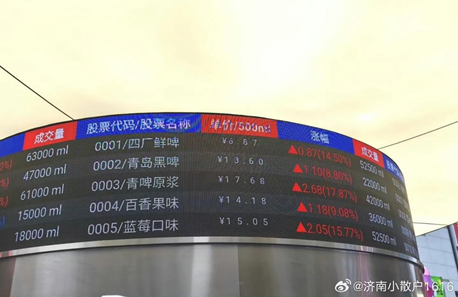
“像极了交易中心的数据大屏”,买啤酒当“股”炒!被挤爆的“青岛啤酒交易所”能否形成长久消费模式?
Mei Ri Jing Ji Xin Wen· 2025-06-12 12:59
Core Viewpoint - The "Qingdao Beer Exchange" has become a popular attraction, merging the experience of drinking beer with stock trading, creating a unique consumer experience that drives sales and engagement during the beer season [2][4][10]. Group 1: Business Model and Consumer Engagement - The "Qingdao Beer Exchange" allows consumers to buy various types of beer, such as Qingdao Pure Draft and Qingdao White Beer, using a stock-like trading mechanism where prices fluctuate based on real-time demand [2][4]. - The exchange has seen significant foot traffic, with daily visitor numbers exceeding 10,000 during the Dragon Boat Festival, and beer sales reaching 120,000 milliliters in a single day [4][5]. - This innovative model combines elements of financial trading with consumer behavior, creating a social and engaging atmosphere that enhances the overall drinking experience [4][10]. Group 2: Market Trends and Consumer Preferences - The trend of "dopamine consumption" is emerging in the beverage market, with consumers seeking new and exciting experiences, such as the interactive nature of the beer exchange [6][10]. - A report indicates that diverse flavors, including tea and floral-infused beers, are gaining popularity among consumers, reflecting a shift towards more varied taste preferences [6]. - The beer industry is increasingly focused on attracting younger consumers by providing emotionally engaging experiences, which is essential for driving sales in a competitive market [8][10]. Group 3: Future Implications and Innovations - Experts suggest that the "Qingdao Beer Exchange" represents a new marketing model that could lead to a transformation in consumer experiences, moving from traditional consumption to emotionally-driven engagement [10]. - The concept of integrating trading-like experiences into beverage consumption could be replicated in various settings, potentially changing how consumers interact with beer and other alcoholic beverages [10].