多平台融合

Search documents
i人事搭建数字化桥梁:多平台无缝联动,破解企业系统融合难题
Sou Hu Cai Jing· 2025-09-12 14:43
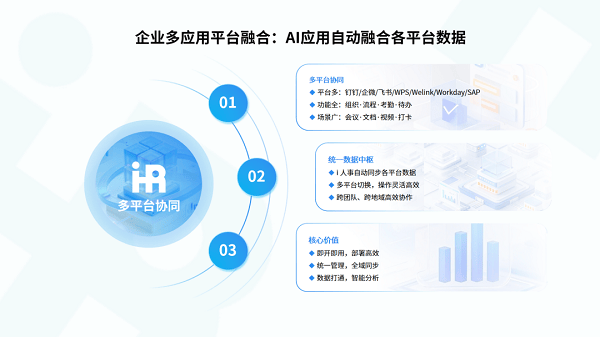
Core Insights - The article highlights the contradiction faced by enterprises during digital transformation, where the number of application systems is increasing, yet operational efficiency is declining [1][3] - The complexity of managing multiple collaboration platforms leads to fragmented information and poor user experience, making deep integration across platforms a key indicator of digital maturity [3][4] - i人事 proposes an innovative solution with a "front-end hub + back-end foundation" approach, enabling seamless integration with major collaboration platforms without the need for secondary development [3][5] Integration Challenges - After addressing front-end collaboration issues, enterprises encounter deeper challenges from "data silos" in core systems like ERP and CRM, leading to inconsistencies in master data [4][5] - The lack of timely permission management can result in data leakage risks, and manual updates across systems slow down responses during organizational changes [4][6] - Unified master data allows for the full utilization of AI and BI technologies, enabling real-time analysis of labor costs and employee performance modeling [4][6] Systemic Engineering - i人事's dual-layer collaborative architecture creates a complete feedback loop between front-end experience and back-end data [5][6] - The integration of organizational and employee data ensures consistency across financial and CRM systems, while operational data supports organizational efficiency analysis [5][6] - The essence of multi-platform integration is a systematic approach to governance of organization, processes, and data, redefining the strategic value of HR systems [5][6]

打破数据孤岛:以i人事HR系统为中枢,驱动企微、钉钉、飞书等多平台融合
Sou Hu Cai Jing· 2025-09-12 05:41
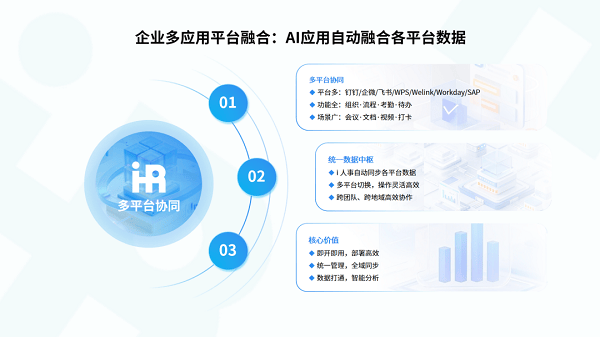
Core Insights - The article discusses the challenges faced by companies in digital transformation, particularly the paradox of increasing operational inefficiency with the growing number of application systems [1] - It emphasizes the need for effective integration of multiple collaboration platforms to enhance organizational efficiency and employee experience [1][8] - The iHR system is presented as a solution to unify various platforms and streamline HR processes, thereby improving data consistency and operational agility [1][5] Group 1: Challenges in Digital Transformation - Companies face operational inefficiencies as the number of application systems increases, leading to fragmented data and poor employee experience [1] - The existence of multiple collaboration platforms complicates HR management, resulting in difficulties in data synchronization and increased management workload [1][3] - Core systems like ERP and CRM create "data silos," leading to inconsistencies in employee information across different systems [4][5] Group 2: iHR System as a Solution - iHR provides an integrated HR system that acts as a central data hub, allowing seamless connectivity with major collaboration platforms without the need for extensive customization [1][3] - Key features of iHR include automatic synchronization of organizational information, streamlined onboarding and offboarding processes, and cross-platform workflow integration [3][4] - The system is designed to enhance data governance and ensure consistency across various business functions, thereby supporting better decision-making [5][6] Group 3: Integration Architecture - iHR employs a three-tier integration architecture consisting of master data, iPaaS, and AI/BI to facilitate backend integration [5][6] - The master data serves as a single source of truth for critical organizational data, ensuring consistency across systems [5] - iPaaS enables low-code integration, significantly reducing the time and complexity involved in connecting various systems [6][7] Group 4: Business Process Optimization - iHR aims to create a closed-loop system where data flows seamlessly between front-end and back-end processes, enhancing overall operational efficiency [8][9] - The system allows for real-time updates and approvals across platforms, streamlining processes such as expense reimbursements [9] - By redefining the role of HR systems, iHR positions itself as a central hub for organizational data, driving cross-departmental collaboration and data-driven decision-making [9]