多晶硅价格下跌

Search documents
多晶硅周报:多晶硅有增产预期,现货继续下调,下方空间打开-20260324
Guang Fa Qi Huo· 2026-03-24 03:07
1. Report Industry Investment Rating No relevant content provided. 2. Core Viewpoints of the Report - The polysilicon market is in a cycle of oversupply, and the surplus is expected to expand, leading to continuous downward pressure on prices [3]. - Multiple companies are rumored to have production increase plans. In the context of pessimistic demand expectations, increasing the operating rate may reduce unit costs but also open up the downward space for spot prices [3]. - Whether the price will fall to the lowest cash cost (below 30 yuan/kg) as in June last year remains to be seen. The current spot average price is approaching the unit cost, and low - price products and futures prices have fallen below the unit cost and are moving towards the cash cost [3]. - The market sentiment tends to trade for market - based clearance, and the price is expected to fall towards the lowest cash cost, leaving further downward space [3]. - The industry chain is moving towards losses again. Attention should be paid to whether any enterprises will be forced out during the process of the price falling towards the lowest cash cost, as well as the impact of improved component quality on raw material requirements [3]. - In terms of trading strategies, the market is currently inactive and in a price - downward cycle, so it is recommended to wait and see [3]. 3. Summary by Relevant Catalog 3.1. Periodic and Spot Price Trends - This week, polysilicon spot quotes continued to decline significantly. The average price of N - type re -投料 decreased by 5.43% to 43.5 yuan/kg, while the N - type granular silicon stabilized at 44 yuan/kg. There is a price inversion between N - type re -投料 rod silicon and granular silicon [11]. - According to statistics from Antaike, the transaction price range of polysilicon n - type re -投料 this week is 42,000 - 45,000 yuan/ton, with an average transaction price of 43,200 yuan/ton, a 4.42% decrease from the previous week. The transaction price range of n - type granular silicon is 43,000 - 45,000 yuan/ton, with an average transaction price remaining at 44,000 yuan/ton [11]. - Trading volume and activity have both declined compared to previous weeks. The market is quiet because some large orders in March were signed at the end of February and early March, and downstream enterprises are pessimistic about the future and cautious in purchasing [11]. - The futures market broke through the support level and fell. One reason is that the falling spot price under high - inventory conditions led to the decline of futures, and the other is that the production increase expectation under high - inventory and weak - demand conditions also caused the price to break through further. On Friday, the futures closed at 37,765 yuan/ton, a significant 10% drop [7]. 3.2. Supply - Demand Situation Analysis 3.2.1 Supply - The output in February decreased to between 77,000 - 85,000 tons. According to SMM, the output in February decreased by 23,800 tons to 77,000 tons. According to the Silicon Industry Association, the domestic polysilicon output in February was about 84,400 tons, a significant 17.3% decrease from the previous month [25]. - There are 10 domestic polysilicon enterprises in production, and the industry's average operating rate has dropped to 35.5%, a 6.5 - percentage - point decrease year - on - year. The weekly output of polysilicon remained flat at 19,000 tons [25]. - In March 2026, the output is expected to increase due to more production days and the resumption of production of some enterprises. The Silicon Industry Association predicts that the total output of polysilicon in March will be between 87,000 - 89,000 tons. Although the maintenance of leading enterprises restricts the supply, the small - scale resumption of previously reduced - production capacity offsets part of the overall supply contraction [25]. - Recently, multiple companies are rumored to have production increase plans, and it is expected that the output will further increase after April, putting downward pressure on prices [25]. 3.2.2 Demand - The prices of silicon wafers and battery cells continued to decline, reflecting both cost reduction and weak long - term demand [27]. - The weekly output of silicon wafers decreased by 0.2GW to 11.78GW, and the inventory decreased by 0.7GW to 27.65GW [38]. - The output of battery cells in February decreased by about 10% to 37.09GW, slightly higher than expected, and the production plan for March is about 46.36GW [43]. - The output of components in January reached 35GW, in February it was 29.3GW, and the production plan for March has rebounded to 41.39GW [47]. - The domestic installed capacity in December was about 40.5GW. The installed capacity in the first quarter was still sluggish, but the export is expected to pick up in the first quarter [53]. 3.3. Cost - Profit Analysis - The falling polysilicon price has led to a rapid decline in profits. Although the price increase in the third quarter of last year repaired the profits, the downstream demand has been continuously weak, and there is no obvious sign of recovery in the first quarter of 2026. The recent price decline and demand drop have made the overall profit outlook still not optimistic [62]. - Daquan Energy's February investor interaction record released on March 4 shows that in the fourth quarter of 2025, the unit cash cost of polysilicon decreased to 33.95 yuan/kg, and the unit cost decreased to 43.46 yuan/kg. In 2025, the company achieved an operating income of 4.83 billion yuan, with a net profit attributable to the parent company of - 1.13 billion yuan, and the loss amplitude narrowed significantly year - on - year. The company's production and sales rate reached 103%, and the inventory was maintained at a reasonable level, with continuous optimization of asset operation efficiency [62]. - Referring to Daquan Energy, Tongwei and GCL have relatively more cost advantages, opening up the expectation space for the futures market [62]. 3.4. Import - Export - In January and February 2026, the imports of polysilicon were 1,047 tons and 1,222 tons respectively, and the exports were 1,838 tons and 2,215 tons respectively. It has been a net exporter since the beginning of the year [65]. - From January to February 2026, the export volume of silicon wafers increased, the import volume decreased, and the net export was 6,736 tons [73]. - From January to February 2026, the export volume of battery cells decreased month - on - month but increased year - on - year, with a 20% year - on - year increase in February. The exports of components decreased [77]. 3.5. Inventory and Warehouse Receipt Changes - The weekly inventory decreased by 13,000 tons to 344,000 tons. The warehouse receipts decreased by 880 lots to 9,810 lots, equivalent to 29,430 tons [88].
1208热点追踪:迟来的回归!多晶硅下跌能否延续?
Xin Lang Cai Jing· 2025-12-08 09:04
Group 1 - The article discusses the recent decline in polysilicon prices and questions whether this downward trend will continue [3][5]. - It highlights the significance of this price movement in the context of the solar energy industry and its potential impact on related sectors [3][5]. - The article suggests that the recent price changes may be a delayed response to market dynamics and supply-demand factors [3][5].


盘中跌破5万元/吨大关!多晶硅市场交易逻辑有变
Qi Huo Ri Bao· 2025-09-24 00:13
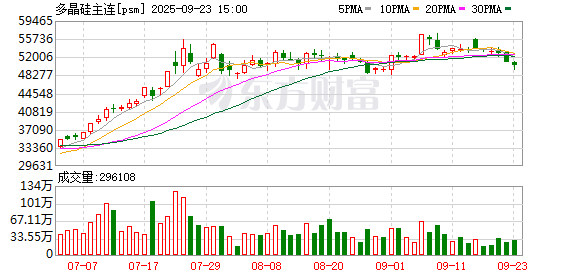
Core Viewpoint - The price of polysilicon futures continues to decline, primarily due to insufficient progress in capacity storage and a lack of supportive policies, leading to a cooling of market sentiment and a return to fundamental trading logic [2][3]. Group 1: Price Trends and Market Sentiment - On September 23, polysilicon futures prices fell to below 50,000 yuan/ton, closing at 50,260 yuan/ton, a decrease of 2.74% [2]. - Analysts indicate that the recent weak performance of polysilicon prices is attributed to the absence of policy support and positive news [2][3]. - The market is experiencing a supply surplus, with September's polysilicon production expected to exceed 130,000 tons, while downstream silicon wafer production is around 59 GW [3]. Group 2: Supply and Demand Dynamics - The fourth quarter is expected to see polysilicon monthly production between 115,000 to 135,000 tons, with inventory levels continuing to rise [2]. - Domestic demand for photovoltaic products is not optimistic, with a significant decline in component bidding volumes from April to September, down 67% year-on-year to 35.61 GW [2]. - Analysts suggest that the implementation of production limits and sales restrictions has tightened polysilicon supply, but high inventory levels among downstream manufacturers are suppressing purchasing demand [3]. Group 3: Future Outlook - To maintain a balance in raw material supply and demand, polysilicon companies may need to reduce their operating rates due to low terminal demand [4]. - The market is expected to remain in a range-bound fluctuation before the National Day holiday, with ongoing attention required on policy changes and company operating rates post-holiday [4].
【安泰科】多晶硅周评—产出预期上调 价格再度下跌(2025年6月18日)
中国有色金属工业协会硅业分会· 2025-06-18 10:51
Core Viewpoint - The price of polysilicon has decreased this week, with significant drops in both n-type and p-type polysilicon prices, indicating a challenging market environment for polysilicon producers and potential implications for the solar industry [1] Price Trends - The transaction price range for n-type feedstock is between 320,000 to 350,000 CNY/ton, with an average transaction price of 344,000 CNY/ton, reflecting a week-on-week decline of 6.27% [1] - The transaction price range for n-type granular silicon is between 330,000 to 340,000 CNY/ton, with an average price of 335,000 CNY/ton, showing a week-on-week decrease of 2.90% [1] - There have been no bulk transactions for p-type polysilicon [1] Market Dynamics - Following the photovoltaic exhibition, the number of polysilicon orders has decreased, leading to further price declines [1] - Major manufacturers are struggling to make sales due to extremely low downstream pricing, resulting in significant price pressure [1] - The decline in prices is attributed to several factors: - A rapid drop in the selling prices of downstream silicon wafer products, leading to expectations of lower raw material prices [1] - Downstream companies have accumulated a certain amount of silicon material inventory, causing significant price pressure on new orders [1] - Polysilicon producers are forced to sell at lower prices to maintain cash flow, which has established a psychological price level for downstream companies that is difficult to exceed [1] Production Capacity - Currently, there are 11 polysilicon producers in operation, all of which are functioning at reduced capacity [1] - Some polysilicon production capacity is expected to resume this month, leading to an anticipated production increase of approximately 8% month-on-month in June [1]