多智能体具身交互

Search documents
丨聚焦多智能体具身交互 第十五届中国智能车未来挑战赛举行
Xin Lang Cai Jing· 2025-12-15 01:42
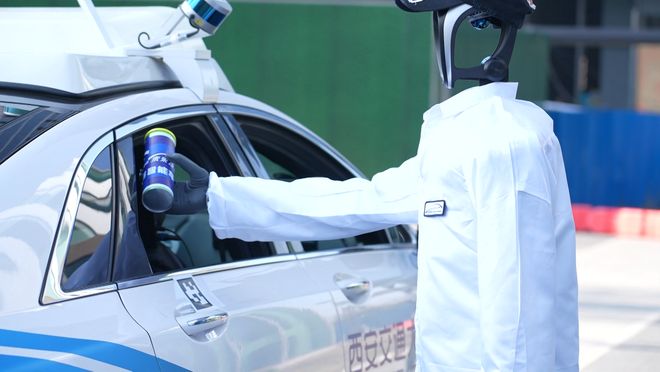
Core Insights - The 15th China Intelligent Vehicle Future Challenge was held in Changshu, Jiangsu, featuring 14 teams from universities and research institutions across the country competing in real-world open road conditions [1] - The theme of this year's event was "Advanced Autonomous Driving and Multi-Agent Embodied Interaction," focusing on the embodied interaction capabilities of human-machine behavior [1] - The competition tested the intelligent driving capabilities of smart vehicles alongside humanoid robots and quadruped robots in complex environments, integrating cutting-edge AI technologies such as large language models, visual large models, and low-altitude drone mapping [1] - The first prize was awarded to the "Wukong" team from the Hong Kong University of Science and Technology (Guangzhou) after intense competition [1] Industry Implications - The event emphasizes the importance of human-machine interaction in the development of autonomous driving technologies, indicating a shift towards more integrated and interactive systems in the automotive industry [1] - The incorporation of advanced AI technologies suggests a trend towards enhancing the capabilities of smart vehicles, which may lead to increased adoption and application in new transportation environments [1] - The competition serves as a platform for innovation and collaboration among academic and research institutions, potentially accelerating advancements in the field of intelligent transportation [1]
2025中国智能车未来挑战赛聚焦多智能体具身交互
Xin Hua She· 2025-12-14 13:27
Group 1 - The 15th "China Intelligent Vehicle Future Challenge" concluded on December 14 in Changshu, Jiangsu Province, with the Hong Kong University of Science and Technology (Guangzhou) team winning the championship, followed by teams from Xi'an Jiaotong University and Tsinghua University receiving second and third prizes respectively [1] - This year's competition focused on "advanced autonomous driving and multi-agent embodied interaction," addressing real-world challenges such as emergency response in dynamic environments, human behavior understanding, and multi-agent interaction [2] - The event serves as an important platform for integrating national intelligent vehicle innovation policies with cutting-edge technology practices, showcasing China's latest research advancements in autonomous driving and providing demonstration scenarios for policy implementation, technology validation, and industry collaboration [2] Group 2 - Since its inception in 2009, the China Intelligent Vehicle Future Challenge has cultivated thousands of experts and talents in the autonomous driving field, leading to significant achievements and the emergence of innovative companies that support China's autonomous driving industry [2]