多模态识别

Search documents
告别 AI 土味审美!Kimi K2.5 实测:扔个视频复刻 iOS 级丝滑动效
歸藏的AI工具箱· 2026-01-27 10:37
Core Insights - Kimi has launched its K2.5 model, which features enhanced aesthetic capabilities and supports multimodal recognition for videos, significantly improving the visual quality of AI-generated web pages [1][5][32] Group 1: Design Capabilities - K2.5 can better adhere to design drafts and prompts, making it easier for designers to realize their visions [8] - For non-designers, K2.5 simplifies the process by allowing users to input content without needing to find attractive design references [8] - The model has shown proficiency in replicating complex interactive components, such as a tab-switching interaction video, demonstrating its advanced multimodal and code generation capabilities [9][17] Group 2: Iterative Design Process - The iterative process with K2.5 allows for easy feedback through screenshots and annotations, leading to quick adjustments and refinements [13][19] - After several iterations, K2.5 successfully recreated a smooth animation effect for a card component system, showcasing its ability to handle multiple card types and animations [30][31] - The model can generate a design system website based on specific prompts, indicating its capability to create comprehensive design specifications [46][49] Group 3: Performance and Limitations - K2.5's performance is notably enhanced in the Agent mode, which allows for higher task completion rates by utilizing virtual machines and various tools [39] - Despite significant improvements, K2.5 still struggles with capturing precise design details, such as small corner radii and specific color values, which remains a challenge for multimodal models [66][68]


怎么看OpenAi的AI浏览器Atlas?
2025-10-22 14:56
Summary of OpenAI's AI Browser Atlas Conference Call Company and Industry - The conference call discusses OpenAI and its newly released AI browser, Atlas, which integrates advanced AI technologies to enhance user experience and functionality [1][2][4]. Core Points and Arguments - **Integration of ChatGPT**: Atlas browser features built-in ChatGPT, allowing seamless user interaction without frequent model switching, thus avoiding performance lags [2][4]. - **Agent Mode**: The browser employs an Agent mode that personalizes user interactions by remembering browsing history and operational details, enhancing contextual assistance [2][4]. - **Data Precision**: OpenAI collaborates with well-known service providers to ensure data accuracy, moving beyond simple OCR technology for page information extraction [2][5]. - **User Base**: Atlas has over 1 million daily active users, with more than 70% being professional consumers who create their own services using OpenAI's tools [8][10]. - **Security Features**: The browser automatically identifies and blocks phishing links, malicious tracking, and unwanted downloads, enhancing user privacy and security [6][10]. - **Developer Support**: OpenAI provides SDKs, Agent Keys, and Codex to lower technical barriers for developers, fostering an open ecosystem for service integration [7][10]. - **Membership Model**: OpenAI's strategy includes a membership system for advanced services, which has successfully attracted existing paid users and new customers seeking enhanced features [10][11]. Additional Important Content - **Future Operating System Entry**: OpenAI aims to position Atlas as a potential entry point for future operating systems, leveraging its advanced model capabilities and strong developer ecosystem [11][12]. - **Challenges for PC Browsers**: The transition of PC browsers to primary entry points faces challenges due to user preferences for mobile devices and potential conflicts with mobile manufacturers [14][15]. - **Cost Management**: Atlas's development requires high standards across various dimensions, including model capabilities and ecosystem partnerships, to ensure user experience despite higher costs [12][13]. - **Multimodal Recognition**: OpenAI addresses the high computational costs associated with multimodal recognition through model optimization and intelligent resource allocation [18][19]. - **Potential Killer Applications**: OpenAI's strengths in large models and developer integration position it well for creating killer applications, particularly through Agent-based solutions and hardware devices [20].
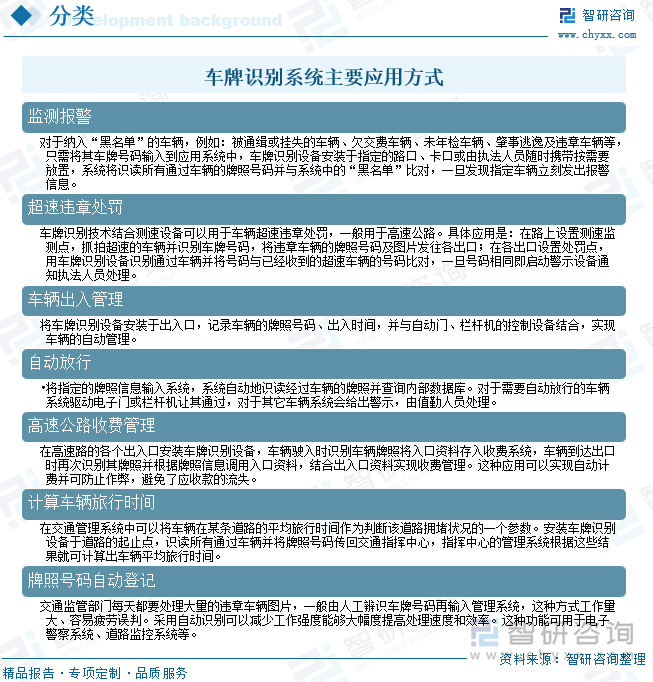
研判2025!中国车牌识别系统行业产业链、发展现状、竞争格局及发展趋势分析:车牌识别系统市场扩容,预计到2029年市场规模将达到23.98亿元[图]
Chan Ye Xin Xi Wang· 2025-06-04 01:10
Core Viewpoint - The intelligent license plate recognition system is becoming an essential part of modern traffic management, significantly improving efficiency and accuracy in various applications such as highway tolls, urban traffic management, and security monitoring [1][14]. Industry Overview - The license plate recognition system utilizes advanced technology to monitor and identify vehicle license information in real-time, playing a crucial role in modern intelligent traffic management [3]. - The market size of China's license plate recognition system industry reached 1.556 billion yuan in 2023, with an expected growth to 2.398 billion yuan by 2029, reflecting a compound annual growth rate (CAGR) of 7.47% [1][14]. Industry Chain - The upstream of the license plate recognition system industry includes components such as chips, sensors, displays, power supplies, and enclosures, with chips being the core component for image processing [8]. - The downstream applications encompass traffic management, vehicle monitoring, and parking management, highlighting the system's versatility in various sectors [8]. Competitive Landscape - The license plate recognition system industry is characterized by low concentration, with numerous small-scale enterprises. Major players include Hikvision, Dahua Technology, and Jieshun Technology, each leveraging their strengths in video monitoring and parking management [16][17]. Development Trends - Multi-modal recognition is identified as a future trend, integrating various sensors and data sources for enhanced vehicle identification and monitoring [21]. - Product differentiation is crucial for competitive advantage, necessitating improvements in service quality, functionality, and customization to meet diverse customer needs [22]. - Increased emphasis on data security and privacy protection is anticipated, driven by regulations such as the Personal Information Protection Law in China, requiring companies to adopt advanced data management practices [24].