车牌识别系统

Search documents
乐山交通监管迈向智能时代 “数字哨兵”紧盯路况
Xin Lang Cai Jing· 2026-02-14 23:01
Core Insights - The project "Digital Transformation and Upgrade of Traffic Infrastructure" in Leshan has successfully completed its three-year task in two years, enhancing traffic monitoring and management through advanced technology [1] Group 1: Project Achievements - Leshan has established 8 new high-position video monitoring points on provincial roads, enabling 24/7 monitoring of traffic flow, road conditions, and unusual events [1] - The project includes the construction of 11 new traffic control stations and the upgrade of 15 national road traffic control stations, equipped with 21 license plate recognition systems for dynamic visibility of traffic data [1] - The digital monitoring system allows for real-time data transmission and AI algorithms to predict congestion risks, significantly improving emergency response capabilities [1] Group 2: Benefits of Digitalization - The project has streamlined the process of vehicle overload detection, reducing wait times at overload stations from 30 minutes to seconds with the introduction of non-stop detection points [1] - The upgraded detection stations utilize a combination of dynamic weighing, license plate recognition, and video monitoring to accurately identify overloaded vehicles and ensure legal transport [1] Group 3: Future Plans - Leshan aims to focus on three key areas: smart road networks, safety emergency response, and green transportation, with plans to further integrate and upgrade 49 national road traffic control stations, 41 provincial road traffic control stations, and 4 rural road traffic control stations [2] - The city has established a comprehensive regulatory network consisting of 11 fixed overload detection stations and 23 non-stop detection points, achieving an 82.1% completion rate for non-stop detection points during the 14th Five-Year Plan, ranking third in the province [2] - The overload rate in Leshan has been maintained at below 1.5%, consistently placing the city among the top tier in the province [2]
门禁系统“沉睡”多年 怎么办
Xin Lang Cai Jing· 2025-12-25 22:30
Group 1 - Residents of Hai Xin Yuan community in Jinghai District reported that the license plate recognition system and barriers installed at the entrances have been idle for years, leading to unauthorized vehicle access and long-term parking issues [1] - The community has seen an increase in "zombie cars" occupying parking spaces for months or even years, as the system has never been officially put into operation [1] - The property management has stated that the license plate recognition system is not under their responsibility, despite multiple complaints from residents [1] Group 2 - The Chaoyang Street Office in Jinghai District responded that the entrance control system was part of a smart security project initiated by the public security department in 2018, but the equipment has become outdated and frequently malfunctions [2] - A meeting involving the community, property management, and residents' committee has been held to discuss the update and activation of the barrier system, with a preliminary plan to repair and officially launch the system by 2026 [2] - The goal of the planned updates is to effectively regulate vehicle access and ensure parking needs and safety for residents [2]
研判2025!中国车牌识别系统行业产业链、发展现状、竞争格局及发展趋势分析:车牌识别系统市场扩容,预计到2029年市场规模将达到23.98亿元[图]
Chan Ye Xin Xi Wang· 2025-06-04 01:10
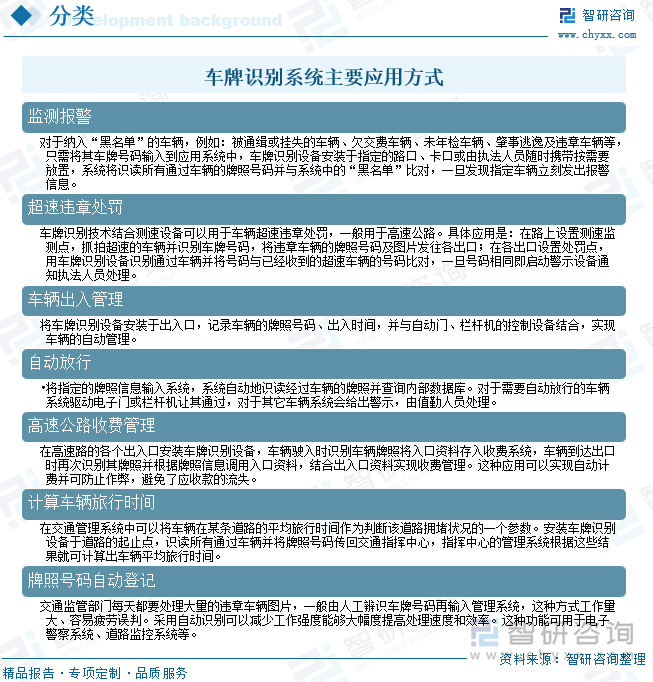
Core Viewpoint - The intelligent license plate recognition system is becoming an essential part of modern traffic management, significantly improving efficiency and accuracy in various applications such as highway tolls, urban traffic management, and security monitoring [1][14]. Industry Overview - The license plate recognition system utilizes advanced technology to monitor and identify vehicle license information in real-time, playing a crucial role in modern intelligent traffic management [3]. - The market size of China's license plate recognition system industry reached 1.556 billion yuan in 2023, with an expected growth to 2.398 billion yuan by 2029, reflecting a compound annual growth rate (CAGR) of 7.47% [1][14]. Industry Chain - The upstream of the license plate recognition system industry includes components such as chips, sensors, displays, power supplies, and enclosures, with chips being the core component for image processing [8]. - The downstream applications encompass traffic management, vehicle monitoring, and parking management, highlighting the system's versatility in various sectors [8]. Competitive Landscape - The license plate recognition system industry is characterized by low concentration, with numerous small-scale enterprises. Major players include Hikvision, Dahua Technology, and Jieshun Technology, each leveraging their strengths in video monitoring and parking management [16][17]. Development Trends - Multi-modal recognition is identified as a future trend, integrating various sensors and data sources for enhanced vehicle identification and monitoring [21]. - Product differentiation is crucial for competitive advantage, necessitating improvements in service quality, functionality, and customization to meet diverse customer needs [22]. - Increased emphasis on data security and privacy protection is anticipated, driven by regulations such as the Personal Information Protection Law in China, requiring companies to adopt advanced data management practices [24].




AI电子眼,帮手还是帮凶?
Hu Xiu· 2025-03-24 07:13
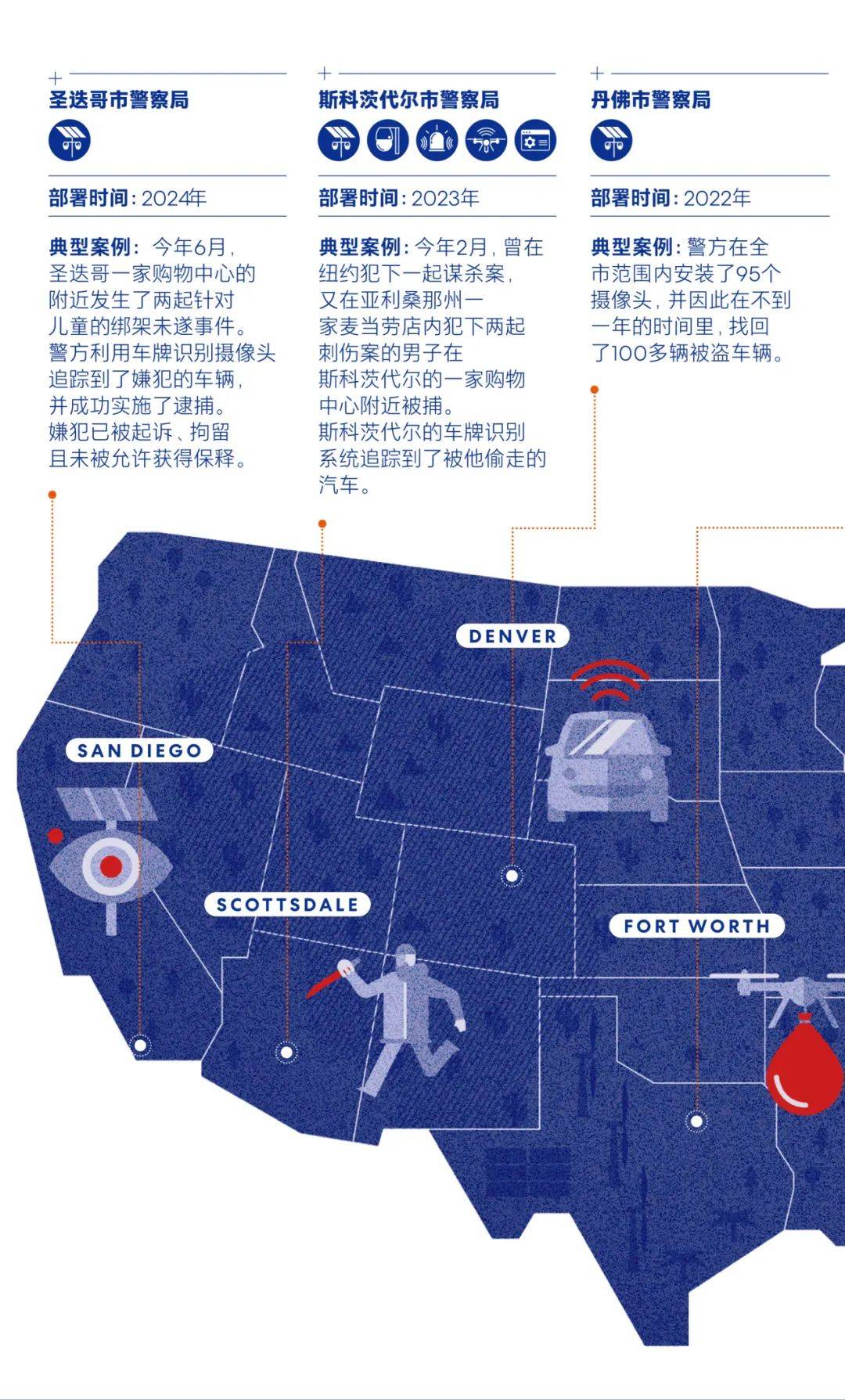
Core Viewpoint - The article discusses the increasing use of technology, specifically license plate recognition (LPR) systems, in law enforcement, highlighting both the benefits and concerns associated with such surveillance technologies. Group 1: Company Overview - Flock Safety, a startup based in Atlanta, specializes in LPR systems and has expanded its product offerings to include security cameras and emergency response drones [2][7]. - The company has raised over $380 million in venture capital and has a market valuation of $4 billion [7]. - Flock's LPR system combines fixed cameras with AI image recognition software, initially priced significantly lower than competitors [8]. Group 2: Contract and Deployment - In March 2024, Flock signed a $3.9 million contract with the San Francisco government to install and operate 400 LPR cameras, with over 200 already deployed by August 2024 [3][5]. - The LPR cameras cover every intersection in San Francisco, which spans 46.9 square miles [3]. Group 3: Market Context and Trends - The article notes a complex crime landscape in San Francisco, where violent and property crime rates are reportedly lower than pre-pandemic levels, despite a significant increase in vehicle thefts nationwide [6]. - Flock has adjusted its sales strategy to emphasize the ability of LPR systems to prevent vehicle theft and assist in law enforcement [7]. Group 4: Public Reception and Concerns - The use of surveillance technology has sparked debate, with civil liberties advocates expressing concerns over privacy violations and potential misuse of data [24][27]. - Despite these concerns, approximately 5,000 individuals, including police chiefs and community leaders, have adopted Flock's systems, indicating a demand for enhanced public safety measures [28]. Group 5: Effectiveness and Criticism - Flock claims to have assisted in solving 10% of reported crimes in the U.S., but the effectiveness of LPR systems in reducing crime remains debated among experts [24][40]. - Critics argue that the proliferation of LPR systems may lead to a surveillance state, raising ethical questions about privacy and civil liberties [39].