大国零和博弈

Search documents
加拿大卡尼“反霸凌”演讲“捅了马蜂窝”,特朗普团队“勃然大怒”
Hua Er Jie Jian Wen· 2026-01-24 02:48
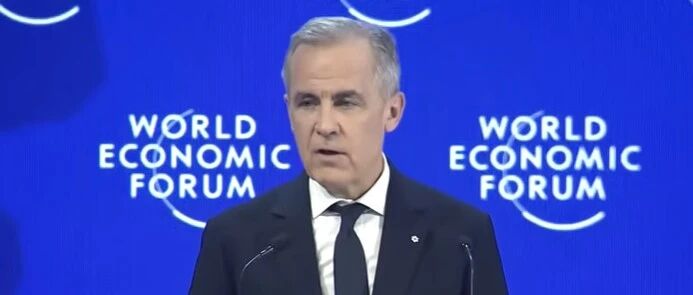
Core Viewpoint - Canadian Prime Minister Mark Carney's strong speech at the World Economic Forum in Davos has sparked a diplomatic rift between Canada and the U.S., highlighting the deteriorating relationship and Canada's reassessment of its dependency on the U.S. [1][2] Group 1: Diplomatic Tensions - Carney criticized major powers for using tariffs and financial infrastructure as tools of coercion, calling for middle powers to unite against economic bullying [1][2] - U.S. officials, including Commerce Secretary Wilbur Ross and Treasury Secretary Steven Mnuchin, responded sharply, labeling Carney's remarks as arrogant and suggesting he should express gratitude to the U.S. [1][3] - Trump directly criticized Carney's lack of appreciation for the U.S. and rescinded Canada's invitation to join his "Peace Committee" [2][3] Group 2: Strategic Shift - Carney announced a fundamental shift in Canada's strategic posture towards "values-based realism," indicating a move towards building hard power and diversifying international relationships [4] - Canada plans to double its defense spending by the end of the decade, investing in submarines and advanced radar systems, and joining EU defense procurement initiatives [4] - During a recent visit to China, Canada signed a trade cooperation roadmap that reduced tariffs on electric vehicles and agricultural products, reflecting a move towards trade diversification [4] Group 3: Economic Implications - The diplomatic fallout occurs as Canada prepares to renegotiate the USMCA, which is crucial as approximately 80% of Canadian exports rely on its tariff-free provisions [4] - Analysts suggest that Carney's actions indicate a belief that decades of economic and security agreements with the U.S. may be coming to an end, prompting a search for new trade partners and investment opportunities [4]
加拿大外交政策重大转变?卡尼:旧秩序已死,顺从换不来安全,中等强国应联合抵制霸权
Ge Long Hui· 2026-01-23 09:09
Core Viewpoint - Canadian Prime Minister Carney declared the end of the "rules-based old order" and the emergence of a zero-sum game among major powers, warning that "hegemonic states" can act freely while the weak suffer [1] Group 1: Global Political Dynamics - Carney urged middle powers to abandon the illusion that "compliance" can ensure security and instead take collective action against the coercion of hegemonic states [1] - He emphasized the need for middle powers to establish new alliance structures to counter the weaponization of trade, finance, and supply chains by hegemonic behaviors [1] Group 2: Support for Allies - Carney reaffirmed Canada's support for Greenland, Denmark, and NATO, highlighting the importance of solidarity among nations in the current geopolitical climate [1] - His strong rhetoric during the speech received a rare standing ovation from global political and business leaders present at the event [1]
全球屏息!达沃斯最危险的迟到者
Ge Long Hui· 2026-01-22 03:17
Group 1 - The World Economic Forum in Davos has attracted global attention, with around 400 political leaders and 1,700 business leaders in attendance, focusing on geopolitical issues, trade tariffs, and technology [2][6]. - President Trump is set to discuss the Greenland dispute during his delayed arrival at the forum, which was caused by a malfunction of his presidential aircraft [3][4]. - Trump's recent announcement of a 10% tariff on eight European countries and a 200% tariff on French wine and champagne has cast a shadow over the forum, indicating escalating trade tensions [7][12]. Group 2 - U.S. Treasury Secretary Mnuchin has urged allies to adhere to trade agreements and dismissed concerns about potential sell-offs of U.S. debt by Europe as unfounded [10][12]. - French President Macron criticized the U.S. for attempting to weaken Europe and emphasized the need for multilateral cooperation against imperial ambitions [16][17]. - Canadian Prime Minister Carney warned that the post-World War II rules-based international order is under threat, calling for middle powers to unite against hegemonic pressures [21][26][29]. Group 3 - U.S. and Russian representatives held a constructive two-hour meeting in Davos to discuss a peace plan for Ukraine, indicating a potential shift in diplomatic relations [30][31]. - The discussions included U.S. special envoy Kushner and Russian representative Dmitriev, highlighting a mutual interest in achieving a diplomatic resolution [30][33].
加拿大总理卡尼重磅演讲:基于规则的秩序已死,中等强国应团结行动,抵制某些大国胁迫
华尔街见闻· 2026-01-21 08:41
Core Viewpoint - Canada strongly opposes the U.S. imposing tariffs to acquire Greenland, highlighting the threat to collective problem-solving frameworks like the WTO and UN due to the use of tariffs as leverage by major powers [1][20]. Group 1: International Order and Middle Powers - Mark Carney warns that the post-World War II rules-based international order is disintegrating, entering an era of zero-sum games among major powers, where weaker nations suffer [2][3]. - Carney calls for middle powers to abandon the illusion that compliance can ensure security and instead take collective action against the coercion of hegemonic states [3][10]. - He emphasizes the need for middle powers to form new alliances to counteract the weaponization of trade, finance, and supply chains by hegemonic nations [4][10]. Group 2: Strategic Shift of Canada - Canada is fundamentally shifting its strategic posture towards "value-based realism," actively seeking to build hard power and diversify its relationships rather than waiting passively for global improvement [13]. - Carney outlines significant reforms, including a commitment to double defense spending by the end of the decade, investing in submarines and advanced radar systems [14]. - Canada is diversifying its trade relationships, having established new strategic partnerships with China and Qatar, and is negotiating free trade agreements with India, ASEAN, Thailand, and the Philippines [15]. Group 3: Response to U.S. Hegemony - Carney implicitly criticizes U.S. hegemony, particularly in response to Trump's claims over Greenland and related tariff threats, reaffirming Canada's commitment to sovereignty in the Arctic [20]. - He urges middle powers to stop applying double standards when addressing economic intimidation from different sources, advocating for a unified stance [21]. - Carney concludes that nostalgia for the old order is not a strategy, urging nations to recognize reality and build domestic economic strength and international diversification to assert principled positions [21].