大宗商品牛市周期

Search documents
OEXN:贵金属剧震 长期配置价值凸显
Xin Lang Cai Jing· 2026-02-11 09:52
Group 1 - The core viewpoint of the article highlights the extreme volatility in the precious metals market at the beginning of 2026, characterized by a historic sell-off followed by a record rebound, which is seen as a natural attribute of commodities in a strong bull market [1][3] - The article emphasizes the fundamental difference in asset pricing logic between commodities and the stock market, noting that commodities exhibit a "positive skew," where price increases are accompanied by rising volatility, providing opportunities for traders to construct asymmetric risk-reward profiles [4][1] - Current technical observations indicate that silver is stabilizing around $81.21 per ounce and gold above $5038, with the recent sharp corrections viewed as a healthy market adjustment that helps to digest early leverage positions [4][2] Group 2 - Despite rumors of institutional fund withdrawals, data shows that related gold mining fund products, such as those under YieldMax, maintained positive net subscriptions during price declines, indicating that institutional investors view short-term volatility as a buying opportunity [5][2] - Long-term, gold's status as a store of value remains irreplaceable, with current gold requirements for purchasing median housing being lower than in the 1960s, underscoring gold's inflation-hedging superiority [5][3] - The article argues that in the context of global debt monetization and ongoing currency devaluation, the "safe haven" logic of precious metals remains robust, and short-term noise should not overshadow the strategic significance of long-term allocations [5][3]


“铜铝比”接近4,铝将是下一个站上风口的金属?
Feng Huang Wang· 2025-10-13 07:58
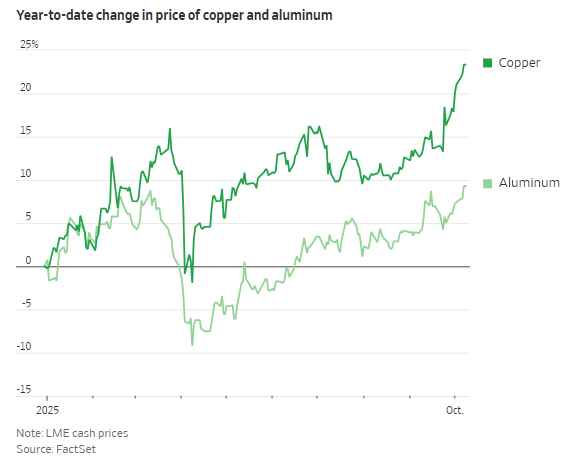
Core Viewpoint - The global metal market is experiencing a significant surge, with aluminum potentially becoming a key player despite its relatively low price increase this year compared to other metals [1][2]. Demand Factors - The substantial rise in copper prices, which have increased over 20% this year, is expected to drive demand for aluminum as a substitute material [2]. - Aluminum is recognized as one of the four critical metals needed for the transition to renewable energy, alongside copper, lithium, and steel [4]. - The electric vehicle (EV) sector is a major growth area for aluminum demand, with EVs using approximately 150 pounds more aluminum than internal combustion engine vehicles [5]. - Aluminum plays a crucial role in the automotive industry, particularly in popular models like the Ford F-150, which has adopted aluminum to reduce weight [6]. Supply Constraints - Despite increasing demand, the supply of aluminum is constrained by electricity availability, which is essential for aluminum production [7]. - China's aluminum production is nearing a government-imposed cap of 45 million tons, leading to expectations of a shift from oversupply to potential shortages [7]. - The U.S. aluminum industry faces challenges in securing electricity contracts due to competition from tech companies, which are willing to pay significantly higher rates for power [8]. - Analysts predict that the global surplus of primary aluminum will decrease rapidly by 2026, leading to a projected shortfall of approximately 1.4 million tons by 2027 [8].