
大湾区扩容

Search documents
中国高铁第一省炼成记
2 1 Shi Ji Jing Ji Bao Dao· 2025-12-22 13:13
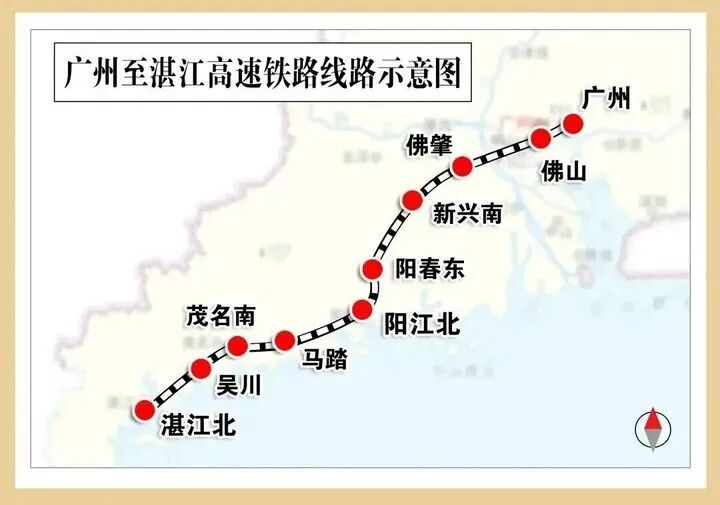
Core Viewpoint - The opening of the Guang-Zhan High-Speed Railway and the Shan-Shan High-Speed Railway marks a significant expansion of Guangdong's high-speed rail network, enhancing connectivity within the Guangdong-Hong Kong-Macao Greater Bay Area and promoting regional economic integration [1][2][10]. Group 1: Infrastructure Development - The Guang-Zhan High-Speed Railway spans approximately 401 kilometers with a total investment of 99.8 billion yuan, making it the most complex and largest railway project in Guangdong [4][10]. - The railway includes the longest underwater tunnel for high-speed rail in China, measuring 9,640 meters, and utilizes advanced construction techniques to overcome significant geological challenges [6][8]. - The Shan-Shan High-Speed Railway features a 9,781-meter underwater tunnel, which is recognized as one of the most challenging construction projects in the country due to its geological conditions [7][9]. Group 2: Economic Impact - The expansion of the high-speed rail network is expected to significantly reduce travel time, facilitating the movement of people and goods, and ultimately driving economic growth in the less developed regions of Guangdong [9][10]. - In 2023, Guangdong's GDP reached 13.57 trillion yuan, with the Pearl River Delta contributing 81.2% of this total, highlighting the economic disparity between the region and the less developed areas [9]. - The Guang-Zhan High-Speed Railway is anticipated to attract talent and capital to the underdeveloped regions of Guangdong, fostering industrial transfer and technological diffusion [9][10]. Group 3: Regional Integration - The new rail connections are set to transform the economic landscape of the Guangdong region, positioning cities like Zhanjiang as strategic nodes in the national railway network and enhancing their role in the Greater Bay Area [10][15]. - The high-speed rail network is part of a broader strategy to create a more balanced and integrated economic environment in Guangdong, addressing historical transportation barriers that have hindered development in the eastern and western parts of the province [11][12]. - The development of high-speed rail is expected to lead to the establishment of "high-speed rail new cities" around stations, promoting urban development and industrial upgrades in surrounding areas [15][16].


中国高铁第一省炼成记
21世纪经济报道· 2025-12-22 12:57
Core Viewpoint - The opening of the Guang-Zhan High-Speed Railway and the Shan-Shan High-Speed Railway significantly enhances connectivity in the Guangdong-Hong Kong-Macao Greater Bay Area, facilitating economic integration and development in the previously isolated regions of East and West Guangdong [4][12][13]. Group 1: High-Speed Railway Developments - The Guang-Zhan High-Speed Railway spans approximately 401 kilometers with a total investment of 99.8 billion yuan, making it the most complex and longest railway project in Guangdong [5][13]. - The Shan-Shan High-Speed Railway connects Shantou to Shantou South, marking a significant addition to the high-speed rail network [2][12]. - With the opening of these railways, Guangdong's high-speed rail network expands to 3,411 kilometers, positioning it to surpass Shandong as the province with the most extensive high-speed rail mileage in China [4][10]. Group 2: Economic Impact and Regional Development - The economic disparity in Guangdong is highlighted by the fact that the East and West Guangdong regions, which occupy nearly 70% of the province's land area, contribute less than 20% to the provincial GDP [10][12]. - The Guang-Zhan High-Speed Railway is expected to attract talent and capital to the West Guangdong region, facilitating industrial transfer and technological diffusion [12][13]. - The railway enhances the strategic importance of cities like Zhanjiang, transforming it from a transportation endpoint to a key node in the national railway network [12][13]. Group 3: Technological Innovations and Construction Achievements - The Guang-Zhan High-Speed Railway features the longest underwater tunnel in China, the Zhanjiang Bay Undersea Tunnel, which is 9,640 meters long and utilizes advanced construction technologies [7][8]. - The project has set multiple records, including the world's first 350 km/h underwater railway tunnel and the largest span for a high-speed railway bridge [7][8]. - Innovative construction methods have been employed to overcome significant geological challenges, resulting in a successful completion of the tunnel within 33 months [7][8]. Group 4: Future Prospects and Urban Development - The integration of high-speed rail is expected to reshape the economic landscape of the regions it connects, fostering urban development and industrial upgrades [16][17]. - Cities along the railway are planning to develop "high-speed rail new towns" to attract investment and facilitate industrial layout [16][17]. - The high-speed rail will enhance the efficiency of business negotiations and talent retention, contributing to the overall economic dynamism of the region [17].
“高铁第一省”炼成记:广东重塑经济地理
2 1 Shi Ji Jing Ji Bao Dao· 2025-12-22 10:21
Core Viewpoint - The opening of the Guangzhan and Shanshan high-speed rail lines marks a significant step in reshaping the economic geography of Guangdong, enhancing connectivity within the Guangdong-Hong Kong-Macao Greater Bay Area and promoting regional development [1][2][8]. Group 1: High-Speed Rail Development - The Guangzhan high-speed rail spans approximately 401 kilometers with a total investment of 99.8 billion yuan, featuring the longest underwater tunnel for high-speed rail in China [4][6]. - The Shanshan high-speed rail includes a 9,781-meter underwater tunnel, overcoming significant geological challenges, and is recognized as one of the most difficult tunnel projects in the country [6][8]. - With the completion of these rail lines, Guangdong's high-speed rail network will extend to 3,411 kilometers, surpassing Shandong to become the province with the most extensive high-speed rail network in China [2][4]. Group 2: Economic Impact and Regional Integration - The new rail lines facilitate a 1.5-hour travel time between previously isolated regions, significantly enhancing the movement of people, talent, and capital, and addressing the economic disparities within Guangdong [2][7]. - In 2023, the GDP of the Pearl River Delta accounted for 81.2% of Guangdong's total GDP, highlighting the need for improved connectivity to boost the economic contributions of the less developed regions [7][8]. - The high-speed rail is expected to attract talent and investment to the less developed areas of Guangdong, transforming them into strategic points within the national railway network [7][8]. Group 3: Technological Innovations and Infrastructure - The Guangzhan high-speed rail project has introduced innovative construction techniques, including the use of intelligent management systems for tunnel construction, which have set multiple records in deep-sea tunnel construction [4][6]. - The Shanshan high-speed rail's underwater tunnel is noted for its resilience against seismic activity and high water pressure, showcasing advanced engineering capabilities [6][8]. - The development of high-speed rail infrastructure is part of Guangdong's broader strategy to create a comprehensive transportation network that supports economic growth and regional integration [9][10]. Group 4: Future Prospects and Urban Development - The high-speed rail lines are expected to stimulate urban development around the stations, with cities planning to create "high-speed rail new towns" to attract investment and enhance local economies [13][14]. - The integration of high-speed rail with existing transportation networks will facilitate the movement of goods and services, enhancing the competitive edge of industries in the region [12][13]. - The rail lines will enable Guangdong to better connect with other economic regions, fostering collaboration and resource sharing across the Greater Bay Area and beyond [8][10].