大湾区机场群协同发展

Search documents
白云机场八千万客流背后:15条跑道撑起大湾区世界级机场群
Nan Fang Du Shi Bao· 2025-12-18 12:31
Core Insights - Guangzhou Baiyun International Airport has officially surpassed an annual passenger throughput of 80 million, joining the global "80 million club" [1][6][15] Group 1: Airport Development and Capacity - The completion of the fifth runway at Baiyun Airport and the third runway at Shenzhen Bao'an Airport has established a world-class airport cluster in the Guangdong-Hong Kong-Macao Greater Bay Area, enhancing regional connectivity and competitiveness [2][9] - Baiyun Airport's new operational structure includes three terminals and five runways, significantly improving its capacity and efficiency for handling high-density flight operations [3][6][7] - The airport has successfully opened or restored nearly 40 international passenger routes this year, expanding its network to over 100 international and regional destinations [7][8] Group 2: Economic and Policy Support - The implementation of a 240-hour visa-free transit policy has effectively attracted international travelers, contributing to a robust recovery in international passenger numbers, which increased by over 19% year-on-year [6][7] - The growth of the Guangdong sports, cultural tourism, and exhibition economies has provided a continuous influx of passengers, further enhancing the airport's role as a hub [7][8] Group 3: Strategic Partnerships - China Southern Airlines, headquartered in Guangzhou, plays a crucial role in supporting Baiyun Airport's hub capabilities, establishing Guangzhou as a primary gateway to Oceania and Southeast Asia [8][15] - The strategic collaboration between Baiyun Airport and China Southern Airlines has led to the development of a "12-hour air traffic circle" connecting Guangzhou with major global economic cities [8] Group 4: Regional Airport Cluster Dynamics - The Greater Bay Area now boasts 15 operational runways, making it one of the regions with the highest airport runway density globally, reflecting a shift towards collaborative and differentiated development among its airports [9][11] - The airports in the Greater Bay Area are forming a multi-layered network, with Hong Kong focusing on international transit, Guangzhou enhancing its Asia-Pacific hub functions, and Shenzhen targeting emerging markets [11][12] Group 5: Future Prospects and Integration - The development of Baiyun Airport and the Greater Bay Area's airport cluster is expected to transform these facilities into high-value industry incubators, attracting high-end industries and services [13][14] - The integration of transportation systems, including high-speed rail and intercity rail, is set to create a comprehensive transport hub, enhancing the efficiency of passenger and cargo flows [12][14]



大湾区机场群迈入“三跑道” 顶级货运枢纽撑起“买全球卖全球”
Nan Fang Du Shi Bao· 2025-12-09 03:17
Core Viewpoint - The expansion and upgrade of the three major international aviation hubs in the Greater Bay Area (GBA) - Guangzhou, Shenzhen, and Hong Kong - signify a shift towards a collaborative network that enhances the overall regional aviation capacity and efficiency, moving into a "3.0 era" characterized by high quality, high efficiency, and high collaboration [1][2][3]. Group 1: Infrastructure Expansion - The three major hubs have completed their runway expansions, with Shenzhen Airport's third runway operational since December 6, 2023, handling over 200 flights in its first week [1][3]. - Guangzhou Baiyun Airport has become the first in China to operate five commercial runways, with its new T3 terminal capable of accommodating an annual passenger throughput of 120 million, and a terminal capacity of 140 million [2][3]. - Hong Kong Airport's three-runway system, fully operational by 2024, is expected to handle 120 million passengers and 10 million tons of cargo annually [3]. Group 2: New Routes and Connectivity - Guangzhou Baiyun Airport has launched new intercontinental routes to Madrid and Darwin, enhancing its position as a key aviation hub connecting China to Europe and Oceania [2][3]. - The "seamless transfer" service between Shenzhen and Hong Kong airports allows passengers to transit without re-entering immigration, significantly improving travel efficiency [5][6]. Group 3: Economic Drivers - The upgrades in the GBA airports are driven by the region's vibrant economy and the specific demands of high-value industries such as electronics, biomedicine, and cross-border e-commerce [7][8]. - The total air cargo volume of the three major airports reached 9.2 million tons in 2024, accounting for 7.2% of the global total, positioning them among the top 20 global cargo airports [7][8]. Group 4: Emerging Economic Zones - The GBA is developing multiple high-end industrial clusters around its airports, including logistics, aircraft maintenance, and high-end manufacturing [8][9]. - The focus on enhancing airport functionalities aims to attract more high-value industries and services, contributing to regional economic growth [9]. Group 5: Competitive Dynamics - The GBA airports face challenges in collaborative development due to overlapping service areas and competition for international routes and cargo resources [10]. - Differentiated positioning is essential, with Guangzhou focusing on Southeast Asia and Oceania, Shenzhen on technology and high-end manufacturing, and Hong Kong on maintaining its global network advantage [10]. Group 6: Future Outlook - By 2035, the GBA is projected to meet an aviation passenger demand of 420 million, necessitating the current infrastructure developments to support global connectivity [11]. - The enhanced airport network is expected to attract multinational companies and elevate the GBA's status in the global economic landscape [11].

事关粤东西北共振!大湾区四座区域航空枢纽能否下好这盘棋?
Nan Fang Du Shi Bao· 2025-11-23 15:53
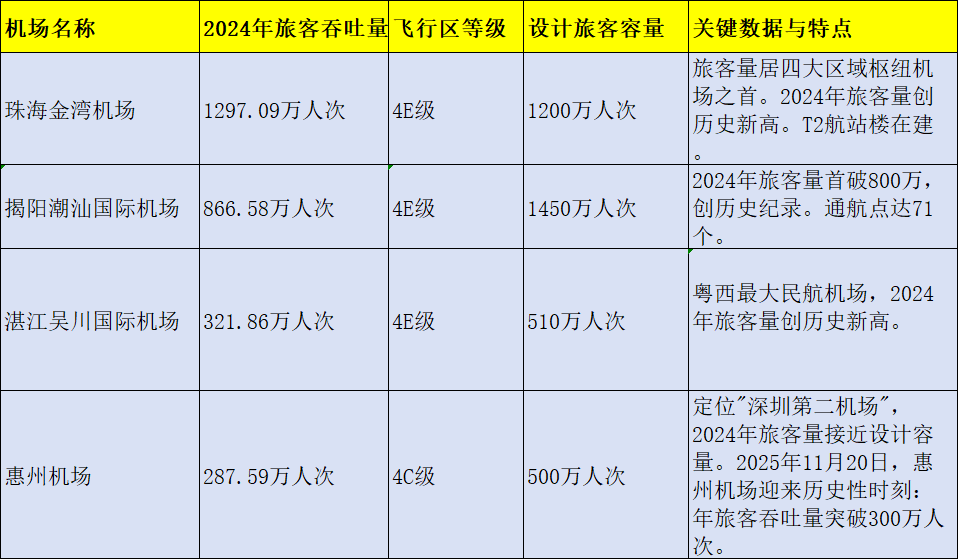
在粤港澳大湾区世界级机场群的"棋盘"上,落子粤东西北的四座区域航空枢纽,正以一连串跃升的数字,展现出强劲的战略价值与发展潜力。 刚刚过去的11月20日,惠州机场年旅客吞吐量刷新纪录,突破300万人次;东翼的揭阳潮汕国际机场2024年全年旅客吞吐量达866.6万人次,创历史新高;西 翼的湛江吴川国际机场则以4E干线机场为目标,迈入提质扩容新阶段…… 珠海机场、揭阳潮汕国际机场、湛江吴川国际机场、惠州机场——这四大枢纽,正以功能互补、错位发展之姿,共同启动区域经济协同的新引擎。它们能否 真正盘活全局,推动粤东西北与珠三角核心区实现更深层次的"共振",值得拭目以待。 "3+4+8"格局下的湾区天空 机场群的多层次布局 当前,粤港澳大湾区世界级机场群建设已进入快速发展阶段。 T3航站楼投运后,广州白云国际机场(以下简称"白云机场")正式迈入"五条跑道+三座航站楼"运行时代,成为中国民航首个五条商用跑道运行的机场,近 期可满足年旅客吞吐量1.2亿人次,货邮吞吐量380万吨使用需求,终端容量更可承载1.4亿人次旅客、600万吨货邮,客货规模均位居世界前列。 T3航站楼的正式启用,不仅是白云机场实现运能跨越的里程碑,更是将 ...