
天然气定价机制

Search documents
开得越多亏得越多!西南气头化企难挺寒冬
Zhong Guo Hua Gong Bao· 2025-10-13 14:15
Group 1 - The core issue facing the southwest gas-based fertilizer companies is the significant disparity between rising natural gas prices and falling urea market prices, leading to operational challenges and potential production halts [1][2] - Natural gas prices have reached 2.29 yuan per cubic meter, with expectations of further increases during the winter heating season, while urea prices have dropped to 1500 yuan per ton, below production costs [1] - The average price of natural gas for chemical use in the southwest region is projected to rise by 32% from approximately 1.75 yuan per cubic meter in 2021 to nearly 2.3 yuan per cubic meter by 2025, contrasting sharply with the decline in urea prices from 2900 yuan per ton to around 1500 yuan per ton [1] Group 2 - There are over 100 gas-based chemical enterprises in the southwest region, consuming nearly 10 billion cubic meters of gas annually, with an estimated urea production capacity of 8.3 million tons in 2024 [2] - The southwest gas-based fertilizer companies are crucial for spring agricultural supply and are considered a foundational element of the southwest industrial system, highlighting the need for government attention and optimization of natural gas pricing mechanisms for sustainable development [2]


西南气头化企难挺寒冬
Zhong Guo Hua Gong Bao· 2025-10-13 02:21
Group 1 - The price of natural gas, a key raw material for fertilizer companies in Southwest China, has reached 2.29 yuan per cubic meter, with expectations of further increases during the winter heating season [1] - The market price of urea has dropped to 1500 yuan per ton, leading to a situation where production costs exceed selling prices, resulting in zero marginal contribution for companies [1] - Companies in the region are facing high inventory levels and are compelled to reduce or halt production due to unsustainable pricing dynamics [1] Group 2 - There are over 100 gas-based chemical enterprises in Southwest China, consuming nearly 10 billion cubic meters of gas annually, with urea production capacity projected at approximately 8.3 million tons in 2024 [2] - The industry emphasizes its strategic importance for spring agricultural supply and calls for government attention to optimize the natural gas pricing mechanism for sustainable development [2]
俄媒:俄罗斯卖给“中国的天然气”仍有大优惠,可能是七折,便宜30%
Sou Hu Cai Jing· 2025-09-05 03:21
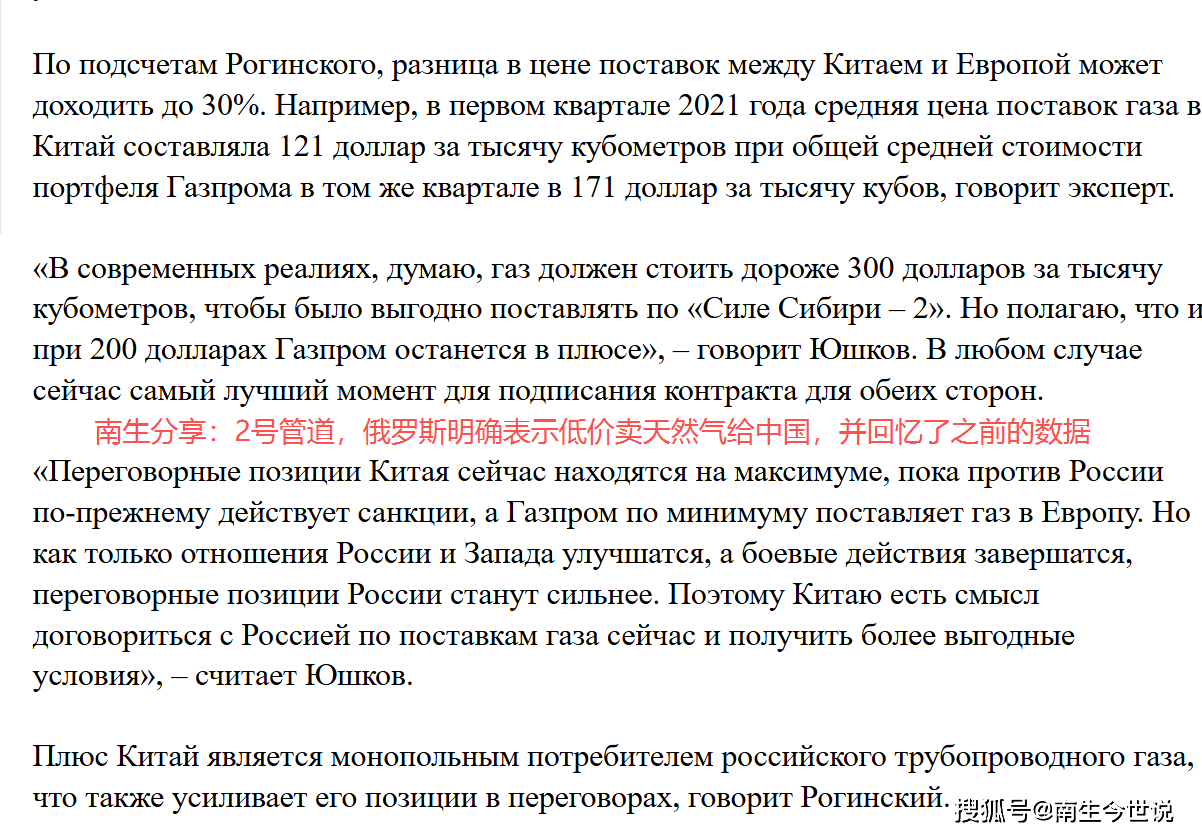
Core Points - The signing of a legally binding memorandum marks a significant step forward for the construction of a new natural gas pipeline system through Mongolia, with an annual capacity of 50 billion cubic meters, known as the "Power of Siberia 2" pipeline, which will connect to China [1] - The project is set against a backdrop of changing geopolitical dynamics, with Russia's gas supply to Europe sharply reduced, making China the largest buyer of Russian gas [1][7] - The negotiation process for the "Power of Siberia 2" project has faced challenges, particularly regarding pricing, but a balance has been found that maintains a price discount for China compared to European prices [1][6] Pricing Mechanism - The pricing for Russian gas supplied to China is based on a formula linked to oil prices, with a nine-month lag, ensuring stable and favorable prices for China [4][10] - In Q1 2021, the average price for Russian gas supplied to China was $121 per thousand cubic meters, compared to an overall export average of $171, indicating a discount of approximately 30% [2][4] - This pricing mechanism contrasts sharply with the spot market pricing used for European gas, which has been volatile [4][6] Strategic Importance - The "Power of Siberia 2" project is strategically significant for both Russia and China, as it provides China with a secure energy supply amid rising tensions with the U.S. and potential disruptions to maritime energy routes [8][10] - Russia's need for stable export revenue and a reliable market for its gas has made China a critical partner, enhancing China's negotiating power [6][8] - The project is expected to take 3 to 5 years to complete, with an estimated total investment of 1.5 trillion rubles, and it benefits from existing infrastructure, reducing development time and costs [10][12] Geopolitical Implications - The pipeline is seen as a key factor in reshaping the Eurasian energy landscape and will inject new momentum into the comprehensive strategic partnership between China and Russia [12] - As the project progresses, the deepening energy cooperation between the two countries is anticipated to have profound implications for the global energy market [12]
天然气行业深度研究(一):从欧洲天然气价格的复盘看天然气价格的演进机制
Guohai Securities· 2025-05-22 15:36
Investment Rating - The report does not explicitly state an investment rating for the natural gas industry Core Insights - Europe is a major consumer of natural gas and has a complex pricing mechanism influenced by market liberalization, supply stability, and geopolitical factors since 1970 [5][14] - The evolution of natural gas pricing in Europe has transitioned from a cost-plus model to oil-linked pricing, and now to a gas-to-gas competition model, highlighting the importance of supply stability [5][14] - The ongoing "de-Russification" of energy supply in Europe and the slow development of alternative supply routes may lead to persistent regional price premiums [5][15] Summary by Sections 1. Historical Pricing Evolution (1970-2024) - The natural gas market in Europe has undergone significant changes influenced by energy crises, geopolitical shifts, and technological advancements [16] - From 1970 to 2000, the market transitioned from a cost-plus pricing model to oil-linked pricing, with long-term contracts being crucial for supply stability [6][17] - The period from 2001 to 2009 saw a significant price increase of 308.5% due to rising oil prices and increased demand for natural gas as an alternative energy source [7][39] - The years 2010-2015 were marked by price fluctuations due to the Fukushima disaster and the European debt crisis, with prices not surpassing 2008 levels despite temporary spikes [53][58] - From 2016 to 2019, LNG trade accelerated, reshaping the supply landscape, with prices experiencing a 140% increase in 2016 before a subsequent decline of 62.3% [8][15] - The period from 2020 to 2024 was characterized by extreme price volatility driven by the COVID-19 pandemic and the Russia-Ukraine conflict, emphasizing the need for energy diversification [9][15] 2. Implications for the Natural Gas Industry - The reliance on a single supplier, particularly Russia, has exposed Europe to significant geopolitical risks, necessitating a diversification of supply sources [9][15] - The urgency of energy transition in China is highlighted, with a need for improved policy coordination and technological advancements to reduce transition costs and risks [9][15] - The report suggests that China should enhance monitoring of industrial gas costs and establish price warning mechanisms to improve industrial resilience [9][15]