
天理

Search documents
天理、物理和数理
猛兽派选股· 2026-02-15 02:33
Core Viewpoint - The article emphasizes the distinction between natural principles (天理), physical laws (物理), and mathematical reasoning (数理), arguing that understanding the natural order transcends mere formulas and calculations [1] Group 1 - The text suggests that those who are overly focused on mathematical formulas may misinterpret the essence of natural and physical laws, leading to misguided conclusions [1] - It highlights the importance of recognizing the cyclical nature of history and the dynamics of commerce, suggesting that true understanding comes from experience rather than rigid formulas [1] - The article warns against the pitfalls of speculation and gambling in investment, indicating that reliance on formulas alone cannot provide clarity in uncertain situations [1] Group 2 - The piece discusses the relationship between mathematical reasoning, physical laws, and natural principles, indicating that true insight is achieved through a gradual understanding of these layers [1] - It reflects on the vastness of the universe and the limitations of human knowledge, suggesting that while life is finite, the pursuit of understanding is boundless [1]


朱熹究竟如何看待人欲
Xin Lang Cai Jing· 2026-01-19 23:20
Group 1 - The core idea of Zhu Xi's philosophy is that the eradication of human desires is not feasible, as desires are inherently linked to external influences and cannot be completely eliminated [1][2][3] - Zhu Xi emphasizes that the concepts of public and private are not mutually exclusive but rather interrelated, with private considerations serving as a foundation for public virtues [2][4] - The notion of "eradicating human desires" is a misinterpretation of Zhu Xi's teachings, which actually advocate for the regulation of desires rather than their complete suppression [3][4] Group 2 - Zhu Xi argues that unrestrained human desires can lead to self-destruction, as they are a form of emotion that must be controlled by natural principles [3][4] - The philosopher highlights the importance of understanding one's inner nature and aligning it with external realities, suggesting that true rationality comes from this alignment [5][6] - Zhu Xi's concept of "learning for oneself" emphasizes the pursuit of inner rationality rather than external gains, advocating for a practical approach to education that aligns with one's inherent nature [5][6]
家务事再难断,也有章法可循
Xin Lang Cai Jing· 2026-01-01 23:53
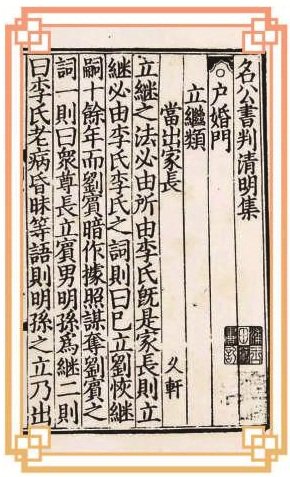
Core Viewpoint - The article discusses a case from the Southern Song Dynasty that highlights the complexities of inheritance disputes among family members, emphasizing the need for judicial officers to balance legal principles with moral considerations in their rulings [2][9]. Summary by Sections Case Background - The case involves a dispute over inheritance between biological sons and an adopted son, showcasing the intricate legal issues surrounding property, inheritance, and familial relationships during the Southern Song period [2][3]. Judicial Process - Judicial officer Hu Ying, known for his integrity and legal acumen, presided over the case, which included various legal topics such as the validity of contracts and the rights of biological sons versus an adopted son [3][4]. - The biological sons, Tan Youji, were disinherited and expelled from their home, while the adopted son, Li Ziqin, inherited all the property, raising questions about the legitimacy of the inheritance [4][5]. Evidence Examination - Hu Ying focused on two main issues: the legal validity of ten contracts submitted by Li Ziqin and whether the biological sons had the right to manage the property during their father's lifetime [5][6]. - The investigation revealed significant flaws in the contracts, including missing signatures and discrepancies in the timing of their execution, leading to doubts about their legal standing [6][7]. Ruling and Reasoning - Hu Ying concluded that the contracts were invalid due to legal violations and that the biological sons had been coerced into signing them, thus rendering the contracts void [6][8]. - The ruling emphasized the importance of familial bonds and moral obligations, ultimately deciding to distribute the property among the biological sons while giving a token share to Li Ziqin due to his long-standing relationship with the deceased [8][9]. Judicial Philosophy - The case illustrates the threefold wisdom of Song Dynasty judicial officers in resolving family disputes: accurately establishing facts, applying laws judiciously, and considering moral implications [9][10]. - Hu Ying's approach serves as a historical reference for contemporary family law, highlighting the need to balance legal norms with emotional and ethical considerations in family disputes [10][12].
认真对待“敬”字工夫
Xin Lang Cai Jing· 2025-12-22 23:27
Core Viewpoint - The article explores the concept of "敬" (respect) in Zhu Xi's philosophy, emphasizing its multifaceted nature and the need for a deeper understanding beyond its modern interpretation [1][2][8]. Group 1: Understanding "敬" - Zhu Xi elevates the concept of "敬" to a fundamental principle in his teachings, stating that it is the essence of the "Saint's teachings" [1]. - The term "敬" traditionally implies respect towards those of higher status or achievement, but Zhu Xi's context challenges this by suggesting respect should also be directed towards "人欲" (human desires) [2]. - In ancient Chinese, "敬" can refer to a variety of subjects, including oneself, adversaries, and even negative entities, indicating a broader application than in modern usage [3][4]. Group 2: Contextual Applications of "敬" - Historical texts illustrate that "敬" can be directed towards potential threats or negative influences, emphasizing the importance of vigilance and caution [4][5]. - The article highlights that "敬" encompasses a range of meanings such as caution, respect, and seriousness, with "认真对待" (seriously regard) being a core interpretation [6][8]. - Zhu Xi's teachings encourage a serious approach to all endeavors, reinforcing the idea that "敬" is about being earnest and attentive in one's actions [7][8].