太空圈地运动

Search documents
星链彻底成功那天,地球人要被美国拿捏了?马斯克的星链计划要是真能彻底成功,别被所谓 “全球通信革新” 的噱头骗了,这根本不是全人类的福利,而是藏着獠牙的科技威胁。是美国在太空搞霸权霸凌的赤裸裸表现,其他国家要是没拿出靠谱的反制手段,往后在太空领域只会处处被动,后果真的没法想象。...
Sou Hu Cai Jing· 2026-01-13 02:31
Core Viewpoint - The success of SpaceX's Starlink program may not be a global benefit but rather a manifestation of U.S. technological dominance, posing significant risks to other nations' sovereignty and security [1][2]. Group 1: Technological Implications - Starlink's network, consisting of over 40,000 terminals, allows for direct communication without traditional ground infrastructure, enabling effective military operations in conflict zones like Ukraine [2]. - The introduction of the "Starshield" program, which plans to launch 15,000 satellites, indicates a shift from civilian to military applications, raising concerns about the potential for coercive control over nations reliant on this technology [2][3]. Group 2: Geopolitical Risks - The limited physical space in low Earth orbit and the scarcity of radio frequencies create a competitive environment where the first to occupy these resources can exert control over others, likening it to monopolizing a vital road [3][4]. - The aggressive deployment of Starlink satellites has previously posed collision risks to international space stations, highlighting the potential for geopolitical tensions and operational hazards in space [4][6]. Group 3: Security Concerns - The proliferation of Starlink technology could inadvertently facilitate global terrorism, as the widespread availability of such systems may fall into the wrong hands, complicating security measures [5]. - Without developing independent satellite systems, nations risk becoming overly dependent on foreign technology, which could lead to vulnerabilities in national defense and communication infrastructures [5].


军工逆市爆发,商业航天满屏涨停!军工ETF华宝(512810)豪涨逾4%创新高!2026“军工大年”稳了?
Xin Lang Cai Jing· 2026-01-08 11:59
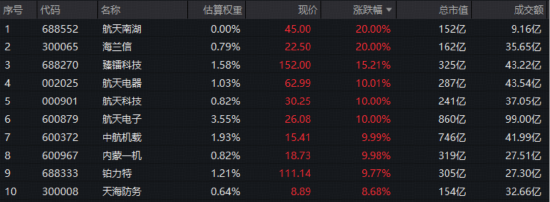
Core Viewpoint - The commercial aerospace sector is experiencing a resurgence, with significant gains in military stocks, particularly those related to the aerospace industry, as evidenced by the performance of the Huabao Military ETF (512810) [1][9]. Group 1: Market Performance - On January 8, 2023, the Huabao Military ETF (512810) saw a peak increase of 4.55% and closed up 4.19%, marking its largest single-day gain in nearly six months [2][10]. - A total of 24 commercial aerospace concept stocks under the Huabao ETF surged, with seven stocks hitting the daily limit, including Aerospace Nanhu and Hailanxin, both up by 20% [1][9]. - The ETF's price reached a new high since its listing in August 2016, with a total trading volume of 88.3 million yuan [2][10]. Group 2: Capital Inflows - There was a significant net buying of 18.932 billion yuan in the defense and military sector, leading all industries, with major inflows into stocks like Aerospace Electronics and Hailanxin, each exceeding 1 billion yuan [4][13]. - The main stocks targeted by institutional investors included Aerospace Electronics, Hailanxin, and Aerospace Electric, all of which saw their prices hit the daily limit [4][13]. Group 3: Industry Developments - The domestic commercial aerospace industry is accelerating, with announcements such as the upcoming launch of the "Vesta-1 Sea Launch" commercial rocket by Xinghe Power Aerospace [11]. - The first offshore reusable rocket recovery base in China is under construction in Zhejiang, indicating a significant step forward in the industry [11]. - Internationally, SpaceX is ramping up production capabilities at its Gigabay facility, aiming for an annual output of 1,000 Starships, reflecting a global trend towards increased aerospace production [11][12]. Group 4: Future Outlook - According to Zhongtai Securities, the global commercial aerospace industry is expected to enter a period of explosive growth over the next two years, driven by technological advancements and increasing demand for launch services and satellite networks [12]. - Guolian Minsheng Securities holds a positive view on the military industry for the coming year, emphasizing the importance of tracking domestic demand recovery and strategic investments in areas like unmanned equipment and commercial aerospace [14].