
太空算力+AI

Search documents
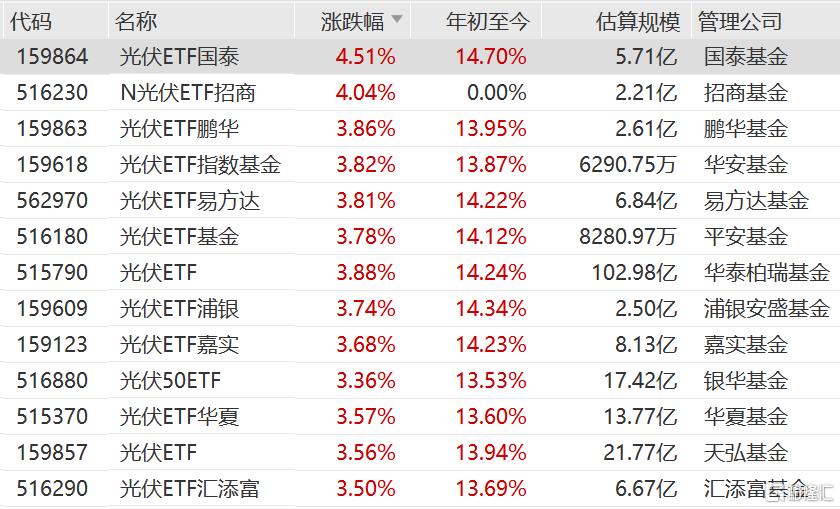
太空光伏概念拉升,光伏ETF国泰、光伏ETF招商涨超4%,光伏ETF易方达、光伏ETF上涨
Ge Long Hui A P P· 2026-02-03 02:49
Core Viewpoint - The space photovoltaic concept is gaining traction, with significant stock price increases in related companies and ETFs, indicating a growing interest and potential in the sector [1][4]. Group 1: Stock Performance - Companies such as Shuangliang Energy and Aotewi have seen their stock prices hit the daily limit, while others like Maiwei Co., Dike Co., and Guosheng Technology also experienced notable gains [1]. - Various photovoltaic ETFs, including Guotai and CMB, have risen over 4%, with others like E Fund and Ping An also showing increases above 3.5% [1][2]. Group 2: Industry Insights - SpaceX's acquisition of xAI highlights the integration of AI in space technology, emphasizing the importance of AI in expanding the capabilities of space-based systems [3]. - The development of space photovoltaics is not merely speculative; it is on the verge of large-scale deployment driven by the need for "space computing power + AI" and the ongoing competition for low Earth orbit resources [4][5]. - The evolution of space photovoltaics is linked to national strategic interests, communication satellite deployment, and the energy revolution driven by AI computing power [4].

中信证券:太空光伏并非炒作 正在进入规模化部署的前夜 远期市场空间有望增长30倍以上
Ge Long Hui A P P· 2026-02-01 01:12
Group 1 - The core viewpoint is that space photovoltaic technology is not a hype but is on the verge of large-scale deployment, driven by real demand, engineering implementation, and a commercial loop [1] - The explosion of space photovoltaic technology is attributed to the new demands of "space computing power + AI" and the ongoing competition for low Earth orbit resources globally [1] - China's accelerated deployment of satellite constellations is primarily for strategic orbit occupation, followed by building communication capabilities, and finally enhancing computing power and AI [1] Group 2 - It is projected that the number of satellite launches will increase from 5,000 to 50,000 between 2025 and 2040, with gallium arsenide batteries dominating in the short term at an 80% penetration rate [2] - As costs decrease and technology advances, the penetration rates of P-type HJT and perovskite/silicon tandem batteries are expected to rise, with perovskite/silicon tandem batteries projected to reach a 60% penetration rate in the long term [2] - The overall market space for photovoltaic cells in the satellite sector is estimated to reach 328.8 billion yuan, representing a growth of over 30 times compared to the short-term market space [2]
