P型HJT电池

Search documents
太空光伏系列报告(一):太空能源心脏,开启商业航天万亿蓝海
Shenwan Hongyuan Securities· 2026-03-27 13:41
Investment Rating - The report indicates a positive investment outlook for the space photovoltaic industry, highlighting significant growth potential driven by technological advancements and market demand [3]. Core Insights - The commercial space sector is entering a large-scale, industrialized phase, with the market expected to reach trillion-yuan levels, particularly in space photovoltaics, which are anticipated to see explosive demand growth [3][30]. - The technology landscape for space photovoltaics is evolving through a tiered approach: GaAs technology dominates high-value applications, while P-type HJT and perovskite technologies are emerging as key players for future applications [3][11]. - The demand for low Earth orbit (LEO) satellites and space computing is creating a substantial market opportunity, with projections estimating the space photovoltaic market could grow from hundreds of billions to trillions of yuan by 2030 [3][30]. Summary by Sections 1. Technology Evolution of Space Photovoltaics - The development path of space photovoltaics shows a clear evolution from silicon to GaAs and then to multi-junction and perovskite technologies, focusing on efficiency, cost, and radiation resistance [5][11]. - Current leading technology is the multi-junction GaAs solar cells, which are highly efficient but face cost and production capacity limitations for broader applications [11][21]. 2. Market Demand and Growth Potential - The low Earth orbit satellite market is projected to reach approximately 29 billion yuan by 2030, with optimistic scenarios for space computing potentially pushing the overall market towards trillion-yuan levels [3][30]. - The rapid increase in satellite launches, particularly by major players like SpaceX and China's satellite constellations, is driving demand for space photovoltaics [30][31]. 3. Investment Opportunities - The report suggests prioritizing investments in photovoltaic equipment manufacturers that possess space photovoltaic technology, as well as companies involved in advanced materials for space applications [3][50]. - Key companies identified for investment include Maiwei, Jiejia Weichuang, and others that are leading in equipment and technology for space photovoltaics [50][55]. 4. Key Companies and Their Developments - Maiwei is highlighted as a leading company in HJT technology with significant orders from SpaceX, indicating strong market positioning [50]. - Other notable companies include Jiejia Weichuang and Laoplas, which are advancing in TOPCon and perovskite technologies, respectively [50][55]. - Companies like Kaisheng Technology and Lens Technology are also making strides in developing materials suitable for space photovoltaic applications [50][55].




商业航天:钙钛矿——下一代太空光伏的重要选择(附42页PPT)
材料汇· 2026-03-15 15:33
Core Viewpoint - The article emphasizes the rapid development of the commercial aerospace industry and highlights the potential of space photovoltaic technology as a key energy solution for future space missions [4]. Group 1: Industry Trends and Market Demand - The low Earth orbit (LEO) and frequency spectrum have become critical strategic resources in global aerospace competition, with a capacity for 175,000 satellites in the 300-2000 km altitude range, far exceeding current satellite registrations [5]. - By 2025, China is projected to achieve a record 92 space launches, with commercial launches accounting for 54% of total launches and 84% of satellites entering orbit being commercial [5][7]. - The commercial aerospace sector is characterized by a collaborative support of hardware (satellites, rockets) and software (frequency resources, application services), with significant advancements in satellite constellations and reusable rockets [7]. Group 2: Space Photovoltaic Technology - Space photovoltaic technology is gaining attention due to its ability to harness solar energy in space, with efficiency rates 2-3 times higher than ground-based systems, benefiting from continuous sunlight in geostationary orbits [7][19]. - The article outlines the evolution of space photovoltaic technologies, including GaAs, silicon, P-type HJT, and perovskite, with perovskite emerging as a leading candidate due to its lightweight and high efficiency [23][39]. - Perovskite solar cells have shown promising results in space applications, with a radiation tolerance that outperforms traditional III-V cells, making them suitable for long-term space missions [39][45]. Group 3: Investment and Policy Landscape - Over 40 policies supporting commercial aerospace have been issued across more than 20 provinces, with significant investment growth, reaching 18.6 billion yuan in 2025, a 32% increase year-on-year [9]. - The establishment of specialized funds for commercial aerospace indicates a growing interest from investors, with several companies in the sector preparing for public listings [9]. - The Chinese government has prioritized perovskite technology in its energy innovation plans, recognizing its potential to drive down costs and improve efficiency in the photovoltaic sector [41]. Group 4: Future Outlook for Perovskite Technology - Perovskite technology is expected to reshape the aerospace energy landscape, offering a cost advantage of approximately 30% compared to GaAs cells, along with significant weight reduction and flexibility for various spacecraft designs [46][48]. - The domestic perovskite industry is rapidly advancing, with multiple gigawatt-scale production lines being established, indicating a strong push towards commercialization and large-scale application [51]. - The theoretical efficiency of perovskite cells could reach 36%-38%, significantly surpassing traditional silicon cells, making them a viable option for future space missions [48].

2026年中国太空光伏行业产业链、发展背景、需求量预测及未来趋势展望:受益于卫星发射数量激增及太空算力部署加速,太空光伏或成下一个增长蓝海[图]
Chan Ye Xin Xi Wang· 2026-02-09 01:14
Core Viewpoint - Space photovoltaics is emerging as a strategic solution for commercial space and high-end applications, with significant growth expected due to the increasing demand for satellite launches and space computing capabilities [1][2][5] Group 1: Overview of Space Photovoltaics - Space photovoltaics refers to the use of solar photovoltaic technology in outer space environments to generate and supply energy, either transmitted wirelessly to the ground or used to power satellites and space stations [2][5] - The industry is at a turning point, with a projected increase in satellite launches leading to a shift from niche markets to large-scale applications [1][5] Group 2: Industry Development Background - The global satellite launch market is experiencing a surge, with over 10,000 low Earth orbit satellites expected to be registered by the end of 2025, including approximately 45,000 from the U.S. and 53,000 from China [5][6] - Space photovoltaics is seen as the only viable long-term power solution for spacecraft, as traditional energy sources face significant limitations in space [6][7] Group 3: Current Status of the Space Photovoltaics Industry - The industry has evolved from early applications of solar energy in satellites to advanced technologies, with gallium arsenide batteries achieving over 30% efficiency and becoming the gold standard for high-end space equipment [9][10] - The current technology roadmap includes short-term gallium arsenide, mid-term silicon-based HJT, and long-term perovskite tandem technologies, each achieving significant breakthroughs [10][11] Group 4: Market Size Forecast - By 2035, if satellite launches reach 15,000 annually and power per satellite increases from 15 kW to 30 kW, the total photovoltaic battery demand will reach 0.45 GW [11] Group 5: Industry Layout and Key Players - Companies such as Hangzhou Shangyi Optoelectronics Technology Co., Ltd., and Shenzhen Guangyin Technology Co., Ltd. are accelerating their involvement in the space photovoltaics sector, leveraging their expertise in materials and systems integration [2][12] - The collaboration between traditional aerospace companies and photovoltaic leaders is creating new growth opportunities in the "photovoltaics + aerospace" space [12] Group 6: Challenges and Trends in Industry Development - The space photovoltaics industry faces challenges such as high costs, the need for improved material reliability in extreme environments, and the lack of a mature supply chain [12][13] - Future trends indicate a gradual commercialization process, focusing initially on specific space facilities, then expanding to low Earth orbit satellite constellations, and eventually enabling large-scale energy transmission to Earth [12][13]

中信证券:太空光伏设备价值量或将实现跃迁式提升 重点推荐龙头公司
智通财经网· 2026-02-09 00:58
Core Viewpoint - The report from CITIC Securities highlights Elon Musk's investment in photovoltaic manufacturing as a pathway to power orbital computing and AI, indicating strong growth potential for leading Chinese photovoltaic equipment manufacturers in the supply chains of Tesla and SpaceX, which could lead to substantial orders and new growth opportunities [1] Group 1: SpaceX and Photovoltaic Demand - SpaceX is targeting orbital computing, with the demand for space photovoltaics expected to grow exponentially, driven by the rapid development of the Starlink satellite network and plans to deploy millions of satellites [2] - In a conservative scenario, global space photovoltaic demand is projected to reach 1GW and a market size of over 80 billion yuan by 2030; in an optimistic scenario, these figures could rise to 70GW and nearly 3 trillion yuan [2] Group 2: Market Projections and Technology - The report outlines significant growth in satellite launches and power requirements, with domestic satellite launches expected to increase from 1,000 in 2026 to 3,000 by 2030, and eventually to 500,000 [3] - The demand for space photovoltaic batteries, particularly P-HJT and perovskite technologies, is anticipated to grow dramatically, with projections indicating a market expansion of up to 100 times or more in the next five years [2][3] Group 3: Manufacturing Capacity and Equipment Value - Musk revealed plans for Tesla and SpaceX to establish 100GW of photovoltaic manufacturing capacity each in the coming years, with Tesla likely to adopt TOPCon technology and SpaceX favoring P-HJT technology [4] - The leading Chinese photovoltaic equipment manufacturers are well-positioned to meet the high standards and demands of Tesla and SpaceX, potentially capturing significant market share and opening up extensive growth opportunities from ground to space [4][7] Group 4: Future Market Dynamics - The growth of space photovoltaic technology is expected to surpass traditional photovoltaic systems due to higher complexity, customization, and equipment standards, leading to a significant increase in equipment value [7] - The overall market for space photovoltaics is projected to exceed expectations, with a potential market size reaching 173.78 trillion yuan by the ultimate target [3][7]


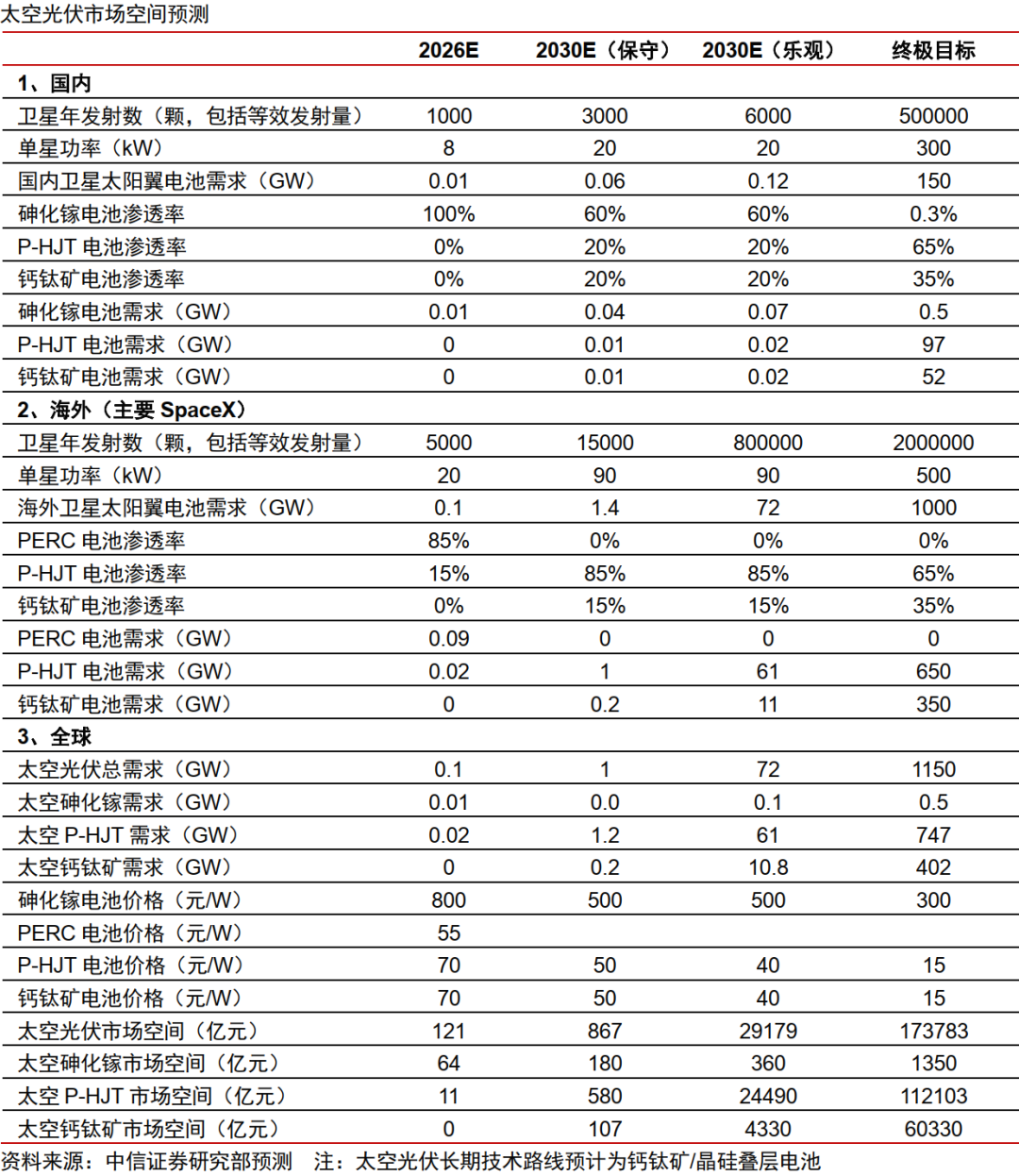
中信证券:太空光伏卖铲人,有望迎价值跃迁
Xin Lang Cai Jing· 2026-02-09 00:55
Core Insights - The demand for space photovoltaic technology is expected to experience exponential growth, driven by SpaceX's initiatives and the need for energy in satellite and orbital computing [3][12] - Major Chinese photovoltaic equipment manufacturers are well-positioned to enter the supply chains of Tesla and SpaceX, potentially securing high-value orders and opening new growth opportunities [3][5][12] - The value of space photovoltaic equipment is anticipated to significantly increase due to its unique requirements and technological advancements [7][16] Group 1: Market Demand and Projections - SpaceX is accelerating the development of its Starlink project and plans to deploy millions of satellites, which will drive the demand for space photovoltaic systems [3][12] - In a conservative scenario, global demand for space photovoltaic systems is projected to reach 1GW and a market size of over 80 billion yuan by 2030; in an optimistic scenario, these figures could rise to 70GW and nearly 3 trillion yuan [3][12] - The market for space P-type HJT and perovskite batteries is expected to grow by 100 to 1000 times in the next five years [3][12] Group 2: Technological Developments and Manufacturing Capacity - Elon Musk announced plans for Tesla and SpaceX to establish 100GW of photovoltaic manufacturing capacity each, focusing on ground and space applications [5][14] - The technological focus for Tesla is likely to be on TOPCon technology, while SpaceX may adopt the P-type HJT technology route [5][14] - The increasing complexity and customization of space photovoltaic technology will likely enhance the value of related equipment, with expectations for a market size that exceeds current estimates [7][16] Group 3: Investment Opportunities - The strong iterative capabilities and rapid response of leading Chinese photovoltaic manufacturers position them favorably to meet the high standards set by Tesla and SpaceX [5][12][18] - The anticipated inflationary effects on space photovoltaic equipment value could lead to significant investment opportunities in this sector [7][18] - Recommendations are made to focus on leading photovoltaic equipment manufacturers that possess technological, product, and market share advantages [3][12][18]
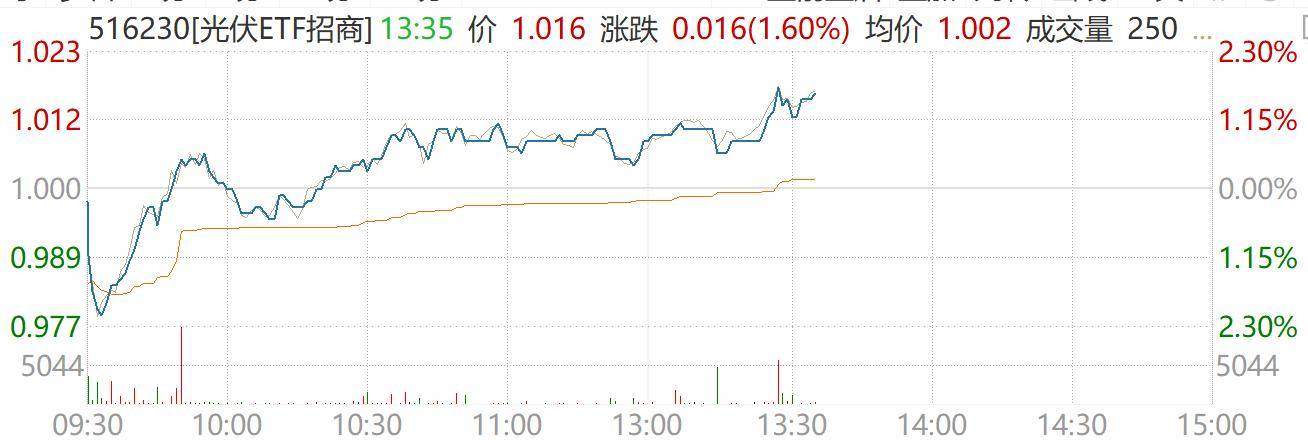
产业盈利触底回升,太空需求打开新蓝海,光伏ETF招商(516230)午后放量拉升
Sou Hu Cai Jing· 2026-02-06 05:58
Core Insights - The photovoltaic sector continues to show strong performance, with significant stock price increases among key companies [1][3] - The market's heightened focus on industry trends, particularly "space photovoltaics," is driving this momentum [3][4] Group 1: Industry Performance - As of Q3 2025, the photovoltaic industry's profitability indicators are expected to stabilize, with a projected return to positive net profits for the year [4] - The overall revenue growth rate for the photovoltaic industry is anticipated to end its decline starting Q1 2025, indicating a potential shift towards high-quality development [4] Group 2: Technological Advancements - The demand for high-performance photovoltaic systems is being driven by global low-orbit communication constellations and space AI computing initiatives, leading to a new market for space photovoltaics [7] - The evaluation criteria for photovoltaic systems are shifting from cost-efficiency for ground stations to power, reliability, and manufacturability for space applications, raising technical barriers and product value [7] Group 3: Investment Opportunities - Companies leading in HJT equipment, perovskite technology research, and core material supply are experiencing stock price increases, reflecting market revaluation of technological leadership and new growth areas [8] - The emerging demand for space photovoltaics, although in its early stages, indicates a strategic direction for the photovoltaic industry to upgrade its value amidst cyclical challenges [8]
太空光伏概念股集体回应业务情况 市场情绪波动引关注
Xin Lang Cai Jing· 2026-02-06 00:59
Group 1 - The core viewpoint of the articles highlights the volatility in the space photovoltaic concept stocks, with significant declines following initial surges due to rumors of investigations by Elon Musk's team [1][2] - Companies such as Junda Co., Shuangliang Energy, and others have issued announcements clarifying their current business status regarding space photovoltaics, indicating that they have not engaged in related business and that their main operations remain focused on terrestrial photovoltaic sectors [1][2] - The photovoltaic industry is currently undergoing a deep adjustment period, with significant challenges in supply-demand mismatches, and regulatory bodies emphasize the need to address "involution" within the industry as a priority for the year [2] Group 2 - Despite the recent pullback in concept stocks, some brokerages remain optimistic about the long-term prospects of space photovoltaics, suggesting that the technology is on the verge of large-scale deployment [3] - According to CITIC Securities, the number of satellite launches is expected to increase from 5,000 to 50,000 between 2025 and 2040, with gallium arsenide batteries currently holding an 80% market share, but other technologies like P-type HJT and perovskite/silicon tandem cells are anticipated to gain traction [3] - The future market space for photovoltaic cells in the satellite sector is projected to reach 328.8 billion yuan, indicating a potential growth of over 30 times compared to the current market size [3]
太空光伏概念热度退潮,多家上市公司紧急澄清业务现状
Xin Hua Cai Jing· 2026-02-06 00:54
Core Viewpoint - The A-share space photovoltaic concept stocks experienced a collective decline following rumors of an investigation by Elon Musk's team, leading to significant drops in several companies' stock prices. Group 1: Company Responses - Junda Co. stated that space photovoltaic technology is still in the preliminary exploration stage, with no orders or revenue related to this sector, and their main business remains focused on ground photovoltaic fields [1] - Jingcheng Machinery emphasized that the application scenarios for space photovoltaics are still exploratory, and the industrialization process faces uncertainties, with no substantial impact on current business performance [1] - Shuangliang Energy clarified that they have not engaged in space photovoltaic business and that the related application scenarios are still in the exploration phase, with no significant impact on current performance [1] - Guosheng Technology clarified that their heterojunction (HJT) battery components are primarily used in ground-based power plants and do not involve space photovoltaic business [2] Group 2: Industry Insights - The photovoltaic industry is undergoing a deep adjustment period, with significant challenges in supply-demand mismatches, and the focus will be on addressing "involution" within the industry [2] - Despite the recent stock declines, some brokerages remain optimistic about the long-term prospects of space photovoltaics, suggesting that it is on the verge of large-scale deployment [2] - CITIC Securities projects that the market space for photovoltaic cells in the satellite sector could reach 328.8 billion yuan, indicating a potential growth of over 30 times compared to the current market [3]
太空光伏概念热度退潮 多家上市公司紧急澄清业务现状
Xin Hua Cai Jing· 2026-02-05 13:10
Core Viewpoint - The A-share space photovoltaic concept stocks experienced a collective decline following a previous surge due to rumors of an investigation by Elon Musk's team, prompting several companies to clarify their involvement in space photovoltaic business [1][2]. Group 1: Company Responses - JinkoSolar stated that space photovoltaic technology is still in the preliminary exploration stage, with industrialization affected by various factors, and that its main business remains focused on ground photovoltaic, with no revenue from space photovoltaic [1]. - Jinglong Technology indicated that the application scenarios for space photovoltaic are still exploratory, and the industrialization process faces uncertainties, with its main business being the research, production, and sales of photovoltaic equipment and materials [1]. - Shuangliang Eco-Energy announced that the application scenarios for space photovoltaic are still in exploration, with significant uncertainties in industrialization, and that it has not engaged in space photovoltaic business, which has no substantial impact on current performance [1]. - Guosheng Technology clarified that its heterojunction (HJT) battery products are primarily used in centralized and distributed power stations, with no involvement in space photovoltaic business [2]. Group 2: Industry Outlook - The photovoltaic industry is undergoing a deep adjustment period, with significant challenges in supply-demand mismatches, and addressing "involution" in the industry is a key focus for regulatory authorities this year [2]. - Despite the recent pullback in concept stocks, some brokerages remain optimistic about the long-term prospects of space photovoltaic, with CITIC Securities indicating that it is on the verge of large-scale deployment [2]. - CITIC Securities projects that the number of satellite launches will increase from 5,000 to 50,000 between 2025 and 2040, with gallium arsenide batteries currently holding an 80% market share, but the penetration of P-type HJT and perovskite/silicon tandem batteries is expected to rise as costs decrease and technology advances [2]. - The future market space for photovoltaic cells in the satellite sector is estimated to reach 328.8 billion yuan, representing a potential growth of over 30 times compared to the current market [3].
马斯克团队秘密调研中国企业,拉爆太空光伏概念股
Xin Lang Cai Jing· 2026-02-04 10:19
Core Viewpoint - Musk's recent capital movements have significantly impacted the Chinese photovoltaic sector, with rumors of his team conducting research on several Chinese solar companies, potentially indicating future collaborations [1][2]. Group 1: Company Research - Musk's team has reportedly investigated multiple Chinese photovoltaic companies, including TCL Zhonghuan, JinkoSolar, and Jinglong Technology, although specific details about potential collaborations remain undisclosed [1][2]. - JinkoSolar confirmed interactions with Musk's team, focusing on their technological capabilities and production equipment, while other companies have not provided comments [1][2]. - The stock prices of key players in the photovoltaic sector surged following the news, with TCL Zhonghuan and JinkoSolar hitting their daily price limits, and Jinglong Technology rising by 12.97% [2]. Group 2: Market Trends - The photovoltaic sector is experiencing heightened interest, particularly in "space photovoltaic" concepts, although the practical application of these technologies is still in exploratory stages [3]. - The market is reacting positively to the potential of space photovoltaic technology, with companies like Maiwei and others seeing significant stock price increases, reflecting investor enthusiasm [3][4]. - Musk's ambition for space solar energy and AI computing is expected to drive innovation and investment in the sector, with projections indicating that space-based AI computing could become the most cost-effective solution within the next 2-3 years [7][8]. Group 3: Industry Developments - China remains the largest producer of photovoltaic components globally, supplying 70% of the world's solar panels, while the U.S. is still developing its domestic photovoltaic capabilities [7]. - Musk's plans include launching a constellation of satellites to create an "orbital data center," which will rely on solar energy, aiming to meet the growing demand for AI computing power [7]. - SpaceX and Tesla have announced plans to build a total of 200 GW of solar capacity in the U.S. within three years, with a significant portion allocated for powering satellites and data centers [8].