存量增量集成

Search documents
1月资产配置月度报告:跨年行情多点开花,外需韧性超预期
Sou Hu Cai Jing· 2026-01-13 02:57
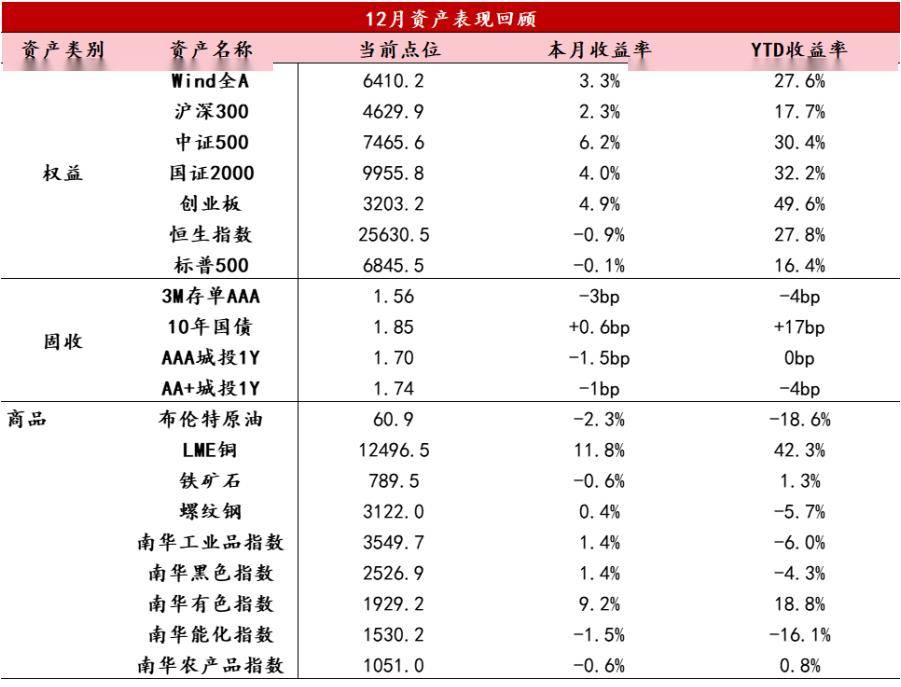
Stock Market Overview - In December, the Federal Reserve's interest rate cut was implemented as expected, leading to fluctuations in future rate cut expectations, while the Nasdaq index experienced volatility [1] - The A-share market showed overall fluctuations, with the Shanghai Composite Index achieving 11 consecutive gains by the end of the month, driven by a positive tone from the Central Economic Work Conference and a declining US dollar index [1] - The Wind All A index recorded a +3.3% increase for the month, with 60% of the Shenwan first-level industries rising, particularly strong performances in defense and military (+17.22%) and non-ferrous metals (+13.68%) [1] Bond Market Overview - The bond market continued to experience wide fluctuations in December, with increased yield volatility and a steeper curve [2] - Despite relatively ample liquidity and the central bank's resumption of bond purchases providing some support, concerns over long-term bond supply and other factors kept the market in a weak oscillation pattern [2] - The 10-year government bond yield ended the month at 1.85%, reflecting an N-shaped trend throughout December [2] Commodity Market Overview - The commodity market showed a bullish atmosphere in December, with precious metals and non-ferrous sectors being the strongest performers [3] - Gold prices fluctuated, with London gold closing at $4318.25 per ounce, up 2.36% from the previous month, while copper prices also saw significant increases [3] - The oil market experienced a downward trend, with Brent crude oil closing at $60.91 per barrel, down 2.26% for the month [3] Macroeconomic Performance - In November, China's exports demonstrated strong resilience, growing by 5.9% year-on-year, driven by a significant increase in machinery and high-tech product exports [5] - However, domestic consumption remained weak, with retail sales growth slowing to 0.3% year-on-year, indicating structural constraints on internal demand [5] - Fixed asset investment continued to decline, with real estate investment adjustments dragging down overall figures, highlighting the challenges in achieving self-sustaining growth [5] Policy Outlook - The Central Economic Work Conference set the tone for macroeconomic policy in 2026, focusing on addressing the structural imbalance of "strong supply and weak demand" [9] - The strategic shift will prioritize investment in human capital and social welfare, aiming to enhance income levels and consumer demand [9] - Fiscal policy is expected to maintain a more active stance, with a nominal deficit rate targeted around 4.0%, while monetary policy will shift focus from total volume to price stability [10][11] Asset Allocation Analysis - In December, net buying in the stock market rebounded to over 2.5 trillion yuan, with significant inflows into equity ETFs [14] - The manufacturing PMI showed a seasonal rebound, indicating improved trade conditions and proactive inventory preparations by companies [15] - Looking ahead to 2026, the market is expected to experience structural trends, with a focus on sectors that demonstrate sustainable performance and profitability [16]