
学术不端

Search documents
川大博导被举报内容公开:83页PDF材料+三十余名硕博生联名举报,硬刚“学术霸凌”
Xin Lang Cai Jing· 2026-02-08 14:34
Core Viewpoint - A group of over thirty graduate students from Sichuan University has jointly reported Professor Wang Zhuqing for serious academic misconduct, financial misappropriation, and ethical violations, supported by an extensive 83-page document containing various forms of evidence [2][22][29]. Group 1: Academic Misconduct - Allegations include data fabrication, where students were reportedly coerced into falsifying experimental results and creating non-existent data to meet expectations [26][31]. - Instances of image reuse were noted, where the same experimental images were manipulated and used across different publications, indicating a lack of originality [26]. - The report claims that Wang has deprived students of authorship rights on research papers, instead attributing work to unrelated individuals [26][27]. Group 2: Financial Misappropriation - The report details fraudulent reimbursement practices, where Wang allegedly used research funds for personal expenses, including household items and repairs [27]. - There are claims of creating a "slush fund" by fabricating student labor payment lists, requiring students to withdraw cash and return it to him [27][29]. - Wang is accused of misusing university funds under the guise of hosting a conference, with students being charged exorbitant registration fees that were funneled into his personal company [43][52]. Group 3: Ethical Violations - The report highlights a toxic environment where Wang allegedly subjected students to verbal abuse and threats, creating a culture of fear and anxiety [28][39]. - Students were reportedly forced to perform personal tasks for Wang, detracting from their academic responsibilities [28]. - Wang's political statements in class reportedly included disparaging remarks about Chinese policies, raising concerns about his influence on students [29][44]. Group 4: Institutional Response - Sichuan University has established a special task force to investigate the allegations against Wang, emphasizing the importance of maintaining a fair academic environment [22][39]. - Wang has reportedly filed a defamation complaint against the students, indicating a contentious response to the allegations [24][22].

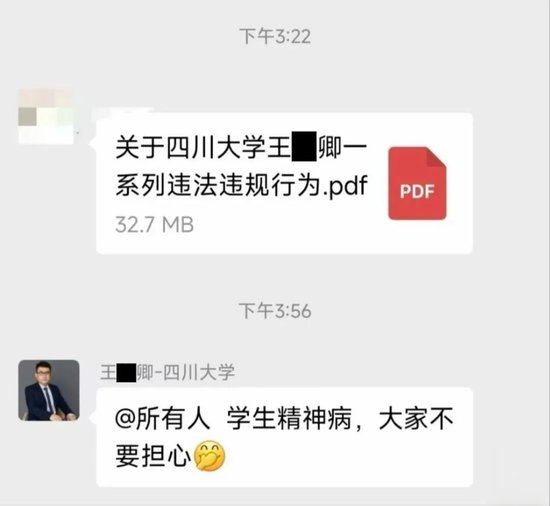
四川大学发布情况通报:收到关于王竹卿老师相关问题的反映,已成立工作专班,并按规定启动调查程序
Xin Lang Cai Jing· 2026-02-07 06:20
Group 1 - The core issue involves allegations of academic misconduct against Wang Zhuqing, a faculty member at Sichuan University [1] - Sichuan University has established a task force to investigate the allegations and will take serious action if the claims are substantiated [1] - The university emphasizes its commitment to maintaining a clean and ethical educational environment [1] Group 2 - Wang Zhuqing is a distinguished researcher at the School of Mechanical Engineering, Sichuan University, and serves as a doctoral supervisor [4] - He is also the head of the Micro-Electro-Mechanical Systems (MEMS) and Intelligent Sensing Innovation Center at Sichuan University [4] - Wang has published a total of 42 academic papers, including 35 in SCI journals, focusing on MEMS sensors and biomedical detection chips [4]
“无痕撤稿”形成灰色产业链,怎样刹住“水论文”歪风
第一财经· 2026-02-01 14:05
Core Viewpoint - The article highlights the alarming trend of "water papers" in the academic field, where a significant number of research outputs lack genuine value and are produced under pressure to meet quantitative metrics rather than pursuing true scientific inquiry [4][5]. Group 1: Academic Integrity Issues - A gray industry has emerged in China, offering services to erase published papers from databases for fees ranging from hundreds to tens of thousands of yuan, often involving fraudulent practices [3][4]. - A study led by Professor Adrian Barnett from Queensland University of Technology found that over 250,000 cancer research papers published between 1999 and 2024 are suspected to be products of "paper mills," with over 170,000 originating from Chinese institutions, accounting for 36% of China's total cancer research output during that period [3][4]. Group 2: Impact of "Water Papers" - The prevalence of "water papers" not only wastes research resources and undermines academic credibility but also hinders genuine scientific progress, necessitating urgent measures to curb this trend [5][6]. - The rise of generative artificial intelligence has made it easier to produce low-quality, homogeneous papers, further diluting the overall quality of academic publications [5][6]. Group 3: Reform Initiatives - Recognizing the issue, various Chinese authorities have initiated reforms to improve the talent evaluation system, aiming to shift focus from quantity to quality in academic outputs [5][6]. - The "Four Only" (唯论文, 唯职称, 唯学历, 唯奖项) evaluation system has been criticized for promoting quantity over quality, and efforts are underway to establish a new evaluation framework that emphasizes innovation, capability, and contribution [6][6].

不管花钱发稿或无痕撤稿都是学术不端 | 新京报微评
Xin Lang Cai Jing· 2026-01-30 04:12
Core Viewpoint - The article highlights the issue of academic misconduct related to "paying for publication" and "invisible retraction," emphasizing the need for strict measures against these practices in the academic community [1] Group 1 - "Invisible retraction" has developed into a gray industry, with intermediaries claiming they can delete or retract papers while erasing traces of the retraction [1] - There is a growing trend where individuals who previously paid to publish papers are now spending money to retract them, indicating a troubling cycle of academic dishonesty [1] - Both "paying for publication" and "invisible retraction" are categorized as academic misconduct, necessitating action from relevant authorities, universities, and academic platforms like CNKI to combat these behaviors [1]
46名学者学术不端,被集中通报批评!
Xin Lang Cai Jing· 2026-01-25 12:06
Group 1 - The National Natural Science Foundation of China (NSFC) has announced disciplinary actions against various individuals for research misconduct and violations related to project funding [1][2][3][4][5][6][7][8][9][10] - Specific cases include the cancellation of funding applications, recovery of disbursed funds, and bans on future applications ranging from 3 to 7 years depending on the severity of the misconduct [1][2][3][4][5][6][7][8][9][10] - The NSFC emphasizes the importance of maintaining scientific integrity and encourages institutions to strengthen their responsibilities in fostering a healthy academic environment [10]
46名学者学术不端,集中通报批评!
中国能源报· 2026-01-25 09:12
Core Viewpoint - The National Natural Science Foundation of China has announced a series of disciplinary actions against individuals involved in scientific misconduct and violations related to project funding applications, emphasizing the importance of maintaining research integrity and ethical standards in scientific endeavors [2][11]. Group 1: Misconduct in Project Applications - Zhang Hongyu from a Beijing university purchased application writing services for a 2021 project, resulting in the revocation of the project and a five-year ban on future applications [2]. - Yi Ying from a Zhejiang university and Tian Ping from a Shandong university were found to have plagiarized content in their 2024 and 2025 project applications, leading to a four-year ban on future applications [2]. - Multiple individuals from various universities were found to have plagiarized content in their 2025 project applications, resulting in a three-year ban on future applications [3]. Group 2: Violations During Project Review - Du Peng from a Gansu hospital engaged in multiple violations during the 2025 project application process, including unauthorized personnel listings and providing false ethical approval documents, leading to a five-year ban [4]. - Li Jun from a Beijing university violated review protocols during the 2022-2024 evaluation period, resulting in a permanent ban from both application and review roles [4]. Group 3: Interference in Review Process - Yu Zhixiang from a Sichuan university attempted to influence potential reviewers during the 2024 evaluation period, resulting in a seven-year ban from applications and review roles [5]. - Li Jinbao from a Shanghai university engaged in similar misconduct, leading to a five-year ban [5]. - Ma Xiaohua from a Shaanxi university was also found to have solicited information from potential reviewers, resulting in a five-year ban [6]. Group 4: Data Integrity Issues - Several individuals from various institutions were found to have engaged in data manipulation and fraudulent practices in their published papers, leading to project revocations and bans ranging from three to five years [7][9][10]. - Wang Feng and Li Yaxue from a Heilongjiang university were involved in data fabrication, resulting in a five-year ban from applications [10]. Group 5: Ongoing Commitment to Research Integrity - The National Natural Science Foundation of China will continue to enforce strict measures against scientific misconduct, urging researchers to uphold ethical standards and institutions to strengthen research integrity [11].
46名学者学术不端,集中通报批评!
Zhong Guo Ji Jin Bao· 2026-01-25 08:24
Core Viewpoint - The National Natural Science Foundation of China has announced disciplinary actions against various individuals and institutions for scientific misconduct and violations related to project funding applications, emphasizing the importance of maintaining research integrity and ethical standards in scientific endeavors [2][11]. Group 1: Misconduct in Project Applications - A researcher from a Beijing university, Zhang Hongyu, was found to have purchased ghostwriting services for a project application, leading to the revocation of the project and a five-year ban on future applications [2]. - Researchers from Zhejiang and Shandong universities were penalized for plagiarism in their project applications, resulting in a four-year ban on future applications [2]. - Multiple individuals from various institutions were found to have plagiarized content in their project applications, leading to a three-year ban on future applications [3]. Group 2: Violations in Project Review Process - A researcher from a Gansu hospital, Du Peng, faced penalties for multiple violations, including unauthorized applications and providing false documents, resulting in a five-year ban on future applications [4]. - A researcher from a Beijing university, Li Junfa, was permanently banned from being a review expert and from applying for projects due to violations of review protocols [4]. - A researcher from Sichuan university, Yu Zhixiang, was penalized for attempting to influence review experts during the evaluation process, leading to a seven-year ban on future applications [5]. Group 3: Issues Related to Published Papers - Several researchers from various institutions were found to have engaged in data trading and other unethical practices in their published papers, resulting in project revocations and three to five-year bans on future applications [7][9]. - A researcher from a Jiangsu university was penalized for data fabrication, leading to a five-year ban on future applications [9]. - Researchers from Guangdong universities faced penalties for plagiarism and other misconduct in their published works, resulting in bans ranging from three to five years [10]. Group 4: Emphasis on Research Integrity - The National Natural Science Foundation of China reiterated its commitment to addressing scientific misconduct and urged researchers to uphold ethical standards and integrity in their work [11].
代发论文套路深,多地警方检方提醒论文发表需认准正规渠道
Xin Lang Cai Jing· 2026-01-11 14:09
Core Insights - The article highlights a recent scam involving academic paper publication, where individuals are tricked into paying fees for services that are never delivered, particularly targeting students and teachers eager to publish their work [1][2][3] Group 1: Scam Details - A case was reported where a victim, a student from Southeast University, was defrauded of 75,000 yuan under the pretense of publishing an academic article, with the scammer requesting various fees [1] - The Jiangsu Provincial Public Security Department noted that scams related to paper publication often occur during the peak period for academic title evaluations, specifically from March to May each year [2] - Multiple cases were documented where victims paid amounts ranging from thousands to tens of thousands of yuan for non-existent publication services [2][3] Group 2: Legal Consequences - A notable case involved a doctor who paid 14,850 yuan for three articles, only to find them missing when it was time for his title evaluation, leading to a criminal prosecution for fraud [1] - The Jiangxi Province court ruled in favor of a doctoral student who sought a refund from a fraudulent educational consulting company, ordering the company to return 22,400 yuan, which is 80% of the fees paid [5] - The court emphasized that engaging in such fraudulent publication services violates academic integrity and disrupts educational order, rendering the contracts invalid [4][5] Group 3: Warnings and Recommendations - Authorities are urging individuals to be cautious and to use legitimate channels for academic publication, warning against the allure of shortcuts that could lead to scams [2][3] - The public is advised to protect personal information and report suspicious activities to the police [2] - Legal provisions state that any civil actions violating public order and good morals are invalid, and parties involved may be held accountable for any financial losses incurred [6]
整治科研诚信,需让撤稿回归纠错本位
Xin Lang Cai Jing· 2026-01-11 08:58
Core Viewpoint - The Chinese Ministry of Science and Technology is launching a special rectification action against academic misconduct, focusing on retracted papers, to address the rising trend of academic dishonesty and its negative impact on the scientific community [3][4]. Group 1: Academic Misconduct and Retraction Trends - The total number of retracted papers globally has significantly increased over the past decade, attributed to heightened awareness and improved detection technologies within the academic community [3]. - Retractions are often perceived negatively, leading to the labeling of authors as academically dishonest, which can adversely affect their careers and future opportunities [3][4]. Group 2: Impact of Retractions on Academic Integrity - The negative consequences of retractions extend beyond the papers themselves, damaging the credibility of researchers and the international reputation of China's scientific community [4]. - A recent incident highlighted the absurdity of academic misconduct, where multiple papers used the same flawed experimental material, showcasing the need for stricter oversight [4]. Group 3: Measures for Improvement - The special rectification action will focus on retracted papers by Chinese scholars in international journals, with increased penalties for serious misconduct such as plagiarism and data fabrication [4][5]. - There is a call for improved peer review mechanisms and journal oversight to prevent academic misconduct, emphasizing the need for a more robust institutional framework [5]. Group 4: Philosophical Perspective on Retraction - Retraction should be viewed as a neutral corrective action rather than a moral judgment, distinguishing between "honest errors" and "clear academic misconduct" [4][5]. - Encouraging a culture of innovation and tolerance for failure is essential, with a focus on returning retractions to their original purpose of correcting errors and safeguarding truth in research [5].

旗下30种医学期刊遭仿冒,知名出版单位敦促假网站向受骗者退钱
Xin Lang Cai Jing· 2026-01-10 09:08
Core Viewpoint - The company has identified fraudulent activities involving the creation of fake websites that mimic its medical journals, leading to illegal collection of manuscript submission fees and other charges, which severely harms the rights of authors and the academic reputation of the journals [1][2]. Group 1: Company Actions and Responses - The company has outlined the official submission websites and contact emails for its 30 medical journals, emphasizing that it has not authorized any third parties to accept submissions or collect fees [2]. - The company is taking legal action against the infringing parties, including civil claims, administrative reports, and criminal charges, while urging the fraudulent websites to cease operations and refund deceived authors [3]. Group 2: Journal Information - The company oversees a cluster of 30 national-level medical academic journals, which include notable titles such as "Chinese Journal of Health Medicine" and "Chinese Journal of Geriatric Cardiovascular and Cerebrovascular Diseases," with over 4,000 editorial board members, including more than 50 academicians [1]. - The journals are recognized for their scale, influence, and authority within the domestic medical community, having undergone a change in supervisory units as per the approval from the National Press and Publication Administration by the end of 2023 [1]. Group 3: Author and Reader Guidance - The company advises authors, reviewers, and readers to use official channels for submissions and inquiries, warning against using unverified links or search engine results to avoid scams [2]. - All fees associated with the journals are to be collected through official channels only after manuscript acceptance, ensuring compliance with national regulations and public standards [2].