安迪 - 比尔定律

Search documents
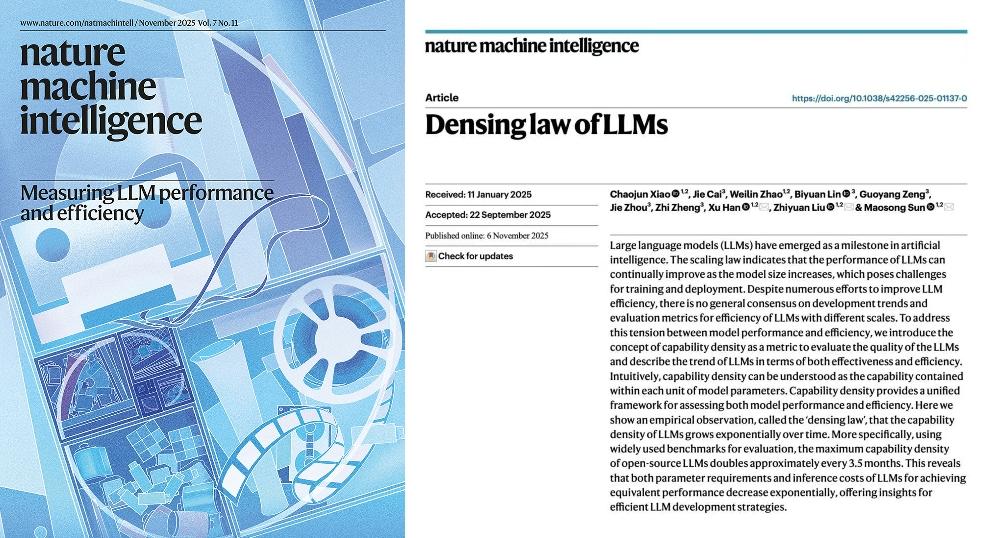
中国大模型团队登Nature封面,刘知远语出惊人:期待明年“用AI造AI”
3 6 Ke· 2025-12-25 01:24
Group 1 - The core principle of the article revolves around the evolution of AI and the emergence of the "Densing Law," which indicates that the capability density of large models doubles approximately every 3.5 months, significantly faster than Moore's Law [5][6][14] - The "Densing Law" suggests that advancements in AI will require less computational power to achieve equivalent performance, with costs potentially decreasing to one-tenth within a year [6][29] - The article highlights the need for a reverse revolution in the industry, where large models must leverage extreme algorithms and engineering to maximize capabilities on existing hardware [4][5] Group 2 - Chinese companies are positioned as key practitioners of this new path, with innovations such as DeepSeek V3 and MiniCPM series models demonstrating significant efficiency improvements [5][11] - The rapid iteration cycle of 3.5 months poses challenges for business models, as companies must recover costs quickly or risk being outpaced by competitors [6][29] - The article emphasizes the importance of efficiency in AI development, particularly in the context of China's limited computational resources, and the necessity for technological innovation to bypass existing limitations [11][12] Group 3 - The article discusses the relationship between the "Scaling Law" and the "Densing Law," suggesting that both are essential for the advancement of AI, with the former focusing on model size and the latter on efficiency [16][17] - Innovations in model architecture, such as the fine-grained mixture of experts (MoE) and sparse attention mechanisms, are highlighted as key developments that enhance computational efficiency [20][21] - The future of AI is envisioned as a collaborative effort between humans and machines, with the potential for AI to autonomously create and improve itself, marking a significant shift in production paradigms [35][36]

回旋镖,AI或将导致手机的内存“反向升级”
3 6 Ke· 2025-12-16 11:41
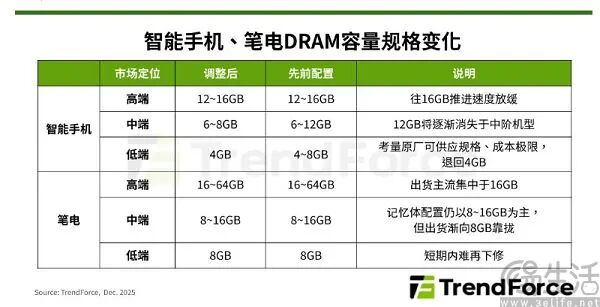
Core Viewpoint - The significant increase in DRAM memory prices has created challenges for both PC gamers and smartphone users, with contract prices rising by 171% year-on-year as of Q3 2025, surpassing the increase in gold prices, making it one of the best-performing investment products of the year [1] Group 1: Memory Price Impact - The rising memory prices are causing OEMs to face increasing cost pressures, with the share of memory in the overall BOM (Bill of Materials) expected to rise significantly by Q1 2026 [2] - Smartphone manufacturers are likely to make tough decisions between sacrificing shipment volumes, raising prices, or reducing specifications due to the high memory costs [3] Group 2: Changes in Smartphone Memory Specifications - Mid-range smartphones are expected to shift from 12GB to 6GB and 8GB configurations, while entry-level models may drop to 4GB, abandoning the 8GB standard [3] - The reduction in memory specifications could lead to a significant decline in user experience, as larger memory allows for more apps to run simultaneously, which is increasingly important in a mobile internet-driven environment [4] Group 3: AI and Memory Requirements - The trend of reducing memory capacity in smartphones could limit the performance of AI applications, as many current apps are developed with a minimum of 6GB memory in mind [6] - Entry-level smartphones with only 4GB of memory will struggle to support on-device AI functionalities, which require substantial memory and bandwidth for effective operation [8] Group 4: Market Dynamics and Future Outlook - The shift towards AI in smartphones is seen as a potential game-changer for market competition, but the rising memory prices and subsequent reduction in specifications may alienate users [9] - The current memory price surge is largely driven by the demand for High Bandwidth Memory (HBM), which has led suppliers to prioritize HBM production over traditional DRAM, disrupting the supply-demand balance [8]