
密度法则

Search documents
大模型公司面壁智能开年获数亿元融资,中国电信领投
机器人圈· 2026-03-06 10:18
Group 1 - The core viewpoint of the article highlights that Mianbi Intelligent has successfully completed its first round of financing after the Spring Festival, with a scale of several hundred million yuan, led by China Telecom, indicating strong market recognition of its leading position in the "efficient large model" sector [2] - The financing will enable Mianbi Intelligent to collaborate deeply with China Telecom, leveraging strengths in cloud computing, networking, and end-user applications to expand AI technology in complex scenarios [2] - Mianbi Intelligent's "density principle" has gained industry-wide recognition as a path for evolution, reflecting the dual advancement of AI technology and application addressing real-world pain points [2] Group 2 - The evolution of large models has shifted from merely "scaling" to "density," with Mianbi Intelligent's MiniCPM series being well-received globally for its efficient and cost-effective characteristics, achieving over 24 million downloads on platforms like GitHub and Hugging Face [3] - The recent release of the MiniCPM-o 4.5 model represents a breakthrough in enhancing intelligent density, achieving human-like interactive perception with a compact size of 9 billion parameters [3] - In the field of embodied robotics, MiniCPM-o 4.5 aims to enhance the "brain" interaction capabilities of robots, enabling real-time environmental perception and proactive decision-making, thus improving natural communication with humans [3]



面壁智能获数亿元融资,大模型“高密度”创新获国家队战略加持
Xin Lang Cai Jing· 2026-02-28 02:44
Core Insights - The core viewpoint of the articles highlights the significant advancements and recognition of Mianbi Intelligent in the "end-side large model" sector, particularly through its innovative "Density Law" and the successful launch of its MiniCPM series models, which have gained substantial traction in various applications [1][2]. Group 1: Financing and Market Position - Mianbi Intelligent announced a financing round of several hundred million yuan, led by China Telecom, indicating strong capital market confidence in its leading position and technological innovations in the industry [1]. - The "Density Law," proposed in collaboration with Tsinghua University, reveals that the capability density of large models doubles approximately every 3.5 months, providing a scientific basis for moving away from traditional computational power dependencies [1]. Group 2: Technological Innovations - Mianbi Intelligent has continuously innovated in model architecture, inference, data, and training, resulting in the MiniCPM series, which offers stronger performance, lower costs, and better power efficiency under the same parameters [2]. - The MiniCPM-o 4.5 model features a compact 9 billion parameters, achieving human-like interactive perception and enabling seamless multi-modal input and output, thus enhancing real-time conversational capabilities [3]. - The MiniCPM-SALA model, based on a novel sparse-linear attention architecture, excels in long text understanding and generation, maintaining competitive performance in knowledge Q&A, mathematical reasoning, and code generation [3].
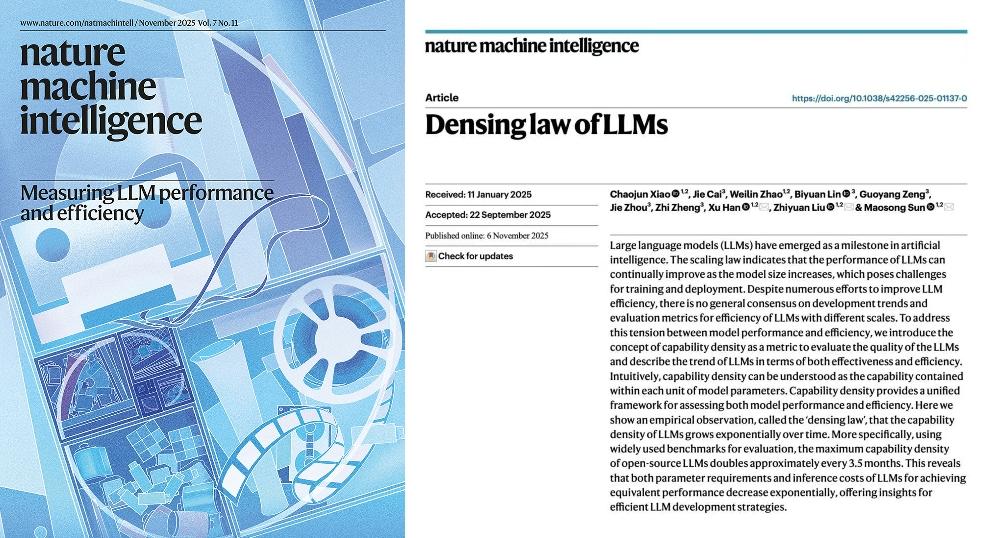
中国大模型团队登Nature封面,刘知远语出惊人:期待明年“用AI造AI”
3 6 Ke· 2025-12-25 01:24
Group 1 - The core principle of the article revolves around the evolution of AI and the emergence of the "Densing Law," which indicates that the capability density of large models doubles approximately every 3.5 months, significantly faster than Moore's Law [5][6][14] - The "Densing Law" suggests that advancements in AI will require less computational power to achieve equivalent performance, with costs potentially decreasing to one-tenth within a year [6][29] - The article highlights the need for a reverse revolution in the industry, where large models must leverage extreme algorithms and engineering to maximize capabilities on existing hardware [4][5] Group 2 - Chinese companies are positioned as key practitioners of this new path, with innovations such as DeepSeek V3 and MiniCPM series models demonstrating significant efficiency improvements [5][11] - The rapid iteration cycle of 3.5 months poses challenges for business models, as companies must recover costs quickly or risk being outpaced by competitors [6][29] - The article emphasizes the importance of efficiency in AI development, particularly in the context of China's limited computational resources, and the necessity for technological innovation to bypass existing limitations [11][12] Group 3 - The article discusses the relationship between the "Scaling Law" and the "Densing Law," suggesting that both are essential for the advancement of AI, with the former focusing on model size and the latter on efficiency [16][17] - Innovations in model architecture, such as the fine-grained mixture of experts (MoE) and sparse attention mechanisms, are highlighted as key developments that enhance computational efficiency [20][21] - The future of AI is envisioned as a collaborative effort between humans and machines, with the potential for AI to autonomously create and improve itself, marking a significant shift in production paradigms [35][36]
2025,中国大模型不信“大力出奇迹”?
3 6 Ke· 2025-12-19 11:06
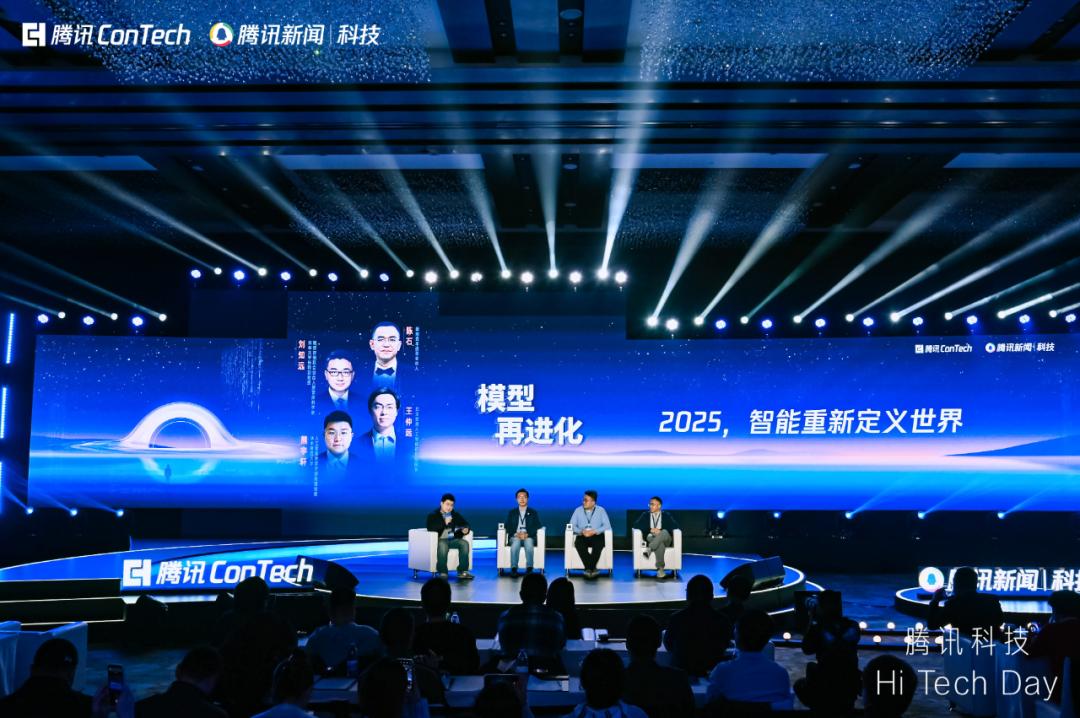
Core Insights - The article discusses the evolution of generative AI leading up to 2025, highlighting three main trajectories: cognitive deepening, dimensional breakthroughs, and efficiency reconstruction [1][2][3] Group 1: Evolution of AI Models - The first trajectory is cognitive deepening, transitioning from "intuition" to "logic," where models evolve from quick pattern matching to multi-step reasoning through reinforcement learning [1] - The second trajectory involves dimensional breakthroughs, moving from "language" to "physical space," emphasizing the importance of spatial intelligence in understanding the physical world [1][2] - The third trajectory focuses on efficiency reconstruction, shifting from "brute force aesthetics" to "cost-effectiveness," necessitating lighter model architectures to support deep reasoning and spatial understanding [1] Group 2: Key Discussions from the Forum - At the Tencent HiTechDay forum, experts discussed the evolution of large models, emphasizing the transition from learning from text to learning from video, which provides rich spatiotemporal information [2][3] - The "Densing Law" proposed by Liu Zhiyuan suggests that the future of AI lies in increasing the "intelligence density" within model parameters, predicting that by 2030, devices could support capabilities equivalent to GPT-5 [3][8] - The commercial landscape is characterized by a "dual-core drive" between open-source and closed-source models, with a focus on building a sustainable business structure that can withstand model iteration cycles [3][10] Group 3: Challenges and Opportunities - The article identifies three main challenges in the commercialization of AI agents: insufficient core reasoning capabilities, the need for domain-specific training, and issues with memory and forgetting mechanisms [11][12] - The discussion highlights the importance of end-side intelligence, which must balance quick responses with deep thinking, particularly in applications like robotics [13][18] - The potential for AI to penetrate various industries is noted, with a focus on the "ToP" (To Professional) market segment as a lucrative opportunity for AI applications [15][21] Group 4: Future Directions and Recommendations - The article emphasizes the need for a collaborative ecosystem that combines open-source initiatives with efficient model technologies to drive AI advancements in China [20][22] - Entrepreneurs are advised to seek opportunities in niche industries that are less accessible to large models and to establish business structures that can adapt to ongoing model iterations [21][22] - The integration of hardware and software is seen as crucial for the future of AI, with a call for investments in both areas to achieve a balanced development [19][20]
对谈刘知远、肖朝军:密度法则、RL 的 Scaling Law 与智能的分布式未来丨晚点播客
晚点LatePost· 2025-12-12 03:09
Core Insights - The article discusses the emergence of the "Density Law" in large models, which states that the capability density of models doubles every 3.5 months, emphasizing efficiency in achieving intelligence with fewer computational resources [4][11][19]. Group 1: Evolution of Large Models - The evolution of large models has been driven by the "Scaling Law," leading to significant leaps in capabilities, surpassing human levels in various tasks [8][12]. - The introduction of ChatGPT marked a steep increase in capability density, indicating a shift in the model performance landscape [7][10]. - The industry is witnessing a trend towards distributed intelligence, where individuals will have personal models that learn from their data, contrasting with the notion that only a few large models will dominate [10][36]. Group 2: Density Law and Efficiency - The Density Law aims to maximize intelligence per unit of computation, advocating for a focus on efficiency rather than merely scaling model size [19][35]. - Key methods to enhance model capability density include optimizing model architecture, improving data quality, and refining learning algorithms [19][23]. - The industry is exploring various architectural improvements, such as sparse attention mechanisms and mixed expert systems, to enhance efficiency [20][24]. Group 3: Future of AI and AGI - The future of AI is expected to involve self-learning models that can adapt and grow based on user interactions, leading to the development of personal AI assistants [10][35]. - The concept of "AI creating AI" is highlighted as a potential future direction, where models will be capable of self-improvement and collaboration [35][36]. - The timeline for achieving significant advancements in personal AI capabilities is projected around 2027, with expectations for models to operate efficiently on mobile devices [33][32].


从ChatGPT3年8亿周活到Higgsfield5个月1亿美元ARR:学术和资本看见了“大模型的摩尔定律 ”|DeepTalk
锦秋集· 2025-12-01 10:00
Core Insights - The article emphasizes the shift from "scaling up" large language models (LLMs) to "increasing capability density," highlighting the limitations of simply adding more computational power and data to larger models [2][3] - A new concept called "Densing Law" is introduced, which indicates that the capability density of LLMs is exponentially increasing, approximately doubling every 3.5 months [18][19] Group 1: Transition from Scaling Law to Densing Law - The article discusses the evolution from Scaling Law, which led to the development of large models like GPT-3 and Llama-3.1, to the need for improved inference efficiency [10] - Two core questions are raised: the ability to quantitatively assess the quality of different scale LLMs and the existence of a law reflecting LLM efficiency trends [10] - A quantitative evaluation method based on a reference model is proposed to address the non-linear relationship between capability and parameter size [11][12] Group 2: Capability Density and Its Implications - Capability density is defined as the ratio of effective parameter size to actual parameter size, allowing for fair comparisons across different model architectures [13] - The article notes that if the density (ρ) equals 1, the model is as efficient as the reference model; if greater than 1, it indicates higher efficiency [15] - A comprehensive evaluation of 51 mainstream open-source foundational models reveals that capability density has been increasing exponentially over time, leading to the establishment of the Densing Law [17] Group 3: Insights from Densing Law - The article identifies three key insights: 1. Data quality is a core driver of the Densing Law, attributed to the explosive growth in pre-training data and its quality [19] 2. Large models do not necessarily equate to high density, as training costs and resource limitations can hinder optimal performance [19] 3. The Densing Law reflects a pursuit of computational efficiency akin to Moore's Law in integrated circuits [19] Group 4: Predictions and Implications - The article predicts that the actual parameter size required to achieve the same performance level will decrease exponentially over time, with a case study comparing MiniCPM and Mistral models illustrating this trend [21] - It also notes that inference costs will decrease exponentially, with recent technological advancements in infrastructure contributing to this reduction [22][23] - The combination of Densing Law and Moore's Law suggests significant potential for edge-side intelligence, with the effective parameter scale on fixed-price hardware expected to double approximately every 88 days [24] Group 5: Acceleration of Density Growth Post-ChatGPT - Following the release of ChatGPT, the growth rate of model density has accelerated, with a notable increase in the slope of density growth trends [25] - Factors contributing to this acceleration include increased investment in LLM research, a thriving open-source ecosystem, and the proliferation of high-quality small models [28] Group 6: Challenges in Model Compression - The article cautions that compression techniques like pruning, distillation, and quantization do not always enhance density, as many compressed models exhibit lower density than their original versions [30] - It emphasizes the importance of ensuring that compressed models undergo sufficient training to maintain or improve capability density [30] Group 7: Future Directions in Model Training - The discovery of Densing Law suggests a fundamental shift in training paradigms, moving from a focus on size to efficiency per parameter [32] - Key dimensions for enhancing density include efficient architecture, advanced data engineering, and the collaborative evolution of large and small models [33][34][35]

大模型不再拼“块头”——大语言模型最大能力密度随时间呈指数级增长
Ke Ji Ri Bao· 2025-11-25 00:13
Core Insights - The Tsinghua University research team has proposed a "density law" for large language models, indicating that the maximum capability density of these models is growing exponentially over time, doubling approximately every 3.5 months from February 2023 to April 2025 [1][2] Group 1: Density Law and Its Implications - The density law reveals that the focus should shift from the size (parameter count) of large models to their "capability density," which measures the intelligence per unit of parameters [2] - The research analyzed 51 open-source large models and found that the maximum capability density has been increasing exponentially, with a notable acceleration post-ChatGPT release, where the density doubled every 3.2 months compared to every 4.8 months before [2] Group 2: Cost and Efficiency - Higher capability density implies that large models become smarter while requiring less computational power and lower costs [3] - The ongoing advancements in capability density and chip circuit density suggest that large models, previously limited to cloud deployment, can now run on terminal chips, enhancing responsiveness and user privacy [3] Group 3: Application in Industry - The application of the density law indicates that AI is becoming increasingly accessible, allowing for more proactive services in smart vehicles, transitioning from passive responses to active decision-making [3]