DRAM内存

Search documents
广发宏观:高频数据下的3月经济:价格篇
GF SECURITIES· 2026-04-01 07:54
Price Index Trends - The Business Price Index (BPI) rose significantly in March, reaching 1103 points, a month-on-month increase of 16.4% compared to the end of February[3] - The energy index increased by 25.3%, while the chemical index surged by 32.4%, but the non-ferrous index fell by 9.5% month-on-month[4] Commodity Price Movements - In the week of March 16-20, five energy commodities saw price increases of over 5%, accounting for 35.7% of the monitored items[4] - The average price of coal in the Bohai Rim region increased by 1.7%, while the chemical price index surged by 33.8% month-on-month[5] Real Estate Market - As of March 23, the second-hand housing price indices in Beijing, Shanghai, Guangzhou, and Shenzhen decreased by 1.0%, 1.8%, 1.4%, and 0.8% respectively[5] - The second-hand housing prices in these cities have seen significant highs over the past year, with peaks recorded at 159.44, 192.67, 181.71, and 251.13 points[6] Emerging Industries - The photovoltaic industry composite index fell by 13.2% in March, with significant declines in prices for battery cells and polysilicon[6] - Lithium carbonate futures prices decreased by 4.9% month-on-month, while DRAM spot prices fell between 5.3% and 8.9%[9] Shipping and Logistics - The China Container Freight Index (CCFI) rose by 9.0% in the fourth week of March, with significant increases in shipping rates to Los Angeles and New York[7] - The Baltic Dry Index (BDI) decreased by 5.1% month-on-month, indicating a mixed outlook for shipping costs[8] Food Prices - The average wholesale price of pork fell by 12.7% in March, while key vegetable prices dropped by 10.9%[9] - The price index for non-food items, represented by the ICPI, decreased slightly to 99.67, reflecting a month-on-month decline of 0.2%[10]
小小内存条,压弯了手机厂的腰
经济观察报· 2026-03-20 12:29
Core Viewpoint - The global DRAM memory market is experiencing significant price increases, leading major manufacturers like Samsung, SK Hynix, and Micron to stop quoting prices to downstream manufacturers, resulting in a volatile pricing environment where prices can change hourly [1][3]. Group 1: Price Increases and Market Reactions - Major smartphone brands such as OPPO, vivo, and iQOO have announced price hikes due to rising storage chip costs, with the cost of a 12GB+256GB memory combination increasing from around $30 to $120-130 [2][5]. - The price of Samsung's LPDDR4X memory surged from $6 to $25 per unit within six months, and by early 2026, prices had increased nearly 400% from a baseline of $28.5 [2][3]. - The demand for high-bandwidth memory (HBM) and DDR5 has skyrocketed due to the AI industry's growth, leading manufacturers to allocate most of their production capacity to high-priced products, impacting the availability of consumer-grade memory [2][3]. Group 2: Strategic Decisions by Manufacturers - Smartphone manufacturers face a dilemma between absorbing losses to maintain market share or raising prices and potentially losing sales [3][4]. - Brands like Honor have opted to raise prices on higher memory versions while keeping base models stable to retain customer loyalty [6][7]. - Huawei has not yet raised prices but has canceled sales incentives for its channels, indicating a cautious approach amid rising costs [7]. Group 3: Impact on Low-End Market - The rising costs of storage components have significantly affected low-end smartphone manufacturers, with the cost of storage in budget phones increasing from a few dollars to over $20, making it difficult for consumers to accept higher prices [9][11]. - Transsion, a major player in emerging markets, has been particularly impacted, experiencing a significant drop in net profit and market share due to rising storage costs [9][10]. - The price hikes have forced some brands to cancel product launches, as seen with Meizu's cancellation of the Meizu 22 Air due to increased design costs and storage prices [10][11]. Group 4: Long-Term Market Outlook - The current storage price surge is expected to last for two to three years, with high points anticipated around mid-2026 [14][15]. - The shift in production focus from DDR4 to DDR5 by major manufacturers is creating a supply gap that will affect the market for an extended period [16][17]. - The overall smartphone market is facing a prolonged period of cost pressures, with all manufacturers, regardless of size, needing to adapt to the new pricing landscape [17].





Micron Technology(MU) - 2026 Q2 - Earnings Call Transcript
2026-03-18 23:02
Financial Data and Key Metrics Changes - The company reported strong pricing increases for both DRAM and NAND, with NAND prices increasing more than DRAM prices in the second quarter of 2026 [27] - The company expects modest volume growth for both DRAM and NAND in the third quarter, driven by supply constraints [28] Business Line Data and Key Metrics Changes - NAND demand is robust, particularly driven by data center growth and AI server requirements, with the company unable to meet the current demand levels [10][11] - DRAM supply impacts from new projects are expected to materialize towards fiscal year 2028, indicating continued tight supply conditions beyond 2026 [18][19] Market Data and Key Metrics Changes - The demand for NAND is significantly undersupplied, with growth driven by KV cache applications and shortages in HDDs [47] - The company anticipates that the demand forecast from customers for 2026 and 2027 continues to escalate, despite efforts to increase supply [19] Company Strategy and Development Direction - The company is expanding its NAND capacity by adding clean room space at existing sites, reflecting confidence in market demand [9][10] - The focus remains on disciplined capital expenditures while addressing the growing demand in the data center SSD space [12] Management's Comments on Operating Environment and Future Outlook - Management expressed that the supply constraints are expected to persist through 2026 and into 2027, with significant improvements in cleanroom space availability only anticipated by 2028 [67][70] - The company is optimistic about the long-term demand for DRAM and NAND, driven by AI and other emerging technologies, but acknowledges the challenges in meeting this demand [63][70] Other Important Information - The company has increased its capital expenditure outlook for FY 2026 to over $25 billion, primarily driven by DRAM and HBM investments [50] - Startup costs related to new fabs are expected to impact margins, but the company is managing these costs effectively [79] Q&A Session Summary Question: Can you discuss the decision to add greenfield capacity for NAND? - Management indicated that the decision was based on confidence in market demand and the need for additional clean room space for technology transitions [9][10] Question: How are you modeling the impact of new DRAM supply on pricing? - Management stated that new supply impacts will be felt in fiscal year 2028, and they expect tight supply conditions to continue beyond 2026 [18][19] Question: What is the outlook for NAND demand from KV cache applications? - Management confirmed that KV cache is a significant driver of demand, contributing to the overall growth in the data center SSD market [46] Question: How do you view the balance between HBM and non-HBM allocations? - Management emphasized that allocations are strategic and aimed at meeting customer needs, with both HBM and non-HBM margins being robust [40] Question: What is the expected CapEx mix for DRAM and NAND? - Management indicated that CapEx will be dominated by DRAM and HBM, with NAND expected to increase but remain a smaller portion of the overall spend [52] Question: How do you see the long-term bit growth for DRAM and NAND? - Management did not provide new long-term bit growth numbers but acknowledged that current forecasts are robust due to strong demand [63] Question: When do you expect to have enough cleanroom capacity to meet demand? - Management stated that significant improvements in cleanroom capacity are not expected until 2028, with ongoing evaluation of demand drivers [67][70]
新材料周报:内存成本上升入门级PC将消失,宝理赢创PEEK和尼龙涨价:基础化工-20260312
Huafu Securities· 2026-03-12 02:34
Investment Rating - The industry rating is "Outperform the Market" indicating that the overall return of the industry is expected to exceed the market benchmark index by more than 5% in the next 6 to 12 months [55]. Core Insights - The report highlights a significant increase in memory costs, leading to the prediction that "entry-level" PCs will disappear by 2028 due to rising prices and a shortage of DRAM memory affecting the PC industry more than others [4][29]. - The report notes that several companies, including Japan's Toray and Evonik, will increase prices for their products due to the inability to absorb the impact of currency fluctuations and rising raw material costs [4][33]. - The semiconductor materials sector is experiencing rapid domestic production acceleration, with major companies expected to maximize their industry benefits [4]. Market Overview - The Wind New Materials Index closed at 5849.59 points, down 5.28% week-on-week. The semiconductor materials index fell by 8.97%, while the display device materials index decreased by 3.12% [3][11]. - The report lists the top gainers and losers in the market, with companies like Hongbai New Materials and Sanxiang New Materials showing significant gains, while companies like Boqian New Materials and Dongcai Technology faced substantial losses [25][26]. Recent Industry Trends - Gartner's report indicates that PC shipments are expected to decline by 10.4% by 2026, surpassing the decline in the smartphone market, as manufacturers struggle to meet the demand for budget-friendly gaming hardware [4][30]. - Companies are responding to rising costs by adjusting prices, with Dow Chemical announcing a price increase of 5% to 15% for its products starting March 27, 2026 [34]. - The report emphasizes the importance of high-performance materials in driving industry upgrades and innovations, suggesting that the new materials industry is poised for rapid growth [4].




5天超120%!龙头股飙涨 历史新高
Zhong Guo Zheng Quan Bao· 2026-02-13 04:50
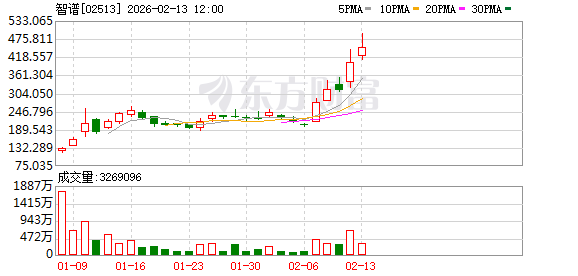
Market Overview - The A-share market experienced a decline, with the Shanghai Composite Index down by 0.7%, the Shenzhen Component Index down by 0.67%, and the ChiNext Index down by 0.96%. However, the Sci-Tech Innovation Board Index saw an increase of 0.34% [2]. Semiconductor Industry - The semiconductor industry chain showed strong performance, particularly in sectors such as photolithography machines, memory chips, and advanced packaging. Notable stocks like Langke Technology and Jingce Electronics saw significant gains [4][8]. - The stock of Zhiyuan Technology surged by 11.89%, reaching a new historical high, with a market capitalization of HKD 200.54 billion. The company announced a structural adjustment in its GLM Coding Plan pricing, with an overall increase starting from 30% [4]. Automotive Industry - The automotive industry chain also performed well, with sectors such as auto parts, smart cockpits, and vehicle networking showing increases. The automotive parts sector rose by 0.71% [9][10]. - Recent favorable industrial policies, including the development of mandatory national standards for intelligent connected vehicles, are expected to enhance the regulatory environment for the industry. Additionally, advancements in humanoid robotics are contributing to the sector's growth [10]. Financial Performance of Key Players - Kioxia, a Japanese flash memory manufacturer, reported a revenue of JPY 543.6 billion for the third quarter of fiscal year 2025, marking a year-on-year increase of 20.8% and a quarter-on-quarter increase of 21.3% [7]. - TrendForce forecasts significant price increases in DRAM and NAND flash memory, with DRAM prices expected to rise over 60% in Q1 2026 and NAND prices projected to increase by 55%-60% [7].



DRAM危机,短期无解
半导体行业观察· 2026-02-11 01:27
Core Insights - The current surge in demand for DRAM memory is primarily driven by the needs of artificial intelligence (AI) data centers, leading to a significant price increase of 80% to 90% in DRAM prices this quarter [2] - The ongoing supply shortage is a result of the cyclical nature of the DRAM industry, exacerbated by the rapid expansion of AI hardware infrastructure [2][8] - The introduction of High Bandwidth Memory (HBM) technology is crucial for meeting the demands of AI applications, but it comes with high costs, often three times that of other memory types [6][14] Group 1: Supply and Demand Dynamics - The DRAM industry is characterized by cycles of boom and bust, with significant capital investment required for new wafer fabs, which can cost over $15 billion and take 18 months or more to become operational [8] - The COVID-19 pandemic triggered a supply panic, leading major data center operators to stockpile memory and storage devices, which initially drove prices up [8] - As demand stabilized and data center expansion slowed in 2022, prices plummeted, prompting major companies like Samsung to cut production by 50% to prevent prices from falling below manufacturing costs [8][9] Group 2: AI Data Center Growth - There is a stark contrast between the lack of new investments in memory production and the surge in demand for new data centers, with nearly 2,000 new data centers planned or under construction globally [12] - McKinsey predicts that by 2030, companies will invest $7 trillion in data center construction, with $5.2 trillion allocated specifically for AI data centers [12] - NVIDIA has emerged as the biggest beneficiary of the AI data center boom, with its data center revenue skyrocketing from under $1 billion in Q4 2019 to $51 billion by Q4 2025 [12][14] Group 3: HBM Technology and Costs - HBM technology, which integrates multiple DRAM chips in a 3D stack, is essential for overcoming the "memory wall" that limits the performance of large language models [6][5] - The cost of HBM can account for 50% or more of the total cost of GPUs, making it a significant factor in the overall expense of AI hardware [6][14] - Micron forecasts that the HBM market will grow from $35 billion in 2025 to $100 billion by 2028, indicating a substantial increase in demand that will outstrip supply [14] Group 4: Future Supply Solutions - To address the DRAM supply issues, the industry is focusing on innovation and building more fabs, but these efforts will take time to impact prices [17] - Major players like Micron, Samsung, and SK Hynix are investing in new fabs, but these projects are unlikely to lower prices significantly in the near term [17][18] - Advanced packaging technologies and improved collaboration between memory suppliers and AI chip designers are seen as key to increasing supply efficiency [17]

从黄金到GPU:一条让你多花钱的隐秘供应链
Sou Hu Cai Jing· 2026-02-10 21:39
Group 1 - The IT industry is experiencing a cost storm due to soaring prices of precious metals, which is impacting the semiconductor supply chain and leading to a "digital inflation" crisis [1][4][5] - Gold prices reached a historical peak of nearly $5600 per ounce before experiencing significant volatility, with a record single-day drop of 40 years on January 30, followed by a rebound [2][4] - Silver has seen dramatic price fluctuations, with a single-day drop exceeding 35% on January 31, erasing all gains made since the beginning of the year, further contributing to cost pressures in the semiconductor industry [4][6] Group 2 - Silver's demand is increasing significantly in various industries, particularly in semiconductors, photovoltaics, and automotive sectors, due to its superior conductivity and thermal properties [8][10] - The photovoltaic industry now consumes nearly 30% of the global physical silver supply, as new technologies require almost double the amount of silver compared to older models [10][12] - The semiconductor packaging segment is highly sensitive to raw material price changes, with a 20% increase in gold costs potentially leading to a 5%-8% rise in packaging costs [12][14] Group 3 - The semiconductor industry is facing a supply-demand imbalance, with a projected 23% increase in global DRAM memory demand in 2026, particularly driven by data centers [14][15] - The AI boom is a significant factor driving the current price increase in the semiconductor sector, as the demand for computing power surges [14][15] - The limited capacity expansion in semiconductor manufacturing, with only a 5% increase expected in 2026, is insufficient to meet the explosive demand growth [14][15] Group 4 - Different players in the semiconductor ecosystem are experiencing varied impacts from the price increases, with domestic semiconductor equipment manufacturers benefiting from increased cash flow due to rising prices [15][17] - Chip design and hardware manufacturers are struggling to pass on rising costs to customers, risking customer loss while facing pressure from raw material price hikes [15][17] - The overall price increase across the semiconductor supply chain is likely to affect consumer electronics, leading to higher prices for end products [17][19] Group 5 - Major PC manufacturers have begun raising prices across their product lines, with increases ranging from 10% to 30% due to rising component costs [21][22] - The smartphone industry is also feeling the impact, with companies like Xiaomi and OPPO announcing price hikes for new models, driven by increased memory costs [22][24] - Cloud computing giants like AWS and Google Cloud have announced price increases for their services, marking a significant shift in the pricing paradigm of the industry [25][28] Group 6 - The rise in cloud service prices is expected to affect consumers directly, as software and application subscription costs are also increasing due to higher underlying computing costs [29][31] - The trend of charging for AI services is shifting from aggressive subsidies to more sustainable pricing models, with many companies adjusting their API prices upwards [31][34] - A significant portion of consumers is now willing to pay for AI functionalities that enhance productivity, indicating a shift in consumer attitudes towards software pricing [34][35]
ETF盘中资讯|存储价格创纪录暴涨,芯原股份创新高!科创芯片继续走强,“全芯”589190涨超2%
Sou Hu Cai Jing· 2026-02-10 02:46
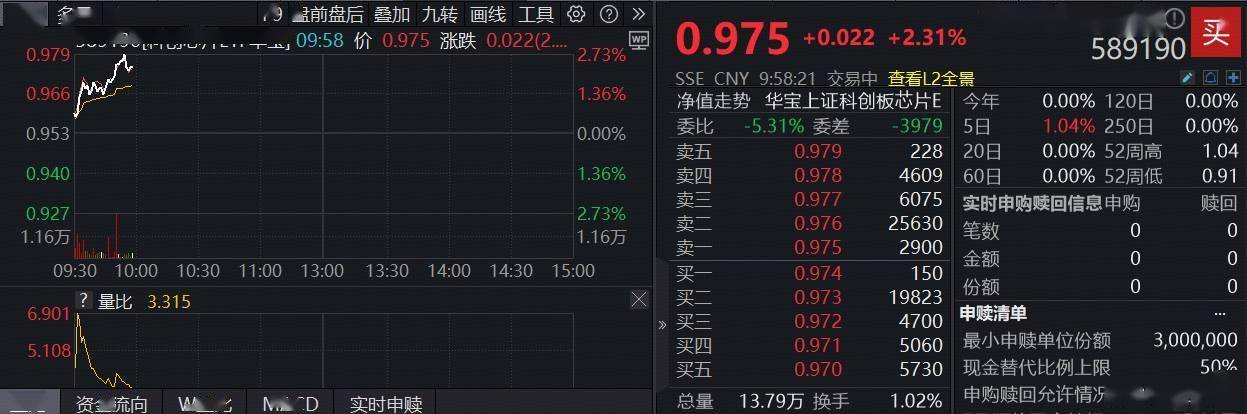
Group 1 - The core viewpoint of the news highlights the strong performance of computing hardware and storage chip stocks, with significant price increases observed in companies like Xinyuan Co., which rose over 10% to reach a historical high [1] - The Huabao Chip ETF (589190) has seen an increase of over 2%, surpassing the 10-day moving average, indicating positive market sentiment towards chip-related investments [1] - A report from Counterpoint indicates that memory prices have surged by 80%-90% year-to-date, marking unprecedented growth, with expectations of a 60% increase in DRAM prices in Q1 [2][3] Group 2 - Major global tech companies, including Google and Amazon, are significantly increasing their capital expenditures for AI infrastructure, with projections of $175-185 billion and $200 billion respectively by 2026, which exceeds market expectations [3] - The Huabao Chip ETF tracks the Shanghai Stock Exchange's chip index, which includes 50 companies across various semiconductor sectors, indicating a strong focus on high-tech and high-barrier industries [3] - The annualized return of the Shanghai Stock Exchange's chip index since its inception is 17.93%, outperforming other semiconductor indices, with a lower maximum drawdown, suggesting a favorable risk-return profile [5][6]

影响市场重大事件:德国企业巨头要为德军打造本土版“星链”;三星电子中国研究院计划投入脑机接口领域研究并进行技术储备;“上海市智算产业高质量发展倡议”启动
Mei Ri Jing Ji Xin Wen· 2026-01-28 10:10
Group 1 - German companies Rheinmetall and Bremen-based OHB are planning to jointly bid to provide a satellite internet service similar to the US Starlink for the German military, with a contract value potentially reaching several billion euros [1] - The initiative aims to create a secure military-grade satellite communication network in low Earth orbit for the German armed forces [1] Group 2 - The China Academy of Information and Communications Technology has released a report indicating that the data intelligence service industry is entering a phase of deep integration, driven by technological advancements and industry demand [2] - The report emphasizes that data intelligence service capabilities are crucial for advancing the "AI+" initiative [2] Group 3 - Samsung Electronics' China Research Institute plans to invest in brain-computer interface research and technology reserves, expressing confidence in the commercialization prospects of this technology [3] - The institute focuses on cutting-edge technologies such as artificial intelligence and next-generation communication [3] Group 4 - The "High-Quality Development Initiative for Shanghai's Intelligent Computing Industry" was launched to promote the construction of new intelligent computing centers and establish a high-level intelligent cloud service system [4] - The initiative aims to create a self-controlled industrial ecosystem and position the intelligent computing industry as a new engine for Shanghai's economic development [4] Group 5 - The National Energy Administration of China has approved the establishment of seven standardization technical organizations related to power safety governance and greenhouse gas emissions management in the energy sector [5] Group 6 - The "Implementation Plan for Strengthening Disease Prevention and Control" aims to establish a modern disease control system by 2027, with improved infrastructure and enhanced public health service capabilities [6] Group 7 - Shanghai is actively implementing the "AI+" initiative to lead the digital transformation of manufacturing, with the city's intelligent computing scale surpassing 120,000 PFLOPS [7][8] - The city plans to construct a batch of intelligent computing infrastructure ahead of demand [8] Group 8 - A report by Yole indicates that global DRAM memory demand is expected to grow by 23% in 2026, with over half of this growth coming from the data center sector, which is projected to increase by 28% [9] - The current DRAM market trend is expected to continue at least until 2027 due to the time required for new capacity to come online [9] Group 9 - The Chinese sports industry is projected to exceed 5 trillion yuan by 2025, with the sports goods market reaching 2.49 trillion yuan, driven by a surge in domestic consumption and innovation [10]
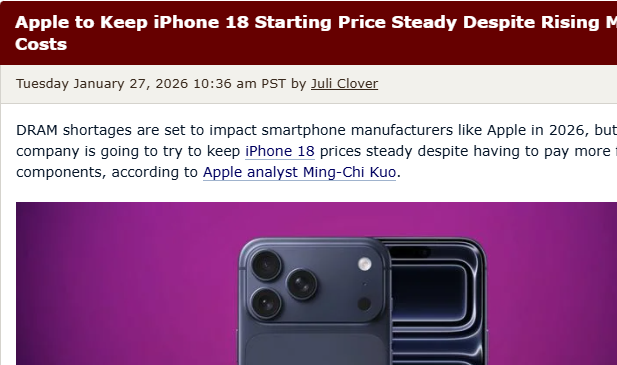
内存成本上涨10%-25%,苹果计划维持iPhone 18起售价
Huan Qiu Wang· 2026-01-28 02:40
Core Viewpoint - The smartphone industry, particularly Apple, is expected to face challenges due to a DRAM memory shortage in 2026, but Apple plans to maintain stable pricing for the iPhone 18 series despite rising component costs [1][4]. Group 1: Memory Pricing and Supply - Apple and memory suppliers are using a quarterly pricing model, with a new round of memory price increases expected in Q2 2026, similar to Q1 [4]. - Current memory prices have risen by 10% to 25% compared to the same period last year, which will directly impact the gross margin of iPhones [4]. - Apple has secured stable supply agreements, allowing it to absorb some of the increased costs due to its industry influence [4]. Group 2: Strategic Positioning - Apple's strategy is to leverage market fluctuations to gain a competitive edge, secure chip supplies, and absorb cost pressures to expand market share [4]. - The company aims to maintain its pricing strategy for the iPhone 18, avoiding price increases despite the memory shortage driven by AI industry demand [4]. - Apple plans to compensate for profit losses through its services business, indicating a clear and defined strategic approach [4].