
客流强度

Search documents
城数Lab. | “十四五”收官在即,谁是最强轨交“黑马”?
Mei Ri Jing Ji Xin Wen· 2025-12-13 03:39
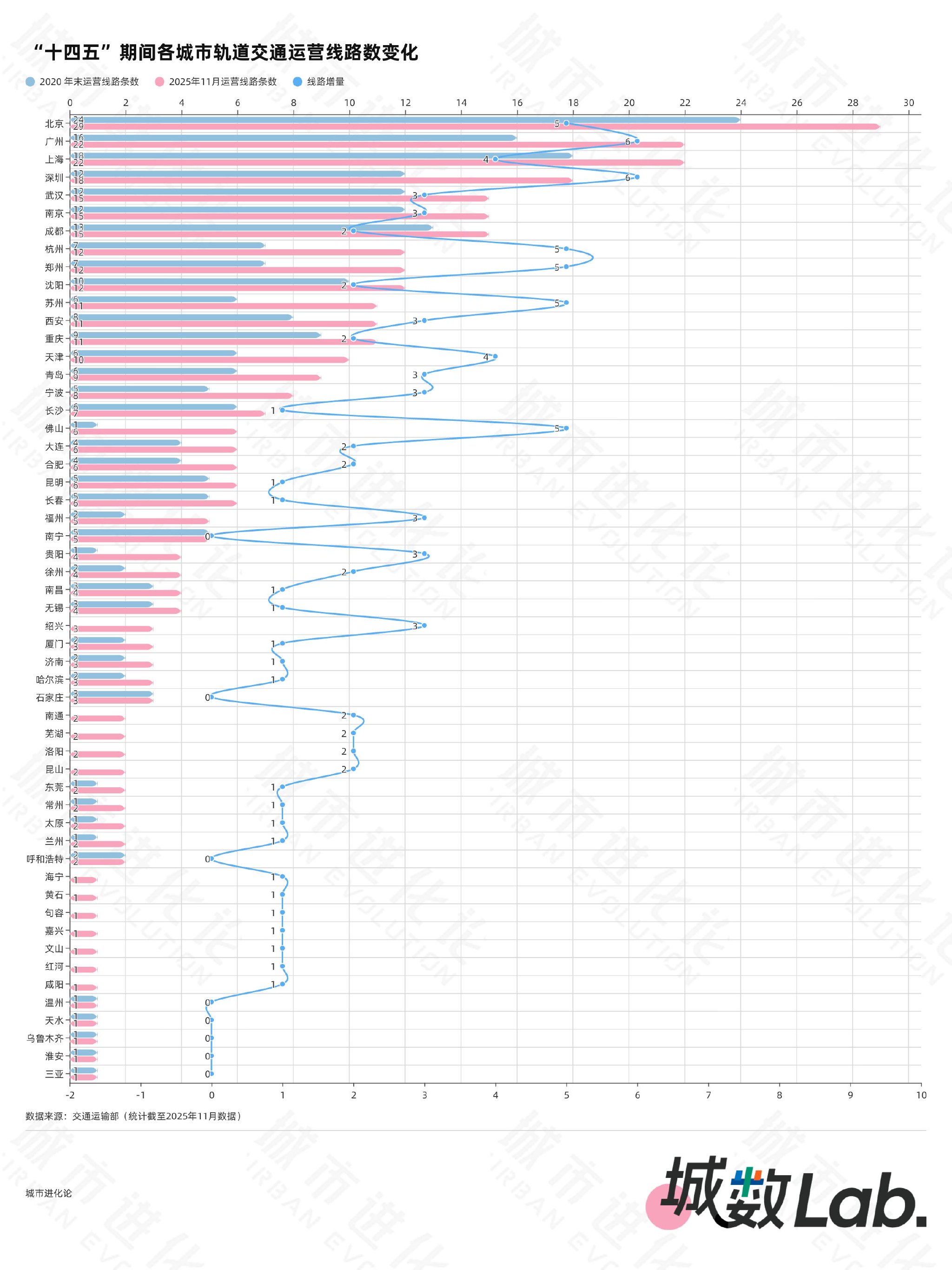
Core Insights - The report highlights the progress of urban rail transit construction and operation in China during the "14th Five-Year Plan" period, with significant expansions in both the number of cities and operational mileage [1][17]. Group 1: Urban Rail Expansion - From the end of 2020 to November 2023, 10 new cities have opened urban rail transit, adding nearly 100 lines and over 3,500 kilometers of operational mileage [1][17]. - Notably, several county-level cities, such as Haining, Kunshan, and Jurong, have entered the urban rail scene, which has drawn attention from larger cities that missed out on this development [4][21]. Group 2: Mileage Rankings - As of November 2023, a total of 54 cities have operational urban rail transit, with Beijing, Shanghai, Guangzhou, Chengdu, and Shenzhen leading in mileage, each exceeding 600 kilometers [4][22]. - The ranking of operational mileage has seen a shift, with Xi'an surpassing Qingdao to claim the tenth position [4][22]. Group 3: Notable Increases in Mileage - Hangzhou and Guangzhou have recorded over 200 kilometers of mileage increase, with Guangzhou expected to surpass Hangzhou by the end of the year due to the opening of additional lines [8][26]. - Jinan is projected to significantly increase its operational mileage to 248 kilometers by the end of the year, potentially surpassing several other cities [8][26]. Group 4: Emerging Players and Trends - Foshan has made a remarkable leap in rankings, moving from 43rd to 23rd place, surpassing several provincial capitals [12][30]. - The trend indicates a tightening of approvals for new urban rail projects during the "14th Five-Year Plan," with a shift in focus towards existing line efficiency and passenger flow metrics [12][30][34]. Group 5: Future Considerations - The emphasis is shifting from rapid network expansion to improving operational efficiency and sustainability in urban rail systems [16][35].

宁波、洛阳两地地铁新规划暂缓 客流强度不达标是主因
Zhong Guo Jing Ying Bao· 2025-11-25 17:18
Group 1 - The approval process for urban rail transit projects has become stricter, leading to delays in new construction plans in various cities due to insufficient passenger flow and fiscal revenue [1][2] - Ningbo and Luoyang have both indicated that their conditions for submitting new rail transit plans are not yet mature, with Ningbo citing the need for improved passenger flow intensity [1][2] - The average passenger flow intensity for Luoyang's metro lines is currently 0.46 million per kilometer per day, below the required standard of 0.7 million [1] Group 2 - Since 2017, following the suspension of the Baotou metro project, there has been a noticeable shift in the approval and construction of metro projects, with increased policy requirements [2] - The State Council's document from July 2018 raised the thresholds for local fiscal revenue and GDP for cities seeking to build metros, requiring a minimum of 300 billion in fiscal revenue and 3 trillion in GDP [2] - As of October, only 15 out of 43 cities operating metros met the required passenger flow intensity, resulting in a compliance rate of 34.88% [3] Group 3 - The investment scale for urban rail transit construction in China peaked at 628.6 billion in 2020 but has been declining, with an expected investment of 474.94 billion in 2024, a year-on-year decrease of 8.91% [4]