
宽松货币政策周期

Search documents
地缘阴云与宽松预期交织 黄金强势格局有望延续
Jin Tou Wang· 2025-09-24 02:18
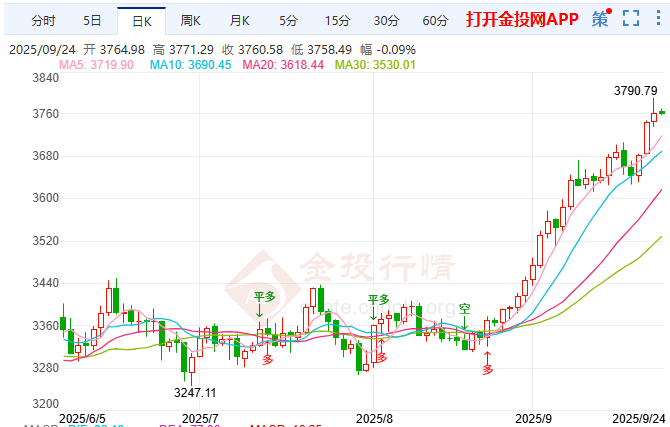
Core Viewpoint - The recent surge in gold prices is driven by expectations of interest rate cuts from the Federal Reserve and escalating geopolitical tensions, leading to increased demand for safe-haven assets like gold [1][3][5]. Group 1: Gold Market Dynamics - Spot gold reached a record high of $3,790.97 per ounce on September 23, closing at $3,763.93, marking a 0.46% increase [1]. - The ongoing anticipation of interest rate cuts by the Federal Reserve is providing strong momentum for the gold market [1][5]. - Geopolitical tensions, particularly involving NATO's warnings to Russia, are heightening investor demand for gold as a safe-haven asset [3]. Group 2: Economic Context - Federal Reserve Chairman Jerome Powell highlighted a challenging economic landscape, with inflation exceeding expectations and a weak job market raising concerns [5]. - Market sentiment remains optimistic regarding potential interest rate cuts in October and December, which could lower the opportunity cost of holding non-yielding assets like gold [5]. - The expectation of a more accommodative monetary policy cycle is providing robust support for gold prices amid market volatility [5]. Group 3: Geopolitical Influences - NATO's strong warnings to Russia regarding its actions in Estonia have intensified uncertainties in international relations, impacting global capital markets [3]. - The ongoing conflict between Russia and Ukraine is seen as a critical factor influencing market dynamics, with potential implications for gold demand as investors seek stability [4].

欧洲央行预计12月进行最后一次降息 宽松周期接近尾声
Xin Hua Cai Jing· 2025-08-12 00:56
Core Viewpoint - The European Central Bank (ECB) is expected to conduct its final interest rate cut in December 2025, marking the end of the current monetary easing cycle, with economists pushing back the timeline for further cuts by three months [1]. Group 1: ECB's Monetary Policy Outlook - The ECB is anticipated to maintain the deposit rate at 1.75% for nine to ten months until market demand prompts a reassessment of its monetary policy direction [1]. - The decision to delay the final cut until the end of the year allows policymakers to better evaluate the economic impact of trade fluctuations caused by U.S. President Trump's policies [1]. - The upcoming economic data for the third quarter and the distortion caused by U.S. tariffs earlier in the year will provide clearer insights for the ECB's December meeting [1]. Group 2: Global Central Bank Sentiment - Central banks worldwide are exhibiting a cautious stance, with the Federal Reserve taking no action this year and the Bank of England acknowledging "substantial uncertainty" [1]. - Despite the ECB maintaining current rates, several officials have indicated that there is no immediate need for further cuts, leading to a cooling of market expectations for a September rate cut [1]. - Current market predictions suggest a slightly higher than 50% chance of one rate cut before the end of the year [1]. Group 3: Economic Analysis - Economists from TD Securities highlight that unless significant changes in trade patterns lead to weak economic data, the ECB is unlikely to rush into further cuts [2]. - If the ECB does not implement a rate cut in December, financial markets may interpret this as a formal end to the easing cycle [2]. - A prior survey indicated that about half of the respondents expect the ECB to refrain from cutting rates in three consecutive meetings, confirming that rates have reached a cyclical low [2].