
对华认知

Search documents
海外学者谈对华认知的历史经纬与现实意义:研究中国已不再是选择,而是需要
Huan Qiu Shi Bao· 2025-12-01 22:58
Group 1 - The perception of China has evolved through various stages since the establishment of the People's Republic of China, initially characterized by demonization during the Cold War, transitioning to recognition as an important partner in the context of counterbalancing the Soviet Union [2] - From the early 1990s to the early 2000s, Western perceptions oscillated between the "China collapse theory" and the "China threat theory," with a gradual acknowledgment of China's role in supporting the global economy, while developing countries deepened their view of China as a reliable development partner [2] - Since 2010, while some Western factions continue to demonize China, many recognize its developmental achievements, and developing countries regard China as an indispensable partner, particularly following China's rise to the world's second-largest economy and the promotion of the Belt and Road Initiative [2] Group 2 - The shift from sinology to Chinese studies reflects the growing importance of understanding contemporary China, as countries seek to explore cooperation paths and learn from China's development experiences [4] - The increasing interest in Chinese studies, which began around 1978, has transformed into a multi-disciplinary approach, indicating a significant global change in the perception and study of China [4] - The recognition of the need for comprehensive Chinese studies is driven by China's expanding economic influence and the necessity for global engagement with its geopolitical stance [4] Group 3 - Different regions exhibit significant variations in their perceptions of China, shaped by factors such as historical experiences and development levels, with Africa's view influenced by shared anti-colonial history and cultural values [6] - In contrast, some Western countries' perceptions are affected by cultural biases and historical legacies, leading to a tendency to reinforce "institutional competition" with China [6] - The ASEAN countries have developed a stable relationship with China, with over half of the population expressing a more positive attitude towards China compared to the United States, highlighting a notable shift in regional perceptions [6] Group 4 - Current Western perceptions of China reflect a mix of competition and cooperation, significantly impacting the trajectory of global order, with emerging market countries recognizing the value of collaboration with China [8] - The recognition of China's development achievements promotes inclusivity in global rules, while biases that view China as a threat reinforce exclusionary frameworks [8] - The global order is undergoing profound changes, with the old order unsustainable and a new one yet to form, leading to instability and unpredictability [8] Group 5 - China is seen as a "beacon of hope" by many countries, with elites inspired by China's example seeking their own paths to modernization [10] - To improve mutual understanding, China should prioritize principles of sovereign equality and development, utilizing multi-level consultation mechanisms and localizing media communication [10] - Strengthening economic ties and long-term research partnerships can contribute significantly to international peace and dialogue, enhancing Europe's voice in global discussions [11]
【环时深度】西方国家对华新认知呈现两个趋势
Huan Qiu Shi Bao· 2025-11-30 22:48
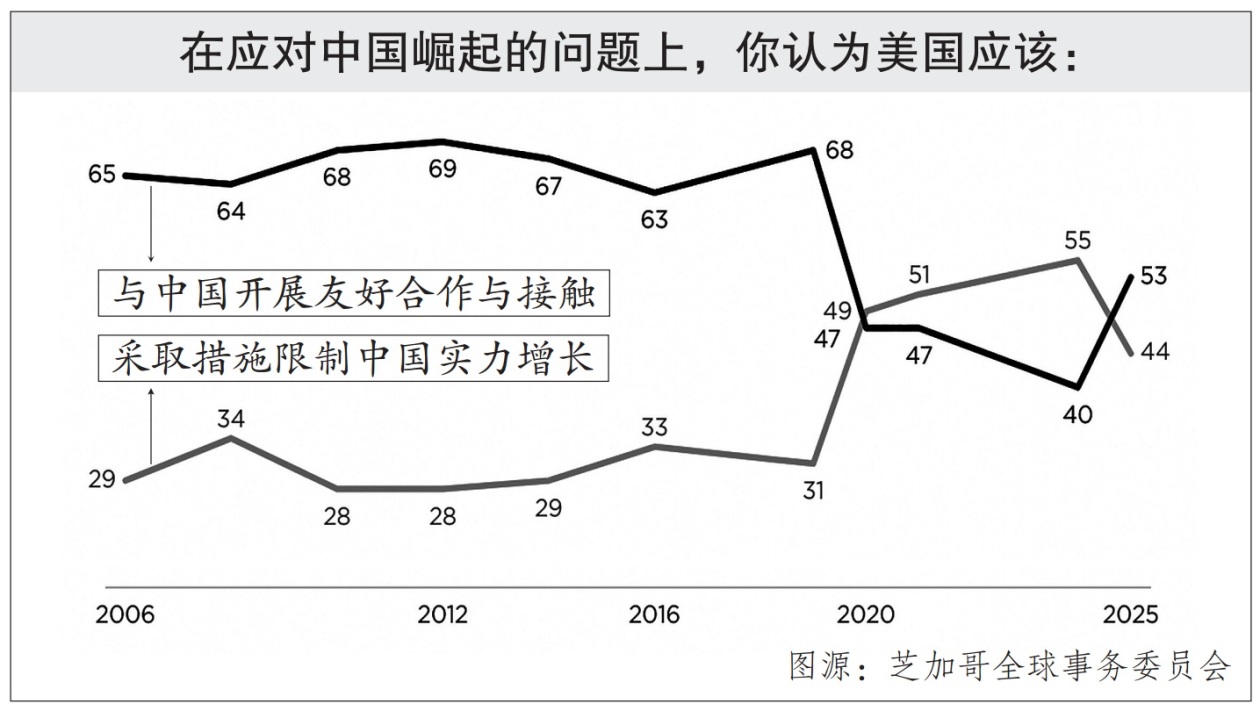
Core Insights - The article discusses the evolving perceptions of China in Western countries, highlighting a trend of more nuanced and diversified understanding, alongside increasing polarization in opinions about China [1][2][9]. Group 1: Perceptions in France - In France, there is a growing dichotomy in perceptions of China, with more people viewing China positively due to its advanced technology and services, while simultaneously, a significant number of individuals express concerns about a "China threat" [2]. - The number of French citizens holding both positive and negative views about China is increasing, indicating a more pronounced division in public opinion [2]. Group 2: Perceptions in the United States - Polling data shows that from 2023 to 2025, the percentage of Americans with negative views of China remains high, with 81% and 77% expressing dislike in 2024 and 2025, respectively [3]. - Despite government narratives promoting "decoupling" from China, over half of Americans (53%) believe in the importance of friendly cooperation with China, reflecting a complex relationship between public sentiment and political discourse [3]. Group 3: Research Trends in the U.S. - The study of China in the U.S. is shifting from "engagement" to "strategic competition," with a focus on national security issues and a reliance on open-source intelligence for research [5]. - Young scholars are increasingly moving towards policy-oriented roles rather than traditional academic paths, indicating a shift in career trajectories within the field of China studies [6]. Group 4: Australia’s Understanding of China - A recent report from an Australian think tank critiques the misinterpretation of China's actions in the South China Sea, highlighting a polarized debate within Australia regarding its relationship with China [7]. - The report emphasizes the need for Australia to develop independent knowledge about China to balance security and diplomatic relations [8]. Group 5: Recommendations for Improved Understanding - Scholars suggest that both Europe and China should take steps to enhance mutual understanding, such as increasing educational exchanges and promoting cultural cooperation [13]. - The article advocates for using personal experiences to counteract macro-level narratives about China, emphasizing the importance of non-political connections and grassroots exchanges [12].

【环时深度】南方国家对华认知何以不断“扩容”
Huan Qiu Shi Bao· 2025-11-27 22:48
Core Insights - The article discusses the increasing recognition and understanding of China among various countries, particularly in the Global South, emphasizing the shift from cultural perceptions to a focus on China's economic growth drivers and institutional frameworks [1][5]. Group 1: Chinese Language Education - Chinese language education is rapidly expanding in Egypt, with 28 universities and over 20 high schools offering Chinese courses, and the number of students at the Confucius Institute at Cairo University rising from under 30 to nearly 4,000 [2]. - The UAE has initiated a "Hundred Schools Project" for Chinese language teaching, with 171 schools currently offering Chinese courses and 71,000 students learning the language [2]. Group 2: Research Institutions and Scholars - The number of research institutions and scholars focusing on China in the Middle East and Africa is increasing, with notable institutions in Egypt, such as the Pyramid Political and Strategic Studies Center and the Cabinet Information and Decision Support Center, producing experts on China [2][3]. - In Nigeria, the establishment of research institutions related to China has surged since 2018, with companies like Dangote Group creating research centers focused on China-Nigeria cooperation [3]. Group 3: Shifts in Research Focus - The focus of research on China has shifted from ancient civilization to development paths, cooperation models, and institutional advantages, reflecting a broader understanding of China's role in global affairs [5][8]. - In Indonesia, the research on China has evolved through three stages, from focusing on China's economic growth to exploring the Belt and Road Initiative and now deepening understanding of China's technological innovations [7]. Group 4: Economic and Political Influence - The growing interest in China among Global South countries is driven by China's increasing economic and political influence, with countries seeking to learn from China's experiences in poverty alleviation, economic growth, and infrastructure development [8][9]. - The trade volume between China and Arab countries is projected to reach $407.4 billion by 2024, prompting a need for Arab businesses to understand Chinese market rules and operational models [9]. Group 5: Geopolitical Context - Middle Eastern countries are increasingly valuing strategic cooperation with China, recognizing its constructive role in global issues such as climate change and energy crises [10]. - The deepening understanding of China has led to tangible development benefits for countries like Egypt, which has become the first African nation capable of satellite assembly and testing [10].