
四大全球倡议

Search documents
金融大家评 | 傅小强:怎么看全球地缘格局之变
清华金融评论· 2026-03-12 09:08
Core Viewpoint - The article discusses the current global geopolitical landscape, emphasizing the instability and uncertainty driven by economic stagnation and technological revolutions, and highlights the importance of China's role in promoting global peace and development amidst these changes [2][3]. Group 1: Geopolitical Changes - The global geopolitical landscape is undergoing significant transformation, characterized by the decline of U.S. hegemony and the rise of multipolarity, with the U.S. economic share dropping from approximately 40% in the 1960s to around 26% recently [3]. - The economic and security challenges faced by traditional powers like the EU and Japan are deepening, while emerging economies in the Global South have increased their economic share to over 40% globally, becoming crucial players in the multipolar world [3][4]. Group 2: Strategic Competition - There is a notable shift towards strategic autonomy among many countries, with a simultaneous rise in confrontational dynamics as Western nations attempt to maintain their hegemony against emerging powers [4]. - The competition for strategic resources and key minerals has intensified, with the U.S. focusing on critical areas such as rare earth elements and strategic maritime routes, indicating a new phase of geopolitical rivalry [5]. Group 3: New Domains of Competition - New domains such as deep sea, polar regions, outer space, and cyberspace are becoming critical fronts in international strategic competition, with nations vying for control over resources and strategic advantages in these areas [6]. - The rapid advancement of technology is reshaping global power structures, with the U.S. employing monopolistic practices to maintain its technological dominance, leading to heightened tensions in the tech sector [9]. Group 4: Impact of Economic Factors - The ongoing economic stagnation has exacerbated international tensions, with low growth rates leading to increased strategic anxieties among nations and a rise in protectionist policies [7]. - The interplay of economic challenges and geopolitical conflicts is reshaping the global landscape, with rising inequalities and instability becoming more pronounced [7]. Group 5: Cultural and Ideological Shifts - The evolution of the global geopolitical landscape is also influenced by cultural and ideological changes, with the decline of neoliberalism and the rise of populism and nationalism contributing to increased international conflicts [11]. - The fragmentation of international dialogue and cooperation is evident as countries adopt more closed and exclusionary foreign policies in response to rising security concerns [11]. Group 6: China's Strategic Response - China emphasizes the importance of promoting common values and international fairness while advocating for a peaceful development path and the construction of a community with a shared future for mankind [12]. - The country aims to enhance its economic resilience and technological independence to better navigate the uncertainties of the global geopolitical landscape [12][13].

最高检:两次国际检察会议为全球安全治理注入中国检察力量
Xin Lang Cai Jing· 2026-02-28 02:44
Core Viewpoint - The Supreme People's Procuratorate of China is actively contributing to global security governance through international prosecutorial cooperation, highlighted by two significant conferences held in Hong Kong and Guangzhou [1] Group 1: International Conferences - The Supreme People's Procuratorate hosted the 15th China-ASEAN Chief Prosecutors' Conference in Hong Kong and the inaugural China-Africa Prosecutorial Cooperation Forum in Guangzhou [1] - These high-level international prosecutorial meetings are designed to address contemporary needs and focus on practical collaboration [1] Group 2: Contributions to Global Governance - The events aim to implement President Xi Jinping's four global initiatives, showcasing the wisdom of Chinese prosecution in global security governance [1] - The meetings are positioned as a means to inject Chinese prosecutorial strength into international security frameworks [1]
王毅:中欧应该行君子之事,走君子之道
Xin Lang Cai Jing· 2026-02-14 14:33
Group 1 - The core viewpoint emphasizes that China and Europe are partners rather than adversaries, rejecting the notion of being "systemic rivals" [1] - Trade between China and Europe amounts to over 2 billion daily, surpassing the total trade volume before their diplomatic relations were established [1] - Differences and divergences exist between China and Europe due to their distinct social systems and cultural histories, but these should not lead to confrontation [1] Group 2 - Wang Yi highlights the importance of mutual respect and appreciation in fostering common development, advocating for a harmonious coexistence despite differences [2] - The call for collaboration in multilateralism and the maintenance of UN authority is crucial in the current complex international landscape [2] - The implementation of President Xi Jinping's four global initiatives is proposed as a shared goal for China and Europe to work towards a more just and equitable global governance system [2]
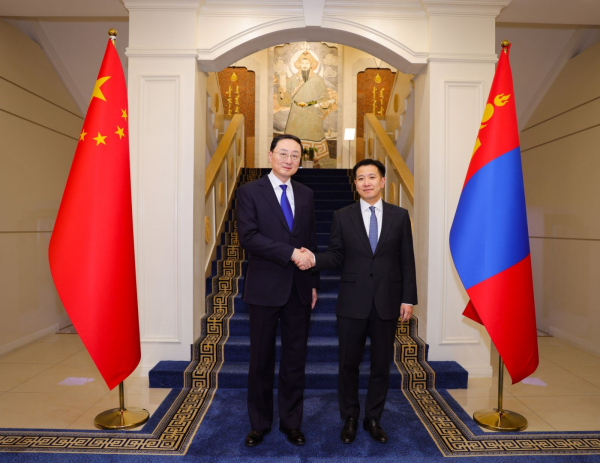
外交部副部长孙卫东赴蒙主持中蒙外交部门战略对话
Xin Lang Cai Jing· 2026-02-12 11:16
Group 1 - The core viewpoint of the article emphasizes the positive development of China-Mongolia relations under the strategic guidance of the leaders of both countries, which benefits the peoples of both nations and promotes regional peace, development, and prosperity [3] - The Chinese side expresses willingness to deepen cooperation across various fields and build a community with a shared future between China and Mongolia, guided by the important consensus reached by the leaders [3] - The Mongolian side reaffirms that developing relations with China is a primary diplomatic policy and supports China's stance on issues related to Taiwan, Tibet, Xinjiang, and Hong Kong, committing to the One China principle [3] Group 2 - Both sides agree to maintain the principles of the United Nations Charter and the basic norms of international relations, aiming to promote a more just and reasonable global governance system [3] - The discussions included a candid exchange of views on international and regional situations, indicating a mutual interest in maintaining stability and cooperation in the region [3] - Mongolia appreciates China's support for its economic and social development and expresses a desire to deepen strategic alignment and practical cooperation, particularly in the context of the Belt and Road Initiative [3]
全球治理倡议标志着中国从规则“接受者”转向“共建者”
Xin Lang Cai Jing· 2026-02-11 14:39
Core Viewpoint - The promotion of the "Four Global Initiatives" is a core task in implementing the spirit of the 20th National Congress of the Communist Party of China, emphasizing the urgency of research in the context of changing international discourse and power dynamics [3]. Group 1: Four Global Initiatives - The "Four Global Initiatives" have gained international consensus as a framework for building a community with a shared future for mankind [3]. - The initiatives encompass four theoretical logics: the Global Development Initiative aims to rebuild order legitimacy through inclusive material distribution; the Global Security Initiative offers inclusive security solutions; the Global Civilization Initiative counters the theory of civilization conflict through mutual learning; and the Global Governance Initiative signifies China's transition from a "rule-taker" to a "co-builder" of global rules [3]. Group 2: Communication Optimization Paths - Communication optimization should focus on four pathways: re-encoding narratives to transform policy discourse into everyday language; symbolically constructing visions for future order; co-creating shared narratives with Global South countries while engaging in dialogue with the West; and translating concepts into practical recognition through flagship projects [3]. - The core of communication is paradigm transformation, shifting from one-way output to building a narrative community through changes in narrative subjects, forms, mechanisms, and value frameworks [3]. Group 3: Ultimate Mission - The ultimate mission of promoting the "Four Global Initiatives" is to enhance global recognition of Chinese ideas and shared human values [3].

最终要实现从“被定义”到“定义者”的国际形象跃升
Xin Lang Cai Jing· 2026-02-11 14:39
Core Viewpoint - The article discusses how the Chinese Communist Party (CCP) can reshape its international image through innovative narratives of "governance modernization" amidst significant global changes and challenges in international communication [3]. Group 1: Governance Modernization - The 20th Central Committee of the CCP uses "governance modernization" as a key entry point to overcome narrative barriers and address Western cognitive biases and ideological conflicts [3]. - Four innovative paths are identified to enhance China's soft power through hard power: replacing confrontational discourse with "governance" as a universal language, showcasing governance achievements like poverty alleviation and ecological protection to highlight the party's capabilities, constructing a narrative matrix that is legal, efficient, responsive, and innovative, and promoting the development of a "CCP Studies" knowledge system [3]. Group 2: International Influence - The goal is to transform the CCP's governance experience into a public knowledge product for global governance, achieving a shift from being "defined" to becoming a "definer" in the international arena [3].

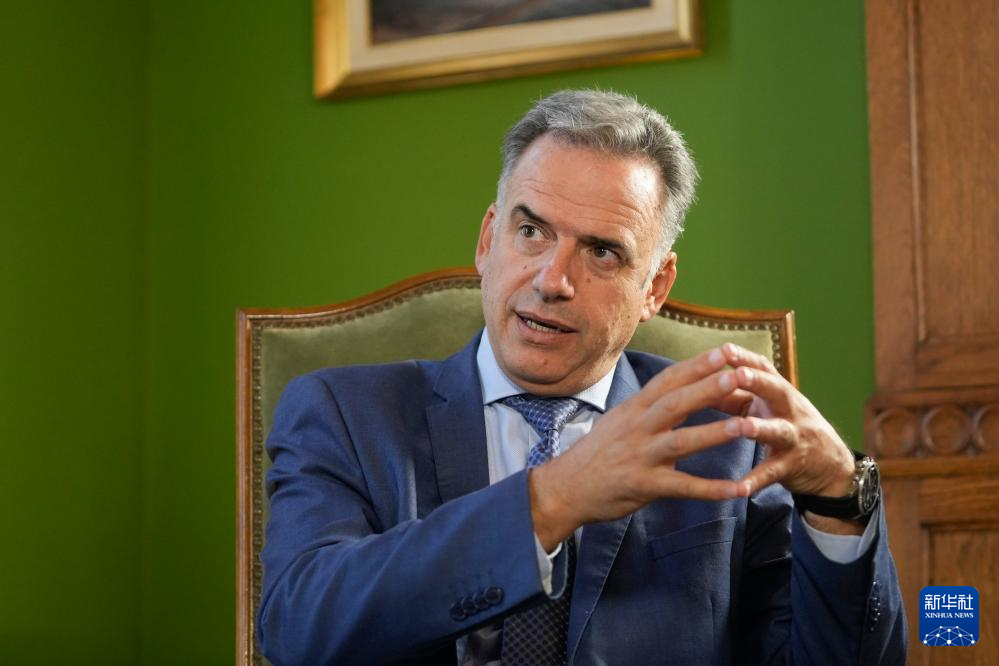
“乌中关系始终向着更紧密方向迈进”——访乌拉圭总统奥尔西
Xin Lang Cai Jing· 2026-01-31 19:28
Group 1 - The core viewpoint of the article emphasizes the strengthening of bilateral relations between Uruguay and China, with President Orsi expressing optimism about the upcoming state visit to China and the ongoing development of a comprehensive strategic partnership [1][2] - Uruguay has established itself as a major supplier of high-quality food products, including beef and grains, to China, highlighting the complementary economic structures of both countries [2] - The collaboration in renewable energy is significant, with Uruguay generating over 97% of its electricity from renewable sources, and there is potential for further cooperation in solar energy technology, where China holds a leading position [2] Group 2 - Uruguay's leadership roles in multiple regional organizations, including the "Group of 77 and China," the Community of Latin American and Caribbean States (CELAC), and the Southern Common Market (MERCOSUR), reflect its commitment to multilateralism and regional integration [3] - The emphasis on sports cooperation, particularly the training programs for Uruguayan athletes in China, has fostered mutual understanding and improved athletic performance [2] - President Orsi's acknowledgment of China's global governance initiatives indicates a shared interest in addressing global governance challenges and rethinking frameworks for international cooperation [2]
高端访谈|“乌中关系始终向着更紧密方向迈进”——访乌拉圭总统奥尔西
Xin Hua She· 2026-01-31 07:45
Group 1 - The core viewpoint of the article is that the relationship between Uruguay and China is continuously strengthening, with expectations for further deepening during President Orsi's upcoming visit to China [1] - Uruguay has established a comprehensive strategic partnership with China, making China its largest trading partner for several consecutive years, with increasing exchanges in various fields [1] - Orsi emphasizes that the development of friendly relations with China is a consensus among all sectors in Uruguay, and each agreement signed contributes to building a stronger bilateral relationship [1] Group 2 - Orsi highlights the importance of China's four global initiatives, particularly the global governance initiative, as a foundation for building a peaceful world and addressing the current global governance deficit [2] - The economic structures of Uruguay and China are highly complementary, with Uruguay supplying high-quality food and beef to China, while Chinese brands of electric vehicles and solar products are well-received in Uruguay [2] - Uruguay's electricity comes from renewable sources, with over 97% generated from hydropower and wind, and there is significant potential for cooperation in solar technology with China [2] Group 3 - Uruguay recently assumed the presidency of the "Group of 77 and China" for 2026 and will also hold the rotating presidency of the Community of Latin American and Caribbean States (CELAC) and the Southern Common Market (MERCOSUR) this year [3] - During its presidency of CELAC, Uruguay aims to strengthen cooperation with China and other countries, promoting multilateralism and regional integration through platforms like the China-Latin America Forum [3]
高端访谈丨“乌中关系始终向着更紧密方向迈进”——访乌拉圭总统奥尔西
Xin Hua Wang· 2026-01-31 07:07
Group 1 - The core viewpoint of the article is that the relationship between Uruguay and China is continuously strengthening, with expectations for further deepening during President Orsi's upcoming visit to China [3][5]. - President Orsi emphasizes that developing friendly relations with China is a consensus across various sectors in Uruguay, and that the bilateral relationship has evolved into a comprehensive strategic partnership [5]. - The article highlights that China has been Uruguay's largest trading partner for several years, with increasing exchanges across various fields [5]. Group 2 - Orsi mentions that every agreement and cooperation signed between the two countries contributes to building a metaphorical "building" of friendship, which will become more magnificent and solid over time [5]. - The article discusses the complementarity of the economic structures of Uruguay and China, noting that Uruguay supplies high-quality food and beef to China, while Chinese brands of electric vehicles and solar panels are popular in Uruguay [5][6]. - Orsi points out that over 97% of Uruguay's electricity comes from renewable sources, and there is significant potential for cooperation in solar energy technology, where China excels [6]. Group 3 - The article notes that Uruguay has taken on leadership roles in multiple international organizations, including the "Group of 77 and China," and aims to promote multilateralism and regional integration [6]. - Orsi expresses the hope that during Uruguay's presidency of the Community of Latin American and Caribbean States (CELAC), the organization will strengthen cooperation with China and other countries to foster a more interconnected and harmonious world [6].
李向阳:美“丛林法则”冲击国际秩序,中国可借APEC凝聚共识
2 1 Shi Ji Jing Ji Bao Dao· 2026-01-30 08:53
Group 1 - The article highlights the shift in U.S. foreign policy towards unilateralism, which poses structural challenges to the post-war multilateral system, as articulated by Li Xiangyang from the Chinese Academy of Social Sciences [1][4][6] - Li emphasizes that the U.S. perception of multilateralism as detrimental to its interests reflects a significant cognitive shift, leading to increased insecurity among smaller nations and a search for ultimate security guarantees [1][4][6] - The establishment of the "Peace Committee" by the U.S. is critiqued for being based on a flawed governance structure that prioritizes power over fairness, raising concerns about its potential to replace the United Nations [1][6] Group 2 - Li outlines China's four global initiatives as a systematic response to the multiple deficits in global governance, aiming to transform the concept of a community with a shared future into actionable practices [2][7] - The APEC forum is identified as a crucial platform for regional consensus, especially in the context of economic globalization challenges, with China set to host the APEC meeting in 2026, enhancing its role in promoting trade liberalization and digital cooperation [2][9] - Li proposes three main directions for future cooperation: deepening the Asia-Pacific community, maintaining multilateralism centered around the United Nations, and practicing open regionalism through initiatives like the Belt and Road [3][8]