对外开放新格局

Search documents
西部陆海新通道:铸牢中华民族共同体意识之路
Xin Lang Cai Jing· 2026-01-08 19:02
Core Viewpoint - The construction of the Western Land-Sea New Corridor is crucial for enhancing the economic development of western regions, promoting regional cooperation, and strengthening cultural exchanges among various ethnic groups in China [1][2][3][4][5][6] Group 1: Economic Development - The Western Land-Sea New Corridor has significantly improved the economic development of western regions, which have historically been limited by geographical constraints [2] - The corridor facilitates tighter connections between inland markets and international markets, reducing transportation time and logistics costs while attracting investments and high-quality foreign goods [2] - The economic contribution of western regions to the national economy has been increasing, with the corridor playing a vital role in this growth [2] Group 2: Industrial Cooperation - The corridor promotes industrial division and cooperation among the regions it traverses, leading to stable supply chains and collaborative economic relationships [2] - Different provinces along the corridor specialize in various industries, such as electronics in Chongqing, cross-border trade in Guangxi, and big data in Guizhou, optimizing their economic layouts [2] Group 3: Cultural Exchange - The corridor enhances the flow of people and culture among different ethnic groups, breaking geographical barriers and fostering interactions [3][4] - Increased transportation convenience has led to more vibrant commercial activities and cultural exchanges, with more ethnic minority students studying in major cities and vice versa [4] - The interaction among different ethnic groups has resulted in a rise in multi-ethnic families, with significant growth in the number of such families reported in Guangxi [4] Group 4: National Unity and Identity - The corridor reflects the government's commitment to supporting western and ethnic regions, involving local communities in its construction and management [5][6] - This initiative not only boosts local economies but also strengthens the recognition and support for national strategies among local populations [5][6] - The corridor enhances China's level of openness and positions western regions as active participants in the global economic network, thereby increasing their international competitiveness [6]
多点发力 共同助推形成对外开放新格局 ——《成渝地区双城经济圈建设规划纲要》在川引起热烈反响(三)
Si Chuan Ri Bao· 2026-01-04 03:59
Core Viewpoint - The "Chengdu-Chongqing Economic Circle Construction Plan Outline" emphasizes the importance of building an inland open strategic highland to enhance international competitiveness and create a new pattern of opening up that integrates land and sea, as well as east and west [1] Group 1: Infrastructure and Connectivity - The outline highlights the significance of "opening up" in the construction of the economic circle, with Chapter 9 dedicated to creating an inland reform and opening highland, indicating its priority [2] - Chengdu and Chongqing have launched the "China-Europe Railway Express (Chengdu-Chongqing)" service, which has accounted for 30% of the national total this year, showcasing the collaborative efforts in logistics and transportation [2] - Future plans include enhancing the connectivity of the economic circle through the development of a world-class airport cluster and improving customs and port facilities [3] Group 2: Economic Development and International Competitiveness - The economic circle, with a GDP of approximately 6.3 trillion yuan, is positioned at the intersection of the "Belt and Road" and the Yangtze River Economic Belt, making it a strategic hub for international competition [4] - The outline proposes the establishment of a collaborative open demonstration zone for the Sichuan-Chongqing Free Trade Zone, focusing on innovative and differentiated reforms in various sectors such as finance, technology, and trade [5] - The plan aims to create a first-class business environment by enhancing market systems and utilizing technologies like big data and blockchain to streamline regulatory processes [6] Group 3: Collaborative Initiatives - Sichuan and Chongqing have signed strategic cooperation agreements to accelerate the development of eight industrial alliances, fostering collaboration in innovation, industry, and governance [5] - The outline includes plans for building an international technology transfer center as part of the "Belt and Road" initiative, focusing on leveraging regional advantages in key industries [6]
金融“活水”涌向西部陆海新通道 21条举措助力对外开放新格局
Xin Hua Cai Jing· 2025-12-25 14:06
Core Viewpoint - The establishment of the "Opinions on Financial Support for Accelerating the Construction of the Western Land-Sea New Corridor" reflects China's commitment to high-level financial openness and aims to enhance financial services along this critical trade route [1][2]. Group 1: Key Highlights of the Opinions - The "Opinions" propose 21 key measures across six areas, including improving organizational collaboration, enhancing financial connectivity, optimizing cross-border payment convenience, supporting digital transformation in finance, promoting financial openness, and strengthening financial risk prevention [2]. - The document emphasizes regional collaborative development, innovative institutional openness, digital empowerment, and leadership in openness as its four main highlights [2]. Group 2: Implementation and Local Efforts - Local authorities, such as the Chongqing government, are committed to enhancing financial services for the corridor through improved mechanisms, cooperation, service focus, and digital empowerment [3]. - Chongqing plans to establish a financial service center for the corridor, aiming to facilitate cooperation among financial institutions and enhance service quality [3]. Group 3: Support from Financial Regulatory Bodies - Various financial regulatory bodies have introduced measures to support the corridor, including the development of railway transport financial services and encouraging integration of domestic and foreign trade [5]. - The China Securities Regulatory Commission is actively supporting IPOs and refinancing for companies along the corridor, with over 650 A-share listed companies in the region [5]. Group 4: Cross-Border Financial Services - The State Administration of Foreign Exchange is focusing on building cross-border financial service platforms, with Chongqing's platform having served over 800 enterprises and facilitated nearly $60 billion in financing [6]. - The People's Bank of China in Chongqing has implemented eight key initiatives to support the corridor, including the establishment of a financial service center and innovative financing tools [6].
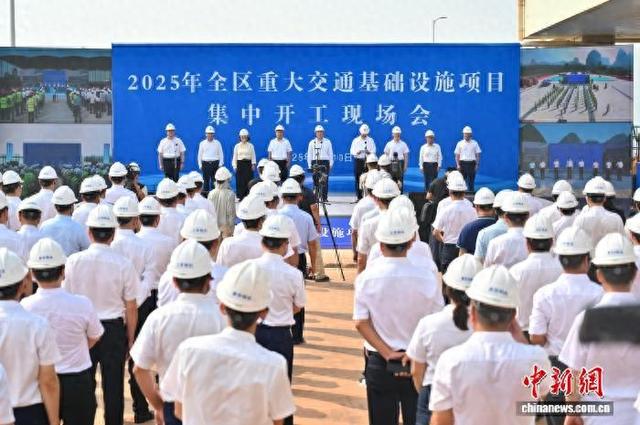
广西集中开工7个重大交通基础设施项目 投资总规模超710亿
Zhong Guo Xin Wen Wang· 2025-10-10 14:57
Core Viewpoint - The Guangxi region is launching seven major transportation infrastructure projects with a total investment exceeding 71 billion RMB, aimed at enhancing the competitiveness of the western land-sea new corridor and establishing a new pattern of open development in Guangxi [1][3]. Group 1: Project Details - The projects include the construction of a 300,000-ton access channel project (Phase I) at Fangchenggang Port, expansion of two 200,000-ton container berths at the Dalanping South Operation Area of the Beibu Gulf Port, and several segments of the G7221 and G7522 highways [3][4]. - The Fangchenggang Port access channel will accommodate 300,000-ton bulk carriers and 100,000-ton bulk carriers, with a total length of 23.1 kilometers [4]. - The expansion of the Dalanping South Operation Area will increase the annual throughput capacity from 1.61 million TEUs to 2.01 million TEUs, significantly enhancing the port's capacity to handle large vessels [4]. Group 2: Strategic Importance - The projects are expected to play a crucial role in improving the transportation infrastructure in Guangxi, facilitating economic development, and establishing a more comprehensive and convenient transportation network [3][4]. - The Vice Governor of Guangxi emphasized the need for relevant departments to leverage this opportunity to achieve breakthroughs in transportation infrastructure construction, highlighting the role of transportation in economic development [3].