
成渝地区双城经济圈建设

Search documents
成眉线、18号线三期盾构掘进“百米冲刺”
Xin Lang Cai Jing· 2026-02-26 18:39
Core Viewpoint - The construction of three rail transit lines in Chengdu is accelerating, with significant progress reported in the construction phases of the Chengde Line, Chengmei Line, and the third phase of Line 18 [1][3]. Group 1: Chengde Line - The Chengde Line, an important project in the Chengde-Meizhou-Zigong urban integration network, spans 70.87 kilometers with 15 stations, including 10 underground stations that have all been capped [4]. - As of now, 37.1 kilometers of shield tunneling has been completed, accounting for 83% of the total [4]. - The project aims to enhance the integration of industries, populations, and production factors between Chengdu and Deyang, significantly contributing to the Chengdu metropolitan area's core capabilities and the development of the Chengdu-Chongqing economic circle [4]. Group 2: Chengmei Line - The Chengmei Line, which stretches approximately 59.139 kilometers and includes 13 stations, has reached 99% completion in shield tunneling, with 19.47 kilometers completed [6]. - The construction has transitioned to post-station engineering and track laying, with 11 station structures capped and about 52 kilometers of track laid [6]. - This line is expected to shorten travel time between Chengdu and Meishan, facilitating efficient aggregation of industries and populations [6]. Group 3: Line 18 Phase 3 - The third phase of Line 18 has completed 98.3% of its shield tunneling, with only 400 meters remaining [6]. - Currently, over 1,000 workers are engaged in the construction, with 4 station structures already capped [6][7]. - Once completed, this line will serve as a crucial transportation link between key locations such as Chengdu Station, Chengdu South Station, and Tianfu International Airport [7].

以钉钉子精神狠抓重点任务落实
Xin Lang Cai Jing· 2026-02-25 23:03
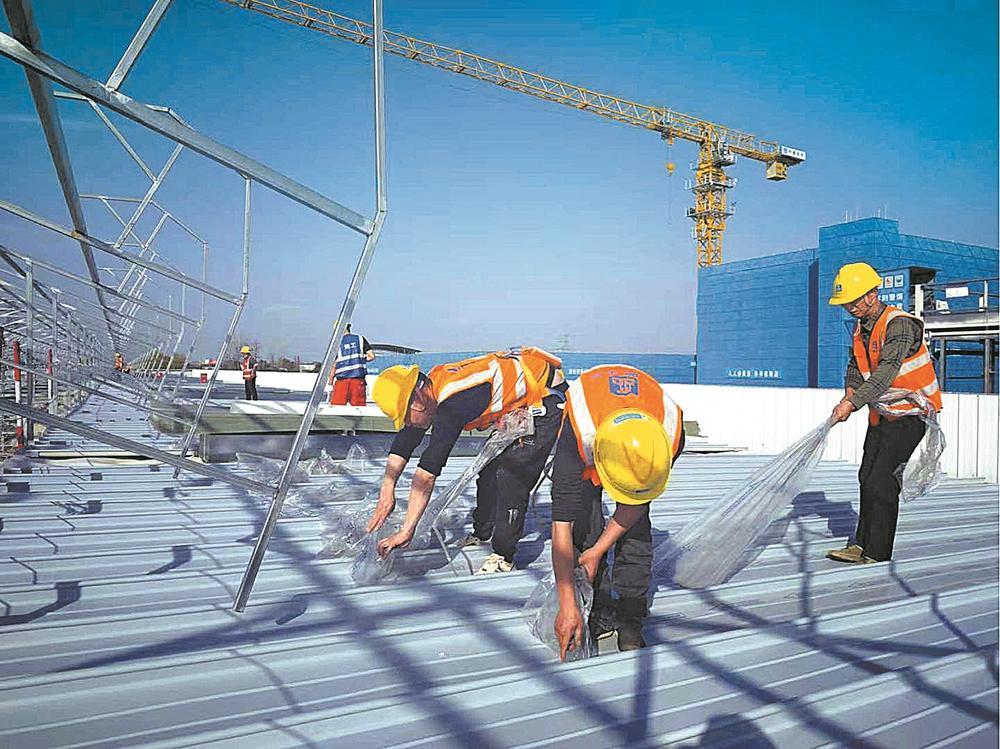
Economic Development Goals - The provincial development and reform commission emphasizes the importance of fulfilling economic and social development goals for the year, marking the start of the "15th Five-Year Plan" [2] - Key strategies include implementing the Chengdu-Chongqing economic circle plan and focusing on 100 annual key tasks and 350 collaborative projects to enhance regional development [2][3] Economic Growth and Investment - The province aims for an economic growth rate of around 5.5%, focusing on optimizing the business environment and supporting key industries such as integrated circuits and aerospace [3] - Investment is targeted to stabilize at a growth rate of approximately 2%, with the implementation of 23 major technology projects and 425 key industrial projects [3][4] Agricultural Modernization - The agricultural sector will focus on enhancing grain production capacity and ensuring food security, with a target of over 96 million acres for planting [7] - Efforts will be made to prevent large-scale poverty and improve income for farmers through targeted support and development of agricultural industries [8] Service Sector and Consumption - The provincial commerce department plans to boost consumption through special actions, including support for the automotive aftermarket and enhancing local consumption experiences [10] - Initiatives will also focus on expanding the service sector's capacity and quality, with a target investment of no less than 700 billion [11] Foreign Trade and Economic Structure - The province aims to maintain a stable scale of foreign trade while optimizing its structure, targeting a growth of over 5% in exports to non-U.S. markets [12] - Participation in high-level trade exhibitions and the establishment of import centers for specific products are part of the strategy to enhance international market presence [12]
致驻川部队官兵和优抚对象的慰问信
Xin Lang Cai Jing· 2026-02-13 22:46
Core Viewpoint - The articles emphasize the commitment of the Sichuan provincial government and military to high-quality development, national defense, and the integration of military and civilian efforts, while also highlighting the importance of social stability and economic growth in the region [1][2][3]. Group 1: Economic Development - The Sichuan provincial government aims to achieve a regional GDP exceeding 6.76 trillion yuan, with a growth target of 5.5% for 2025, focusing on high-quality development and the completion of the 14th Five-Year Plan [1]. - The government plans to implement strategies such as "Four Modernizations in Sync," "Urban-Rural Integration," and "Five Districts Co-Prosperity" to drive economic growth and improve living standards [1]. Group 2: Military and Civil Integration - The military in Sichuan has been actively involved in disaster relief, stability maintenance, and rural revitalization, earning widespread praise from the local population [2]. - The integration of military and civilian efforts has been emphasized, with a focus on enhancing national defense capabilities and supporting military modernization [2]. Group 3: Social Stability and Community Support - The articles highlight the contributions of military families and veterans in various sectors, showcasing their dedication to personal and community development [2]. - The government expresses its commitment to supporting military personnel and their families, ensuring their rights and fostering a strong military-civilian relationship [2].
成渝中线高铁四川段桥梁建设全部完成
Xin Hua Wang· 2026-02-10 10:28
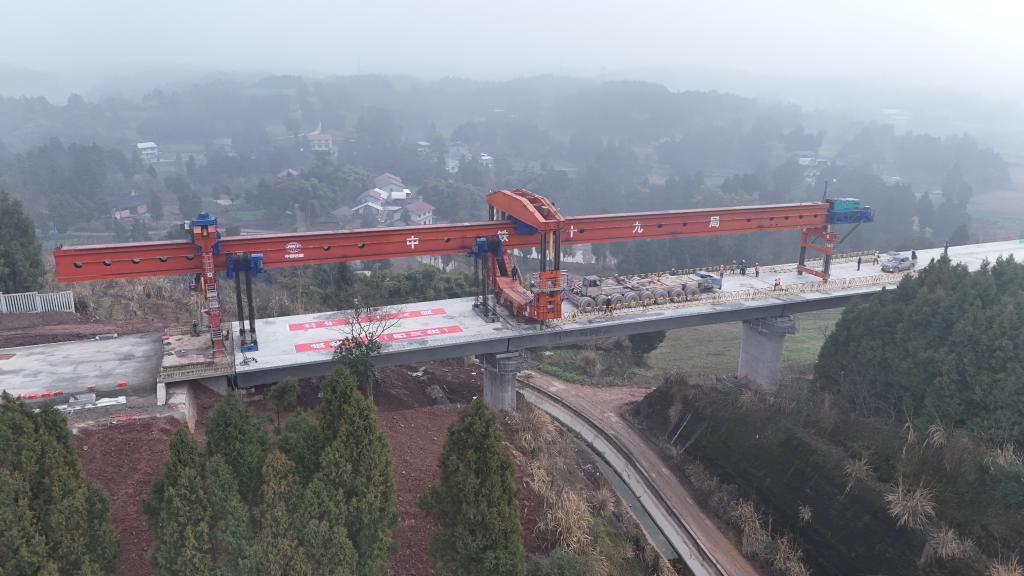
Core Viewpoint - The completion of the bridge construction for the Chengyu Middle Line High-Speed Railway marks a significant milestone, indicating that the project is entering a critical phase of development [1][3]. Group 1: Project Overview - The Chengyu Middle Line High-Speed Railway is a crucial part of China's "Eight Vertical and Eight Horizontal" high-speed rail network, connecting various regions including Chongqing and Sichuan [3]. - The railway line spans a total length of 292 kilometers, starting from Chongqing North Station and ending at Chengdu Station [3]. Group 2: Construction Strategy - The construction team adopted a "zone advancement and multi-point linkage" strategy to address challenges such as the long transportation routes for beams, ensuring efficient and continuous progress in the construction [3]. Group 3: Economic Impact - Once operational, the Chengyu Middle Line High-Speed Railway will enhance connectivity with multiple high-speed rail lines, improving the transportation network in the Chengdu-Chongqing area and significantly reducing travel time between the two cities [3].
创新笔谈丨加快构建成渝区域发展新格局
Zhong Yang Ji Wei Guo Jia Jian Wei Wang Zhan· 2026-02-09 01:44
Group 1 - The core viewpoint emphasizes the importance of implementing the central government's major decisions and enhancing the development capabilities of the Chengdu-Chongqing economic circle [1] - The Sichuan Tianfu New Area's discipline inspection and supervision committee focuses on political supervision to promote the construction and development of the Chengdu-Chongqing economic circle [1] - A systematic approach is taken to ensure the implementation of 110 related construction items in the Tianfu New Area, with a focus on innovation and key infrastructure development [1] Group 2 - The responsibility is emphasized to foster collaborative efforts for regional coordinated development, utilizing a "whole chess game" mindset [2] - The discipline inspection and supervision committee implements a closed-loop supervision chain to address issues such as disciplinary violations and ineffective measures [2] - An open and inclusive business environment is promoted as a necessary condition for high-quality development, with initiatives to facilitate dialogue between government and enterprises [2]
贷款余额突破13万亿元 居西部第一
Xin Lang Cai Jing· 2026-02-07 18:46
Core Insights - Sichuan's financial sector is experiencing stable growth, with significant support for key areas, providing effective financial backing for the province's economic stability and development [1] Financial Performance - By the end of 2025, Sichuan's banking sector assets, liabilities, deposits, and loan balances are projected to reach CNY 18.25 trillion, CNY 17.6 trillion, CNY 14.01 trillion, and CNY 13.06 trillion respectively, with year-on-year growth rates of 8.24%, 8.34%, 8.69%, and 10.5% [1] - Sichuan ranks seventh nationally in asset, liability, and deposit scales, and sixth in loan scale, leading the western region in all four metrics [1] Support for Key Sectors - The loan balance for 810 key projects in the province exceeds CNY 540 billion, with policy banks contributing over CNY 46 billion through new financial tools [2] - Loans for strategic emerging industries and manufacturing have seen year-on-year growth of 27.7% and 11.1% respectively [2] Consumer and Green Financing - Personal consumption loans in the province have increased by 7.6%, while loans for the cultural, sports, and tourism industries have surged by 27.7% [2] - The balance of green loans has surpassed CNY 2 trillion, supporting low-carbon development initiatives [2] Support for Small and Micro Enterprises - The province has implemented various initiatives to support small and micro enterprises, including concentrated guarantee and credit enhancement programs [2] - A total of CNY 1.61 trillion in loans has been issued to recommended small business entities, marking a nearly fourfold increase since the beginning of the year [2]
持续深化政治监督 带头践行“两个维护”
Xin Lang Cai Jing· 2026-02-06 19:58
Group 1 - The article emphasizes the importance of political supervision in supporting the economic and social development of Chengdu, particularly in the context of the "14th Five-Year Plan" and the upcoming "15th Five-Year Plan" [1] - Chengdu's disciplinary inspection and supervision agencies are committed to integrating political supervision into the formulation and implementation of reform and development strategies, ensuring that supervision is specific, precise, and regular [1][4] - The focus is on enhancing the political attributes of the disciplinary inspection agencies and aligning their actions with the major tasks and initiatives of the "15th Five-Year Plan" [2][3] Group 2 - The city’s disciplinary inspection agencies are actively engaged in learning and implementing Xi Jinping's thoughts on socialism with Chinese characteristics for a new era, aiming to unify thought and action with the Party Central Committee's decisions [2][3] - The agencies are implementing a "first agenda" system to ensure continuous learning of important speeches and directives from Xi Jinping, thereby deepening the transformation of innovative theories into practical actions [3] Group 3 - The article highlights the establishment of a comprehensive supervision mechanism that includes regular joint meetings, inspections, and evaluations to enhance the effectiveness of supervision [4] - Chengdu's disciplinary inspection agencies are focusing on key development tasks, such as improving transportation networks and developing the digital economy, by implementing targeted supervision to address issues like inefficiency and misconduct [6] Group 4 - The article discusses the ongoing efforts to optimize the business environment in Chengdu, with the disciplinary inspection agencies actively engaging with businesses to resolve issues and enhance service delivery [7] - In 2025, the agencies visited 175,900 enterprises and addressed 44,000 business-related complaints, demonstrating a commitment to fostering a supportive business climate [7] Group 5 - The article outlines the responsibilities of the disciplinary inspection agencies in enforcing political discipline and ensuring accountability among key officials, with a focus on the "two safeguards" [8][9] - In 2025, the agencies initiated political talks with 340,000 individuals and took action against 263 party members for failing to fulfill their responsibilities [9] Group 6 - The article emphasizes the role of political inspections in identifying and addressing issues within the Party, with a focus on the effectiveness of corrective actions following inspections [10][11] - In 2025, the inspections uncovered 2,771 issues and referred 228 problem leads, indicating a proactive approach to governance and accountability [10]
成渝中线新成都牵引站外部供电工程施工“进度条”加速刷新
Xin Lang Cai Jing· 2026-02-06 18:56
Group 1 - The construction of the 220 kV external power supply project for the Chengdu-Chongqing high-speed railway is progressing rapidly, which is a crucial part of the national major project for the Chengdu-Chongqing high-speed railway [1] - The project aims to provide power supply assurance for the operation of the Chengdu-Chongqing high-speed railway, promoting the development of the Chengdu-Chongqing economic circle and facilitating regional economic coordination [1] - The construction involves complex underground cable networks, including crossing over subway tunnels and rivers, which presents high safety risks [1] Group 2 - As of January 19, the construction has commenced, with 40% of the third shaft already excavated [2] - The project is required to be completed and operational by the end of June to meet the commissioning needs of the Chengdu-Chongqing line [2] - A dedicated coordination working group has been established by the State Grid Chengdu Power Supply to ensure timely completion, enhancing collaboration with local departments and increasing on-site construction efforts [2]
川渝携手经济总量突破10万亿 双城经济圈建设整体成势
Zhong Guo Fa Zhan Wang· 2026-02-06 09:19
Core Insights - The construction of the Chengdu-Chongqing economic circle is being promoted as a significant growth pole for high-quality development in the western region of China, with a focus on innovation and industrial layout [1][2]. Economic Growth Projections - By 2025, Sichuan aims to achieve a GDP of 6.77 trillion yuan, growing at 5.5%, ranking fifth in both total and growth rate nationally [1]. - Chongqing's GDP is projected to reach 3.3758 trillion yuan in 2025, with a growth rate of 5.3%, indicating a significant economic integration between Sichuan and Chongqing [1]. Key Projects and Infrastructure - A total of 555 key projects are being implemented in a rolling manner during the 14th Five-Year Plan, including major infrastructure like the Jiangbei International Airport T3B terminal and the Yukun high-speed railway [2]. - The completion of the Xinjiang electricity transmission project and the Sichuan-Chongqing ultra-high voltage AC project has resolved historical electricity shortages in Chongqing [2]. Industrial and Technological Collaboration - The Chengdu-Chongqing area has been included in the national three major regional technology innovation centers, with successful hosting of the Belt and Road technology exchange conferences [2]. - The electronic information and biomedicine sectors have been recognized as national advanced manufacturing clusters [2]. Tourism and Cultural Cooperation - The construction of the Bashu cultural tourism corridor is progressing, with significant projects like the Sichuan-Chongqing Stone Carving Temple National Heritage Park [2]. - The mutual visitor exchange model between Chengdu and Chongqing has resulted in over 100 million annual visits [2]. Public Services Integration - The two regions have made strides in public service integration, including mutual recognition of electronic certificates and public hospital test results, as well as cross-province transfer of pension insurance and housing funds [2]. Urban and Regional Development - The spatial planning for the Chengdu-Chongqing economic circle has been approved, with a focus on optimizing urban green space and key area planning [3]. Economic Coordination and Infrastructure Development - The Chengdu-Chongqing economic circle's economic total now accounts for approximately 6.5% of the national economy, with significant improvements in regional urban-rural development [4]. - Transportation infrastructure has expanded, with 28 railways, highways, and waterways established, and the railway operating mileage exceeding 7,000 kilometers [4]. Future Development Strategies - In the 15th Five-Year Plan, Chongqing will focus on enhancing the development capabilities of the Chengdu-Chongqing economic circle, implementing seven major special actions and key projects [6]. - The strategy includes strengthening regional collaboration, optimizing industrial development, and enhancing public service standards [7].
提升成都极核功能 为区域高质量发展提供持续动力
Xin Lang Cai Jing· 2026-02-04 22:38
Core Viewpoint - The discussions among representatives and committee members at the Sichuan Provincial People's Congress focus on enhancing Chengdu's core functions to drive regional high-quality development through coordinated growth across different cities and regions [1] Group 1: Development Strategies - The proposal to create a "Panda Home · Health and Wellness Destination" aims to leverage the unique resources and transportation advantages of Chengdu and Ya'an to establish a high-quality health and wellness corridor, fostering new economic growth in the province [2] - A suggestion was made to incorporate the Chengdu-Ya'an high-quality health and wellness corridor into the provincial "14th Five-Year Plan," emphasizing a collaborative development plan that connects multiple health and wellness bases along key transportation routes [2] - The establishment of a unified brand image, "Panda Home · Health and Wellness Destination," is recommended to enhance brand recognition and influence through high-end wellness forums and tourism resources [2] Group 2: Institutional Innovation - A proposal was submitted to enhance Chengdu's core functions through systematic institutional innovation, transitioning from scale leadership to functional leadership, thereby strengthening its role as a core growth engine for the province [3][4] - Recommendations include establishing a technology achievement transformation reform pilot zone and creating a "Sichuan Original, Chengdu Transformation" priority mechanism to facilitate the conversion of technological achievements [3] - The need for an "interest-sharing" mechanism and a task list for core radiation was highlighted to promote collaborative models such as "fly-in economy" and tax sharing [3] Group 3: Economic Integration - The vision to transform the Chengdu Plain Economic Zone into a model area for the integration of innovation, industry, finance, and talent chains was proposed, aiming to enhance its global competitiveness [5] - The development of strategic emerging industries, such as new-generation information technology and advanced manufacturing, is emphasized to position the Chengdu Plain Economic Zone as a national and global hub for future industries [5] - A unified provincial policy to facilitate labor mobility in areas like healthcare, education, and elderly care is suggested to achieve social talent collaboration across economic zones [5] Group 4: Hydrogen Energy Development - The focus on hydrogen energy as a strategic emerging industry highlights the unique resource and location advantages of the Chengdu metropolitan area, with recommendations for establishing a hydrogen pricing control mechanism and expanding hydrogen station networks [6] - The proposal includes promoting hydrogen energy applications in public transportation and logistics, aiming to stimulate regional collaboration and enhance the hydrogen energy industry chain [6] - A call for coordinated planning and implementation of major industrial projects related to hydrogen production, storage, and fuel cells within the metropolitan area is made to strengthen the conversion of research achievements [6]